In case you missed it, the folks at Rorate Caeli ran an online poll asking the question, "If Francis offers a Prelature to Society of St Pius X (SSPX), should they accept it?"
The results: Out of 1,093 respondents, 77% voted yes and 34% voted no.
No doubt there are a lot of people out there who think that getting the FSSPX into the formal structures of the Church will be a great boon to orthodoxy while setting aside the distractions of questions regarding schism and jurisdiction and all that. Though I would normally agree (though I've read and agree with many who've argued a prelature according to the Opus Dei model is the wrong way of doing it), we are not presently in normal times.
After following the tragedy of the Franciscan Friars of the Immaculate and now reading more about the new MP dealing with women religious, it's clear enough the Holy Father and his coterie are not to be trusted.
Bishop Felley and those around him really need to consider what their options are at this point. If they make a deal, once that bell has been rung, they won't be able to unring it by walking out if the deal goes bad.
Showing posts with label fsspx. Show all posts
Showing posts with label fsspx. Show all posts
Friday, September 16, 2016

Tuesday, April 17, 2012
SSPX Resolution Imminent?
For those of you who don't follow Rorate Caeli and the sources it links to regularly on the question of the Priestly Society of St. Pius X's final regularization, here are a few points:
1. The CDF/Ecclesia Dei Commission has been in talks with the SSPX for a few years now.
2. The CDF gave the SSPX a preamble to ponder and with which to agree. There was back and forth as things were clarified and so on.
3. The SSPX was given until April 15 to state its final intention regarding the preamble. Some interpret this as an ultimatum, but it read more to me as a due date.
In any case, that date has come and gone and now there is a lot of talk that regularization is imminent due to private letters being submitted, etc. Since I don't care to get caught up in all the echoing of news, rumor, and gossip, I haven't said anything on this. What will happen will happen according to God's will. However, if it dues turn out to be true and the SSPX is coming in with all or most of its following, this is a very very good thing. People have been talking about how this is the SSPX's last chance given Benedict has been so friendly and the next pope isn't likely to be there with an outstretched hand.
1. The CDF/Ecclesia Dei Commission has been in talks with the SSPX for a few years now.
2. The CDF gave the SSPX a preamble to ponder and with which to agree. There was back and forth as things were clarified and so on.
3. The SSPX was given until April 15 to state its final intention regarding the preamble. Some interpret this as an ultimatum, but it read more to me as a due date.
In any case, that date has come and gone and now there is a lot of talk that regularization is imminent due to private letters being submitted, etc. Since I don't care to get caught up in all the echoing of news, rumor, and gossip, I haven't said anything on this. What will happen will happen according to God's will. However, if it dues turn out to be true and the SSPX is coming in with all or most of its following, this is a very very good thing. People have been talking about how this is the SSPX's last chance given Benedict has been so friendly and the next pope isn't likely to be there with an outstretched hand.
Wednesday, March 11, 2009
Letter to the Bishops
Father Z has an English translation of the letter Benedict XVI has sent out to all the bishops regarding the FSSPX and the Williamson affair. Father Z makes pertinent observations throughout in his usual style and I don't feel the need to reproduce the letter here or pull out any excerpts.
My observation after reading it is pretty simple. If you want the letter's technical merits, you'll need to look elsewhere. I found the letter to be direct and to the point, not at all like so many other letters we get out of Rome. Benedict XVI was obviously not expecting and ended up being personally affected by the Williamson affair and it shows in his letter. While I am not one to prognosticate, I would venture a guess that this letter may prove to be a turning point, not in the FSSPX's relations with Rome perhaps, but rather in Benedict's mindset so far.
My observation after reading it is pretty simple. If you want the letter's technical merits, you'll need to look elsewhere. I found the letter to be direct and to the point, not at all like so many other letters we get out of Rome. Benedict XVI was obviously not expecting and ended up being personally affected by the Williamson affair and it shows in his letter. While I am not one to prognosticate, I would venture a guess that this letter may prove to be a turning point, not in the FSSPX's relations with Rome perhaps, but rather in Benedict's mindset so far.
Saturday, February 14, 2009
The Pope and Israel
Spengler is the pen name of the anonymous columnist for Asia Times Online. Even though he's not one of the Vaticanisti or even known to be Catholic, his writings are as astute as they come when it comes to analysis of the current pontificate.
------------------------------
Benedict's tragedy, and Israel's
By Spengler [atimes.com]
World history is the history of Israel, argued the great German-Jewish theologian Franz Rosenzweig - not the tiny Jewish nation as such, but the Jewish idea, embraced by billions in the form of Christianity, or parodied and rejected by additional billions in Islam. The trouble is that no one wants to actually be Israel, least of all the Jews, who recite with fervor the prayer of Sholom Aleichem's Tevye: "God of mercy, choose a different people!" Jealousy at Israel's Election has provoked the persecution of the Jews for millennia, and it is not surprising that many Jews look for safety in insignificance.
Like many Jewish prayers, Tevye's prayer to be un-chosen also has become popular among some Catholics. The Catholic Church holds itself to be Israel, the People of God descended from Abraham in the Spirit. But many Catholics, including some in leading positions in the Roman Curia, think it an affront to the sensibilities of other cultures to insist on the unique role of the Church. At the other extreme , misnamed traditionalists do not think that the mustard-seed of faith is sufficient, and that the Church cannot fulfill its function without returning to the bygone days of state religion. Pope Benedict XVI, like his predecessor John Paul II, has fought manfully against these prospective deserters within his ranks. The tawdry burlesque over the case of the paranoid Jew-hater and Holocaust denier Richard Williamson is a sad gauge of his degree of success.
[...]
------------------------------
Go and read the rest.
------------------------------
Benedict's tragedy, and Israel's
By Spengler [atimes.com]
World history is the history of Israel, argued the great German-Jewish theologian Franz Rosenzweig - not the tiny Jewish nation as such, but the Jewish idea, embraced by billions in the form of Christianity, or parodied and rejected by additional billions in Islam. The trouble is that no one wants to actually be Israel, least of all the Jews, who recite with fervor the prayer of Sholom Aleichem's Tevye: "God of mercy, choose a different people!" Jealousy at Israel's Election has provoked the persecution of the Jews for millennia, and it is not surprising that many Jews look for safety in insignificance.
Like many Jewish prayers, Tevye's prayer to be un-chosen also has become popular among some Catholics. The Catholic Church holds itself to be Israel, the People of God descended from Abraham in the Spirit. But many Catholics, including some in leading positions in the Roman Curia, think it an affront to the sensibilities of other cultures to insist on the unique role of the Church. At the other extreme , misnamed traditionalists do not think that the mustard-seed of faith is sufficient, and that the Church cannot fulfill its function without returning to the bygone days of state religion. Pope Benedict XVI, like his predecessor John Paul II, has fought manfully against these prospective deserters within his ranks. The tawdry burlesque over the case of the paranoid Jew-hater and Holocaust denier Richard Williamson is a sad gauge of his degree of success.
[...]
------------------------------
Go and read the rest.
Thursday, February 12, 2009
Rabbi Speaks on Williamson and the FSSPX
Via Father Z...
--------------------
Left Wing of the Catholic Church Destroying the Faith Says Orthodox Rabbi [LifeSiteNews.com]
By Hilary White, Rome correspondent
ROME, February 11, 2009 (LifeSiteNews.com) - The dissident, leftist movement in the Catholic Church over the last forty years has severely undermined the teaching of the Catholic Church on the moral teachings on life and family, a prominent US Orthodox rabbi told LifeSiteNews.com. Rabbi Yehuda Levin, the head of a group of 800 Orthodox rabbis in the US and Canada, also dismissed the accusations that the Holy See had not sufficiently distanced itself from the comments made by Bishop Richard Williamson of the Society of St. Pius X (SSPX) on the Holocaust.
"I support this move" to reconcile the traditionalist faction in the Church, he said, "because I understand the big picture, which is that the Catholic Church has a problem. There is a strong left wing of the Church that is doing immeasurable harm to the faith."
Rabbi Levin said that he understands "perfectly" why the reconciliation is vital to the fight against abortion and the homosexualist movement.
"I understand that it is very important to fill the pews of the Catholic Church not with cultural Catholics and left-wingers who are helping to destroy the Catholic Church and corrupt the values of the Catholic Church." This corruption, he said, "has a trickle-down effect to every single religious community in the world."
"What's the Pope doing? He's trying to bring the traditionalists back in because they have a lot of very important things to contribute the commonweal of Catholicism.
"Now, if in the process, he inadvertently includes someone who is prominent in the traditionalist movement who happens to say very strange things about the Holocaust, is that a reason to throw out the baby with the bathwater and start to condemn Pope Benedict? Absolutely not."
During a visit to Rome at the end of January, Rabbi Levin told LifeSiteNews.com that he believes the media furore over the lifting of the excommunications of the four bishops of the Society of Saint Pius X is a red herring. He called "ridiculous" the accusations that in doing so Pope Benedict VXI or the Catholic Church are anti-Semitic and described as "very strong" the statements distancing the Holy See and the Pope from Williamson's comments.
Rabbi Levin was in Rome holding meetings with high level Vatican officials to propose what he called a "new stream of thinking" for the Church's inter-religious dialogue, one based on commonly held moral teachings, particularly on the right to life and the sanctity of natural marriage.
"The most important issue," he said, is the work the Church is doing "to save babies from abortion, and save children's minds, and young people's minds, helping them to know right and wrong on the life and family issues."
"That's where ecumenism and inter-religious dialogue has to go."
Although numbers are difficult to determine, it is estimated that the Society of St. Pius X has over a million followers worldwide. The traditionalist movement in the Catholic Church is noted for doctrinal orthodoxy and enthusiasm not only for old-fashioned devotional practices, but for the Church's moral teachings and opposition to post-modern secularist sexual mores. Liberals in the Church, particularly in Europe, have bitterly opposed all overtures to the SSPX and other traditionalists, particularly the Pope's recent permission to revive the traditional Latin Mass.
The Vatican announced in early January that, as part of ongoing efforts to reconcile the breakaway group, the 1988 decree of excommunication against the Society had been rescinded. Later that month, a Swedish television station aired an interview, recorded in November 2008, in which Bishop Richard Williamson, one of the four leaders of the Society, said that he did not believe that six million Jews were killed in the Nazi death camps during World War II.
At that time, the media erupted with protests and accusations that the Catholic Church, and especially Pope Benedict XVI, are anti-Semitic.
Rabbi Levin particularly defended Pope Benedict, saying he is the genius behind the moves of the late Pope John Paul II to reconcile the Church with the Jewish community.
"Anyone who understands and follows Vatican history knows that in the last three decades, one of the moral and intellectual underpinnings of the papacy of Pope John Paul II, was Cardinal Ratzinger.
"And therefore, a lot of the things that Pope John Paul did vis-à-vis the Holocaust, he [Benedict] might have done himself, whether it was visiting Auschwitz or visiting and speaking in the synagogues or asking forgiveness. A lot of this had direct input from Cardinal Ratzinger. Whoever doesn't understand this doesn't realise that this man, Pope Benedict XVI, has a decades-long track record of anti-Nazism and sympathy for the Jews."
--------------------
Left Wing of the Catholic Church Destroying the Faith Says Orthodox Rabbi [LifeSiteNews.com]
By Hilary White, Rome correspondent
ROME, February 11, 2009 (LifeSiteNews.com) - The dissident, leftist movement in the Catholic Church over the last forty years has severely undermined the teaching of the Catholic Church on the moral teachings on life and family, a prominent US Orthodox rabbi told LifeSiteNews.com. Rabbi Yehuda Levin, the head of a group of 800 Orthodox rabbis in the US and Canada, also dismissed the accusations that the Holy See had not sufficiently distanced itself from the comments made by Bishop Richard Williamson of the Society of St. Pius X (SSPX) on the Holocaust.
"I support this move" to reconcile the traditionalist faction in the Church, he said, "because I understand the big picture, which is that the Catholic Church has a problem. There is a strong left wing of the Church that is doing immeasurable harm to the faith."
Rabbi Levin said that he understands "perfectly" why the reconciliation is vital to the fight against abortion and the homosexualist movement.
"I understand that it is very important to fill the pews of the Catholic Church not with cultural Catholics and left-wingers who are helping to destroy the Catholic Church and corrupt the values of the Catholic Church." This corruption, he said, "has a trickle-down effect to every single religious community in the world."
"What's the Pope doing? He's trying to bring the traditionalists back in because they have a lot of very important things to contribute the commonweal of Catholicism.
"Now, if in the process, he inadvertently includes someone who is prominent in the traditionalist movement who happens to say very strange things about the Holocaust, is that a reason to throw out the baby with the bathwater and start to condemn Pope Benedict? Absolutely not."
During a visit to Rome at the end of January, Rabbi Levin told LifeSiteNews.com that he believes the media furore over the lifting of the excommunications of the four bishops of the Society of Saint Pius X is a red herring. He called "ridiculous" the accusations that in doing so Pope Benedict VXI or the Catholic Church are anti-Semitic and described as "very strong" the statements distancing the Holy See and the Pope from Williamson's comments.
Rabbi Levin was in Rome holding meetings with high level Vatican officials to propose what he called a "new stream of thinking" for the Church's inter-religious dialogue, one based on commonly held moral teachings, particularly on the right to life and the sanctity of natural marriage.
"The most important issue," he said, is the work the Church is doing "to save babies from abortion, and save children's minds, and young people's minds, helping them to know right and wrong on the life and family issues."
"That's where ecumenism and inter-religious dialogue has to go."
Although numbers are difficult to determine, it is estimated that the Society of St. Pius X has over a million followers worldwide. The traditionalist movement in the Catholic Church is noted for doctrinal orthodoxy and enthusiasm not only for old-fashioned devotional practices, but for the Church's moral teachings and opposition to post-modern secularist sexual mores. Liberals in the Church, particularly in Europe, have bitterly opposed all overtures to the SSPX and other traditionalists, particularly the Pope's recent permission to revive the traditional Latin Mass.
The Vatican announced in early January that, as part of ongoing efforts to reconcile the breakaway group, the 1988 decree of excommunication against the Society had been rescinded. Later that month, a Swedish television station aired an interview, recorded in November 2008, in which Bishop Richard Williamson, one of the four leaders of the Society, said that he did not believe that six million Jews were killed in the Nazi death camps during World War II.
At that time, the media erupted with protests and accusations that the Catholic Church, and especially Pope Benedict XVI, are anti-Semitic.
Rabbi Levin particularly defended Pope Benedict, saying he is the genius behind the moves of the late Pope John Paul II to reconcile the Church with the Jewish community.
"Anyone who understands and follows Vatican history knows that in the last three decades, one of the moral and intellectual underpinnings of the papacy of Pope John Paul II, was Cardinal Ratzinger.
"And therefore, a lot of the things that Pope John Paul did vis-à-vis the Holocaust, he [Benedict] might have done himself, whether it was visiting Auschwitz or visiting and speaking in the synagogues or asking forgiveness. A lot of this had direct input from Cardinal Ratzinger. Whoever doesn't understand this doesn't realise that this man, Pope Benedict XVI, has a decades-long track record of anti-Nazism and sympathy for the Jews."
Tuesday, February 03, 2009
One Holy Catholic Church
Saturday, January 24, 2009
Remission of Censure
As you all may have read at other places, the four bishops of the Priestly Society of St. Pius X have had the excommunications lifted. In more technical terms from the decree itself:
From the decree quoted in full at Rorate Caeli.
Rorate also has a series of posts that are good background reading in the lead-up to this decree.
Based on the faculty expressly granted to me by the Holy Father Benedict XVI, in virtue of the present Decree, I remit from Bishops Bernard Fellay, Bernard Tissier de Mallerais, Richard Williamson, and Alfonso de Galarreta the censure of latae sententiae excommunication declared by this Congregation on July 1, 1988, while I declare deprived of any juridical effect, from the present date, the Decree emanated at that time.
From the decree quoted in full at Rorate Caeli.
Rorate also has a series of posts that are good background reading in the lead-up to this decree.
Tuesday, July 01, 2008
SSPX Letter Content?
Rorate Caeli has a story from I.MEDIA via AFP that the SSPX superior-general's letter has asked that the excommunications be lifted. Go read the dispatch over there.
Sunday, June 29, 2008
Coming Home to Rome
With events with the SSPX moving forward to some form of conclusion (or at least a new condition), there is also word out there that the process continues for the Traditional Anglican Communion's petition for communion with the Church of Rome. Two comments at the blog TitusOneNine shed light on the subject.
In the first comment, 'Ad Orientem' has this to say:
In the second, Dr. William Tighe follows up with this bit of information:
The comments come from a post at TitusOneNine regarding the meeting of Anglican bishops in Jerusalem that has just concluded. If you're interested in that event, Times of London correspondent Ruth Gledhill has more.
As for the Priestly Society of St. Pius X and its travails, Father Z and Rorate Caeli are doing an outstanding job keeping us up to date.
In the first comment, 'Ad Orientem' has this to say:
TAC has pretty much written off the Anglican Communion and the ABC. They are mostly Anglo-Catholic in their orientation and are far more conservative than most of the GAFCON crowd rejecting women’s ordination among other things. They really would have no reason to participate in GAFCON since they have submitted a petition to the Pope in Rome asking to be received into communion with the Holy See as a sort of uniate Anglican Rite Church analogous to the Byzantine Rite Catholics.
The last I heard was their petition is being handled by the Congregation for the Doctrine of the Faith (CDF) in Rome, and they are waiting for a reply from the Vatican. In making this petition they have of course petty much signed onto all of the dogmatic teachings of the Roman Catholic Church. They hope to retain a distinctly Anglican liturgy and a married clergy. There have been a number of rumors circulating of late that Rome might be preparing to make some sort of decision but are holding off until after the Lamberth meeting as a courtesy to the ABC. This however is strictly rumor, and the sources are not what I would call reliable.
In the second, Dr. William Tighe follows up with this bit of information:
This accords with what I have heard, too. However, since all the TAC bishops who were present at their Portsmouth Synod in England last October individually signed their names to both a copy of the *Catechism of the Catholic Church* and to a document declaring their acceptance of all that that catechism contains, and sent a delegation to Rome immediately thereafter to deliver the document to the Congregation for the Doctrine of the Faith, I see no reason for the qualification “pretty much” in “they have of course petty much signed onto all of the dogmatic teachings of the Roman Catholic Church,” as they have clearly and unequivocally done so.
There was a rumor that Rowan Williams had made a direct appeal to the pope to defer the promulgation of any “Anglican Uniate (sic) Church” until after the Lambeth Conference. I understand that Lambeth Palace issued a formal disavowal in late May that any such request had been made. Whatever the truth of this, I have heard from several well-informed (and separate) sources that the project is progressing slowly in Rome, and has the favor of the pope himself.
The comments come from a post at TitusOneNine regarding the meeting of Anglican bishops in Jerusalem that has just concluded. If you're interested in that event, Times of London correspondent Ruth Gledhill has more.
As for the Priestly Society of St. Pius X and its travails, Father Z and Rorate Caeli are doing an outstanding job keeping us up to date.
Wednesday, June 04, 2008
Time to Call It?
Rorate Caeli has this quote from the superior-general of the SSPX, Bishop Bernard Fellay that was taken from here:
Father Z has commentary on the subject:
I agree with Father Z's assessment. I'd go so far as to say that it is perhaps time to step back and reflect. The Church is moving forward along other avenues. The SSPX one looks as though the barricade will not be removed anytime soon. Time to follow another of those avenues until this one is open.
The funny thing is that if we all lived with a Church and a society that Bishop Fellay so obviously prefers, he and his brethren would probably not be in a position to move forward with their views as they are now.
And now, we have a perfectly liberal Pope, my very dear brothers. As he goes to this country [the United States] which is founded upon Masonic principles, that is, of a revolution, of a rebellion against God. And, well, he expressed his admiration, his fascination before this country which has decided to grant liberty to all religions. He goes so far as to condemn the confessional State. And he is called traditional! And this is true, this is true: he is perfectly liberal, perfectly contradictory. He has some good sides, the sides which we hail, for which we rejoice, such as what he has done for the Traditional liturgy.
What a mystery, my very dear brothers, what a mystery!
Father Z has commentary on the subject:
I cannot believe that a person who desires unity with the Roman Pontiff would stand up in a pulpit and say this sort of thing about the reigning Pope.
Thinking it is one thing, but saying it in a sermon is another.
However, this statement does underscore what I have been saying all along. The real problem for the SSPX is not so much the liturgical issue or the excommunications, or even some juridical structure they could fit into. Those things can be solved with the a few signatures.
The real obstacle is the Church’s teaching about religious liberty.
I agree with Father Z's assessment. I'd go so far as to say that it is perhaps time to step back and reflect. The Church is moving forward along other avenues. The SSPX one looks as though the barricade will not be removed anytime soon. Time to follow another of those avenues until this one is open.
The funny thing is that if we all lived with a Church and a society that Bishop Fellay so obviously prefers, he and his brethren would probably not be in a position to move forward with their views as they are now.
Wednesday, March 14, 2007
Final things
The Apostolic Exhortation Sacramentum Caritatis came out yesterday. I read through the introduction and then skimmed through the body. I think what I love most about Benedict is his pure emphasis on the Mass. If we all go to Mass and participate in Mass and if the Mass is done well, with love and care and attention, everything else in the world will sort itself out: The Mass is LOVE, our love of God, God's love of us. That's what I took to be the gist.
I was going to read through all of it, but my brother headed out and as he left, he brought in the package that was sitting outside the door. My 1962 Daily Missal finally arrived. After that, I spent some time leafing through it. It is a beautiful little book and well worth the wait. Now all I need to do is find the local Indult Mass (or go see the SSPX in Cedar Rapids) and watch.
Also this week, Putin came to visit the Holy Father in Rome. Asia News has a summary. Both sides afterwards described the meeting as positive.
That's about it. Tomorrow is my surgery. I've been anointed and I'm ready. I thank you all for your prayers and well-wishes that I've received so far. God bless you all.
Yours in Christ,
I was going to read through all of it, but my brother headed out and as he left, he brought in the package that was sitting outside the door. My 1962 Daily Missal finally arrived. After that, I spent some time leafing through it. It is a beautiful little book and well worth the wait. Now all I need to do is find the local Indult Mass (or go see the SSPX in Cedar Rapids) and watch.
Also this week, Putin came to visit the Holy Father in Rome. Asia News has a summary. Both sides afterwards described the meeting as positive.
That's about it. Tomorrow is my surgery. I've been anointed and I'm ready. I thank you all for your prayers and well-wishes that I've received so far. God bless you all.
Yours in Christ,
Friday, November 10, 2006
The condom thing (again)
There have been various articles floating around out there for the last few days. This one from the LA Times alleges that Benedict is waiting for a report on condom use.
Peter C. Boulay, "a former religious brother, has been a reporter, magazine editor and editor of a Catholic newspaper. He is writing a book on gender issues within the Catholic Church," launches into a critique of the encyclical which does not concern me here.
Let us be frank. Assuming Benedict is actually waiting for a report, there are certainly pastoral reasons out there that supposedly justify an acceptance of condoms in order to protect young wives in Africa from whatever their husbands may carry home.
1. They have a plan for after? Allowing the use of condoms is merely a stopgap measure that does not solve the underlying problem. Do the cardinals and bishops who advocate the acceptance of condom use also have a plan for teaching Catholic men who are unfaithful about the damage they're doing to their immortal souls? I would really need to know a whole lot more about actual cases on the ground and how they're being handled before I would even begin to contemplate what is being suggested.
2. The global impact. In this day and age, if there were to be an acceptance of condoms, it would be traumatic for the Church. In a secularized world, such a move would be seen as a defeat. Condoms may only be tolerated in Africa, but they're still being tolerated and that would send a message to all kinds of groups. In the debates lately about the universal indult, the talk has been about reconciliation with the SSPX, etc. However, as commentators so often point out, there is much more than just the 1962 Missal. How would the SSPX react? For that matter, how would most faithful, orthodox Catholics react at a sudden reversal of such a central pro-life tenet?
Benedict XVI is a brilliant man. I trust him. My thought is that with so much else on his plate, pulling off a nuanced message on the use of condoms would be nearly impossible. Once the bell is rung, it'll be next to impossible to unring it.
Today — three popes and nearly 40 years later — Pope Benedict XVI has ordered a Vatican staff report on whether condoms can be approved for situations in which there is potential for HIV infection. That report is imminent, according to Vatican rumors, and it is likely that Benedict will act quickly on it given that it was undertaken on his initiative.
Benedict’s review was prompted, in part, by a handful of prominent cardinals and bishops who assert that condoms are necessary to control HIV infection worldwide. Bishop Kevin Dowling of Rustenburg, South Africa, after watching countless young women die of AIDS in a health clinic he established, veered from Vatican orthodoxy when he said in 1998 that “denying condoms is a death sentence for women.”
If in fact Benedict moves away from the absolute prohibition against condoms, it likely will be a very measured step; for instance, he might allow their use only in developing countries, where there is little stigma attached to husbands’ infidelity, a factor that increases the risk of infection for innocent wives. However, no matter how narrowly focused, any relaxation of the rules about condoms will have far-reaching consequences.
[...]
But a change of doctrine may not be easy.
Even the smallest reversal of Paul’s absolute moral rule calls into question the entire contraception ruling, the morality of abortion (which the encyclical forbids under the same argument as contraception) and the doctrine of papal infallibility. This last because even though Paul did not formally invoke papal infallibility, it was clear he meant to lay down a law with no exceptions.
Yet Humanae Vitae is not, in its reasoning, as absolute as one might think.
Peter C. Boulay, "a former religious brother, has been a reporter, magazine editor and editor of a Catholic newspaper. He is writing a book on gender issues within the Catholic Church," launches into a critique of the encyclical which does not concern me here.
Let us be frank. Assuming Benedict is actually waiting for a report, there are certainly pastoral reasons out there that supposedly justify an acceptance of condoms in order to protect young wives in Africa from whatever their husbands may carry home.
1. They have a plan for after? Allowing the use of condoms is merely a stopgap measure that does not solve the underlying problem. Do the cardinals and bishops who advocate the acceptance of condom use also have a plan for teaching Catholic men who are unfaithful about the damage they're doing to their immortal souls? I would really need to know a whole lot more about actual cases on the ground and how they're being handled before I would even begin to contemplate what is being suggested.
2. The global impact. In this day and age, if there were to be an acceptance of condoms, it would be traumatic for the Church. In a secularized world, such a move would be seen as a defeat. Condoms may only be tolerated in Africa, but they're still being tolerated and that would send a message to all kinds of groups. In the debates lately about the universal indult, the talk has been about reconciliation with the SSPX, etc. However, as commentators so often point out, there is much more than just the 1962 Missal. How would the SSPX react? For that matter, how would most faithful, orthodox Catholics react at a sudden reversal of such a central pro-life tenet?
Benedict XVI is a brilliant man. I trust him. My thought is that with so much else on his plate, pulling off a nuanced message on the use of condoms would be nearly impossible. Once the bell is rung, it'll be next to impossible to unring it.
Monday, October 16, 2006
Old Order, New Order, Old Order
In case anyone was wondering, I haven't sounded off yet on the whole Tridentine/Pian/Old/Latin/etc. Mass yet because frankly others have made better points.
For example, Amy and Father Jim Tucker make a lot of good points.
On a purely academic level, the return of the Pian Mass (recall, brethren, the great discussion Papabile had over the best term to use in referencing it) is a positive for the Church. As many have already noted, the SSPX and others out there are not going to return en masse just because of an indult (or whatever legal framework is designed).
For my own personal tastes, I can't say that I'm waiting for the Pian Mass's return with much enthusiasm. I have never seen personally the worst modern excesses of the Novus Ordo and due to my situation, I don't have to listen to the wailing and crooning of overzealous music directors anymore (which in itself is rather disappointing, you don't miss it until it's gone).
My own taste as far as what makes a church Catholic has really gone towards exterior and interior appearance. If you all look down to the picture I posted of the new church going up in Tennessee, you'll get an idea of what I mean.
Buildings aside though, liturgy is fundamental for the life of the Church. It's always interesting to read about people talking about bad music and soft, squishy homilies, but being unable to hear Mass leads one to really focus on the little details such as decor and what the priest is doing up there amid his surroundings. Everyone would do well to put on a pair of earmuffs or stick in some ear plugs and just sit through the Liturgy of the Eucharist and watch the priest. Over and above what he has to say for a homily or how he might intone the various parts of the Eucharistic Prayer, his basic motions I would surmise say a lot more about him. My parish priest I think says Mass more reverently than any other man I've ever seen.
As one friend noted, even with an indult, the Pian Mass is not going to make massive inroads out here in Iowa if only because there are not enough trained personnel to pull one off except in special locations such as the basilica up in Dyersville or other approved parishes. I think the point that the Pian Mass will enrich the Novus Ordo is valid and such a filtering down of the best of the Pian Mass's attributes onto the Novus Ordo would be the best outcome. But in the end for me, the quality of Mass is based on the where it's at and the how it's done, not the what is being done.
For example, Amy and Father Jim Tucker make a lot of good points.
On a purely academic level, the return of the Pian Mass (recall, brethren, the great discussion Papabile had over the best term to use in referencing it) is a positive for the Church. As many have already noted, the SSPX and others out there are not going to return en masse just because of an indult (or whatever legal framework is designed).
For my own personal tastes, I can't say that I'm waiting for the Pian Mass's return with much enthusiasm. I have never seen personally the worst modern excesses of the Novus Ordo and due to my situation, I don't have to listen to the wailing and crooning of overzealous music directors anymore (which in itself is rather disappointing, you don't miss it until it's gone).
My own taste as far as what makes a church Catholic has really gone towards exterior and interior appearance. If you all look down to the picture I posted of the new church going up in Tennessee, you'll get an idea of what I mean.
Buildings aside though, liturgy is fundamental for the life of the Church. It's always interesting to read about people talking about bad music and soft, squishy homilies, but being unable to hear Mass leads one to really focus on the little details such as decor and what the priest is doing up there amid his surroundings. Everyone would do well to put on a pair of earmuffs or stick in some ear plugs and just sit through the Liturgy of the Eucharist and watch the priest. Over and above what he has to say for a homily or how he might intone the various parts of the Eucharistic Prayer, his basic motions I would surmise say a lot more about him. My parish priest I think says Mass more reverently than any other man I've ever seen.
As one friend noted, even with an indult, the Pian Mass is not going to make massive inroads out here in Iowa if only because there are not enough trained personnel to pull one off except in special locations such as the basilica up in Dyersville or other approved parishes. I think the point that the Pian Mass will enrich the Novus Ordo is valid and such a filtering down of the best of the Pian Mass's attributes onto the Novus Ordo would be the best outcome. But in the end for me, the quality of Mass is based on the where it's at and the how it's done, not the what is being done.
Thursday, April 06, 2006
Snippets
New pope confounds critics and supporters
My opinion Andrew M. Greeley
Tucson, Arizona | Published: 04.06.2006
Father Greeley just kind of lost all credibility with the above paragraph. There are 'conservative' Catholics out there who are disappointed with Benedict XVI to some degree. However, Father Greeley's list of disappointments is more along the lines of the SSPX stance than 'conservative' Catholicism. And since the SSPX is not in the Church, I'm just not at all sure who he is talking about here with his description of 'conservative' Catholics wanting to roll back the council's statement on religious liberty or wanting a complete roll back of the whole council.
Aside from the glee of those who are pleased that Benedict XVI is not Pius XII, with the one-year anniversary coming up, the looks-back at the past year are being spun along the lines of the following:
Pope surprises by not being not the 'Rottweiler' he was expected to be
By Russell Shaw
4/5/2006
Our Sunday Visitor (www.osv.com)
Did we just get to New Jersey? Is Benedict XVI really Old Blue Eyes, the Chairman of the Board, Mr. Frank Sinatra? He's doing things 'his way', so we are left to wonder...
More generally though, I find it interesting that the media is spinning it this way. A year ago, I had no real expectations aside from a few vague ideas stemming from Benedict's age and experience. So I can't really say I've been surprised by anything. I can say though that Benedict has not done anything that would make me cringe. Far from it.
Putting it simply, I just think this coverage is all wrong. We're still dealing in stereotypes in the press. We've simply gone from the Panzerkardinal to the Pope of Love who is not the hard-liner after all.
My opinion Andrew M. Greeley
Tucson, Arizona | Published: 04.06.2006
A year later the conservative Catholics are the ones who are angry. The pope has not repealed the council, he has not imposed the old Latin Mass, he has not banned women from the liturgy, he has defended the council's statement on religious liberty.
Father Greeley just kind of lost all credibility with the above paragraph. There are 'conservative' Catholics out there who are disappointed with Benedict XVI to some degree. However, Father Greeley's list of disappointments is more along the lines of the SSPX stance than 'conservative' Catholicism. And since the SSPX is not in the Church, I'm just not at all sure who he is talking about here with his description of 'conservative' Catholics wanting to roll back the council's statement on religious liberty or wanting a complete roll back of the whole council.
Aside from the glee of those who are pleased that Benedict XVI is not Pius XII, with the one-year anniversary coming up, the looks-back at the past year are being spun along the lines of the following:
Pope surprises by not being not the 'Rottweiler' he was expected to be
By Russell Shaw
4/5/2006
Our Sunday Visitor (www.osv.com)
VATICAN CITY (Our Sunday Visitor) – In the year since his election as top leader of the church, Pope Benedict XVI has surprised and sometimes confounded critics and supporters alike. His message to both camps is that he intends to be pope his way, not theirs.
[...]
Did we just get to New Jersey? Is Benedict XVI really Old Blue Eyes, the Chairman of the Board, Mr. Frank Sinatra? He's doing things 'his way', so we are left to wonder...
More generally though, I find it interesting that the media is spinning it this way. A year ago, I had no real expectations aside from a few vague ideas stemming from Benedict's age and experience. So I can't really say I've been surprised by anything. I can say though that Benedict has not done anything that would make me cringe. Far from it.
Putting it simply, I just think this coverage is all wrong. We're still dealing in stereotypes in the press. We've simply gone from the Panzerkardinal to the Pope of Love who is not the hard-liner after all.
Monday, February 13, 2006
The Siri thesis
From Inside the Vatican is an interesting piece on conspiracy theories and their debunking. The piece is rather long and there are a lot of good excerpts (I didn't hold back, as you will notice by reading down). In the context of Benedict's priority of bringing the SSPX back into the fold, the content of this is welcome news indeed.
[...]
In other words, given the crisis in the liturgy, in Mass attendance, in traditional sacramental belief, in the priesthood (the various scandals), in the episcopate, in the Church’s seminaries and universities, in the family life of ordinary Catholics, it is understandable that thoughtful Catholics should ask, "What went wrong?"
It is not the purpose of this article to offer a comprehensive answer. It would require the work of many thoughtful scholars and believers, and perhaps many decades of time, even to begin to formulate such an answer. But it is our purpose to suggest that now, 40 years after Vatican II, at the beginning of a new pontificate, following a pontificate which lasted for 26 years, may perhaps be an opportune time to begin to try to sort through things and to bring a bit of clarity out of the confusion.
Confusion has always been and will always be the enemy of the Church. Precision in language, exact definitions, clarity of understanding, do not readily allow for confusion. This is what we need.
In this context, we were intrigued by a small newsletter which recently arrived in our editorial offices. It was the December 2005 issue of an 8-page typewritten newsletter entitled "The War Is Now!", edited by Hutton Gibson, the father of Mel Gibson the actor and film producer.
In this newsletter, Hutton Gibson gives a fascinating glimpse into the minds of Catholics who have grown so frustrated and confused by the shifting "trends" in the post-conciliar Church that they have latched onto various "conspiracy theories" to explain what has happened.
The elder Gibson argues that one of the more elaborate of these conspiracy theories, called the "Siri thesis," simply isn’t true and must be discarded.
The "Siri thesis" argues that the rather conservative cardinal archbishop of Genoa, Giuseppe Siri, was actually elected Pope in 1958, but that his election was suppressed, leading to the election of Angelo Roncalli, who became John XXIII, called the Council, rehabilitated Giovanni Battista Montini, who became Paul VI, thus ushering in the entire "post-Pius XII" era in the Church.
[...]
The "Siri thesis" is built upon one key point: the issue of the "white smoke" that appeared for a brief time on October 26, 1958, before changing to black. The thesis is that Siri was elected on that occasion, that the smoke was white to signal his election, but that the color changed to black when the conclave annulled or overturned Siri’s election.
A key piece of evidence for this theory has been an article written by Silvio Negro for the evening edition of Corriere della Sera (Milan, Italy) for October 27, 1958.
But, according to the elder Gibson, the Negro article has been misunderstood by the proponents of the "Siri thesis." Negro narrates a story from the 1939 conclave, when the smoke was also a confusing mixture of white and black, until the secretary of the conclave, one Monsignor Santoro, sent a note to Vatican Radio to advise that, so matter what color the smoke seemed, it was white, and that Eugenio Pacelli had been elected Pope Pius XII.
In the elder Gibson’s December newsletter, however, this "Siri thesis" is denounced as false, built on shoddy scholarship and inadequate fact checking.
[...]
We find this announcement by the elder Gibson interesting because it reveals two important things: (1) how people who are perplexed by change (in this case, some traditional Catholics), may grasp at untenable theories in order to explain disturbing realities; and yet (2) how an openness to sifting theories to ascertain their conformity to historical truth can persist even in these same traditionalist Catholic circles.
As one associate of the elder Gibson expressed it to us: "If the truth about our current confusion is ever to be clarified and understood, the necessary first step must be for those suspicious of Rome and of recent pontiffs to commit themselves to seeking the truth even if it goes against deeply-held positions arrived at without all the evidence in hand."
Thus, the "Siri thesis" has been dismantled by "insiders," members of that very traditional Catholic milieu which had been favorable to the idea in principle.
[...]
If this is the perspective of the most radical of the Catholic traditionalists, there seems room for guarded optimism about the possibility of coming to some sort of meeting of the minds over the questions which most trouble Catholic traditionalists, involving the changes in the Church’s liturgy and in her rites of ordination of priests and consecration of bishops. In this new pontificate, the time may have come for traditional Catholics and "conciliar Rome" to "reason together" to find a way forward in a complex and confusing world.
Friday, February 10, 2006
SSPX = CC??
Top Church Leaders Insist Splinter Group Not Catholic from allAfrica.com
I think the SSPX people on the ground are a bit removed from what their upper echelons have had to say lately...
Catholic leaders yesterday maintained that a splinter group - the Lefebvrites - had been ex-communicated by the Vatican.
Nairobi archbishop Ndingi mwana a'Nzeki, Nyeri archbishop John Njue and Kenya Episcopal Conference secretary Vincent Wambugu said the Vatican had not lifted the order.
Archbishop Ndingi said: "This church is staffed by members of the schismatic Lefebvrites group which refuses to acknowledge the authority of the Pope."
They were reacting to a story in yesterday's Nation, in which the Lefebvrites in Kenya said they were part and parcel of the Catholic Church.
Last Sunday, a visiting Lefebvrite priest from Rome, Fr Alan Mark Nely, celebrated Latin Mass assisted by the regional superior, Fr Christophe Nouveau. He said: "Very soon, the Vatican will issue a statement on the status of our movement."
The Lefebvrites insist on celebrating Mass facing the altar, their backs to the congregation, the way Mass was celebrated before Vatican II reforms.
Archbishop Ndingi said he received the group in his office last Thursday, but had not discussed their movement.
"The group is not under my archdiocese," he said. "They were invited to the country by a lay person. Go and ask them who brought them here and under whom they are operating as missionaries."
I think the SSPX people on the ground are a bit removed from what their upper echelons have had to say lately...
Friday, February 03, 2006
Doing the legal leg work
Dr. Peters over at In the Light of the Law takes a frank look at what needs to canonically happen for the four bishops of the SSPX to return to the Church.
As he points out, "The SSPX membership has never (to my knowledge) been declared to be under a penalty; its leadership (the surviving bishops) have been so declared. It is their canonical status that is at issue just now; other things are certainly related, but canonically distinct. In short, one problem at a time."
As he points out, "The SSPX membership has never (to my knowledge) been declared to be under a penalty; its leadership (the surviving bishops) have been so declared. It is their canonical status that is at issue just now; other things are certainly related, but canonically distinct. In short, one problem at a time."
Thursday, October 13, 2005
Interest in an indult
Amid other things, Cardinal Arinze was asked about something that we've heard nothing about so far.
Read the complete article Prelates tackle controversial Synod issues (Thursday update) from Catholic World News.
I didn't think anything would come of a 'universal indult' or anything else for the Tridentine Mass. As I noted before, aside from the usual buzz from the 'traditional' folks, it wasn't until the meeting with Fellay that a lot of noise was made on the topic. With the SSPX dialogue back to where it was before, a unilateral move on the part of the Holy See just didn't seem probable.
Questioned on a different topic-- whether the Church might expand the permission for celebration the Tridentine-rite Mass-- Cardinal Arinze replied that the topic had not been discussed at any length during the Synod, and was not one of the "priorities" of the assembly.
Read the complete article Prelates tackle controversial Synod issues (Thursday update) from Catholic World News.
I didn't think anything would come of a 'universal indult' or anything else for the Tridentine Mass. As I noted before, aside from the usual buzz from the 'traditional' folks, it wasn't until the meeting with Fellay that a lot of noise was made on the topic. With the SSPX dialogue back to where it was before, a unilateral move on the part of the Holy See just didn't seem probable.
Friday, September 30, 2005
Into the Synod
The Word From Rome is updated and Allen covers the Synod, (cue dramatic music) the Homosexual Document and (cue happy music) the Meeting Between Kung and his old buddy/nemesis/buddy Joseph Ratzinger.
Allen as usual covers a lot of ground, so I won't quote anything directly. But one point on the Synod is in order.
Do I think a 'universal indult' will be granted?
No. Let's look back. Aside from the usual chatter on the subject, the issue of the universal indult really only came up due to the meeting with Fellay. Despite the relative positive outcome of the meeting itself, Fellay's words in the aftermath illustrated that a universal indult wasn't the panacea that would end the schism. Yet talk of the universal indult has left the context of the SSPX and continues on its own.
There may be a compromise of some kind to provide the Tridentine Mass on a permanent basis, but the universal indult is not going to happen.
* * *
Aside from that, most of the other questions outlined by Mr. Allen are pretty much 'executive' rather than 'legislative' questions. We'll see how it goes as the Year of the Eucharist reaches its conclusion.
Allen as usual covers a lot of ground, so I won't quote anything directly. But one point on the Synod is in order.
Do I think a 'universal indult' will be granted?
No. Let's look back. Aside from the usual chatter on the subject, the issue of the universal indult really only came up due to the meeting with Fellay. Despite the relative positive outcome of the meeting itself, Fellay's words in the aftermath illustrated that a universal indult wasn't the panacea that would end the schism. Yet talk of the universal indult has left the context of the SSPX and continues on its own.
There may be a compromise of some kind to provide the Tridentine Mass on a permanent basis, but the universal indult is not going to happen.
Aside from that, most of the other questions outlined by Mr. Allen are pretty much 'executive' rather than 'legislative' questions. We'll see how it goes as the Year of the Eucharist reaches its conclusion.
Friday, September 02, 2005
If it's Frday, it's...
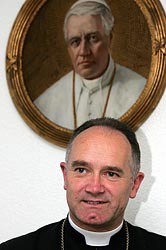 John Allen comments on the meeting between the Pope and Fellay. He also has comments on WYD debriefings and the big shindig last week in Italy of the Communion and Liberation movement.
Read first, then read my comments, I won't quote extensively.
On the Lefebvrites:
Allen's comments on the why and the how of the Lefebvrite movement's validity vs. illicitness are very well timed. The context of the negotiations are typically glossed over in the mainstream Catholic press. The fact that the SSPX could very well build a 'valid' mirror Catholic hierarchy is a very important one. Kudos to John for explaining this in detail.
On Islam:
The Pope met with Oriana Fallaci, the famed Italian journalist who is terminally ill with cancer. Allen makes the connection that her audience with the Holy Father is yet another example of the new stance of jihadist Islam and the tacit approval of a lot of the mainstream Islamic leaders.
The idea that those countries under Shariah law are somehow not completely civilized is I think a slight mistake. As I've noted before. the problem is more with ingrained social custom. In places like Spain, the Caliph had to beg the Christians not to make trouble. One exception perhaps, but it goes to show that blanket condemnations are not always the best.
On gay martyrs:
Here I'll quote something:
Philip and Randi Reitan of Eden Prairie, Minn., said they had symbolically "adopted" Ormando as their own son, since his natural family had rejected him. "We know so many young gay men like him, so hurt by the teachings of the church," Randi Reitan said. "When the church teaches people not to accept and to love their own children, it destroys a mother's heart."
Don't blame the Church and its teachings for the social taboos of rural Sicily, thank you very much.
Finally, On Communion and Liberation:
I'll quote again, this time CL's founder:
"A movement in the church is like an unplanned pregnancy … the child may be unwanted, but it can't be aborted,"
An interesting and rather striking insight into such things...
Subscribe to:
Posts (Atom)