Tuesday, January 23, 2007

China, again (and again)

There is all this talk in the media about some kind of olive branch to be offered to the People's Republic of China. The Pope will be sending a letter to Chinese Catholics.

What will the letter say?

Is this one of those times when we will see the Vatican perform its usual act of feel-good diplomacy? Or is it possible that this in fact could be a real example of Benedict's call of a smaller Church, dedicated to its core beliefs?

As I've said again and again here, the PRC is not to be trusted. The Communists and their Patriotic Association lackeys have done nothing to earn any kind of special compromises. They arrest bishops, priests and laity. People disappear into the bamboo gulag forever. Cardinal Zen has written the preface to a collection of writings by various Chinese martyrs. He recounts one episode from his hometown:

The most relevant episode happened on the tragic day of September 8, 1955, when police conducted a gigantic raid, arresting hundreds of Catholics - from the bishop to priests, from catechists to members of the faithful belonging to [religious] associations, above all the Legion of Mary. They were brought to the dog racing stadium, where the bishop, the heroic Ignatius Gong Pinmei - created a cardinal in pectore in 1979, while he was still in prison - instead of renouncing the faith, cried out amid the distress of the Catholics huddled there and the disdain of the guards: “Long live Christ the King, long live the pope!”

In mainland China, all suffer for Christ. Countless martyrs have died and will die before the political landscape of the PRC is changed for the better. The question is will some kind of detente between the Holy See and the PRC help or hurt?

Let us ask this question instead...

The Red Chinese agree to give the Holy See final say over ordinations, which is allegedly the key sticking point. In return, the Pope plans on visiting at the time of the Olympics in 2008. Between then and now, the Red Chinese go on with persecuting others, Christians of other churches, Falun Gong, political dissidents.

Has in this hypothetical the situation of Chinese Catholics been helped or hurt?

Sunday, January 21, 2007

Apocalypses and disaster movies on the same night: bad

Father Elijah: An Apocalypse was slightly disconcerting. The events of the novel take place in the last year of the millennium as a priest who lives in a monastery in Israel is called to Rome because the Pope wants him to go see the newly elected leader of the European Union to convert him back to the Faith. The Pope and his senior lieutenants are convinced that this leader, who is very rich, very powerful, very influential worldwide, through his efforts to bring about a world government and a casting off of any kind of faith in an exterior divinity in favor of an interior humancentric divinity will bring about the reign of the Anti-Christ.

O'Brien's story was well constructed and his characters were well designed, if slightly one-dimensional here and there. Obviously, they served a purpose and didn't need to be more than they were. The main character was of course the most well thought out of them all.

Of course, this book is old and I expect many of you out there have read it already. But it's new to me, right? I finished this book in the evening and then I went out to watch TV for awhile. The movie Deep Impact was on. Comets flying into the earth and all that. Quite disconcerting.

Wednesday, January 17, 2007

Where I've been

Saint Anthony

Starting last weekend, the cable internet here was down. Apparently there was something wrong with where the cable met our building. Since I don't like to blog on my laptop (loading times for all the graphic intensive stuff out there is just too frustrating), things ground to a halt here.

I will be only lightly blogging the next few days while I get up to speed.

Friday, January 12, 2007

Civil unions are counterproductive

AKI:

Vatican City, 11 Jan. (AKI) - Pope Benedict XVI on Thursday warned Italian lawmakers against the planned approval of legal rights to civil unions. "Projects aimed at granting improper legal recognition to forms of unions other (than marriage) appear dangerous and counterproductive as they inevitably weaken and destabilise the legitimate family based on matrimony," the pontiff told a gathering of local administrators with the city of Rome, led by mayor Walter Veltroni, the capital's province and the Lazio region.

The pope first stepped into a debate on highly controversial legislation proposed by Italy's progressive government on 22 December, when he condemned the legal recognition of civil unions, including gay couples. "I can't hide my concern about legislation on de facto couples," the pontiff said at the time in a Christmas speech to the Rome clergy.

Benedict moreover harshly criticised last month the possibility that gay couples could be given the same rights as a husband and wife.

The Italian government announced on 7 December it would draft legislation giving legal rights to civil unions including homosexual couples by the beginning of next year despite the opposition of some Catholic coalition members.

Family minister Rosy Bindi, a practising Catholic, shocked many in her coalition and in the conservative opposition when she announced in May, shortly after the new government was sworn in, that Italy had a duty to discuss some kind of recognition of civil unions - even in the face of warnings from the Roman Catholic Church that it opposed any move perceived as a threat to the traditional family.


Her coalition and the conservative opposition were shocked... Does that equal scandalized?

The measure was not part of the electoral programme of the broad eight-party progressive coalition of premier Romano Prodi whose members, including one prominent Catholic party, are deeply divided on the issue.

The Vatican warned Prodi before the vote it condemned civil unions and gay marriages.

When one has broad coalitions, it's wise not to rock the boat on divisive issues, no matter how progressive the coalition parties may be. Prodi doesn't have absolute control like the Socialists in Spain. Of course, floating the issue like this could simply be a ploy to see how it will do. If it goes down in flames, no harm no foul. I ought to find the numbers for the coalition and the opposition as far as seats. That would be instructive. (I looked, 348 to 281. Prodi's majority, if stable enough, has a chance.)

You'd never know it by reading this

Within the Octave of the Epiphany
Feria


Zenit:

ROME, JAN. 11, 2007 (Zenit.org).- In the wake of routing the Islamic movement that controlled Somalia, the bishop of Djibouti says that the country's fate now totters between a weak, transitional government and chaos.

Bishop Giorgio Bertin made these comments in a statement issued by Caritas Internationalis in which he expressed his fear that the current government will collapse if Ethiopian troops pull out.

Somalia has not had a functioning government since clan-based warlords toppled dictator Mohamed Siad Barre in 1991, and then turned on one other, and drove the country into a state of anarchy.

[Background on recent Somali history]

"If Ethiopia withdraws its troops and there is no support mechanism put in place, the transitional government can't stand on its own. It will collapse," said Bishop Bertin, who is also the apostolic administrator of Mogadishu, and president of Caritas in Somalia and Djibouti.

"If the international community does not intervene, there is a real risk that Somalia could go back to the worst violence and clan warfare of 1991," he continued. "We need an African or U.N. force, supported by the Europeans and the North Americans, in place to fill the void once the Ethiopians leave."

In its own interest, and at the request of the Somali interim government, Kenya has sealed off its border with Somalia to prevent Islamic militants from escaping the country.

"We also have to understand this severe measure," said Bishop Bertin. "Kenya is worried about the huge influx of Somalis, especially the threat of Islamists entering and destabilizing its territory."

Kenya lacks the capacity to effectively screen people wanting to cross the border, continued the bishop, so until Kenya can guarantee that a system is in place that distinguishes between refugees and possible militants, this is the solution.
[...]

Friends, notice the double standard. Kenya may close its border to the possible criminal element, but the US may not...

The bishop said that the most difficult task will be piecing back together Somalia's fragmented society, which has almost been completely destroyed.
[...]

I just bring this up in light of my recent post on the Republic of Somaliland in the north. If one read only the comments of the bishop, one would never know that there is in fact a functioning democratic state in the north.

Foreign policy-makers in the Secretariat of State take note: your next nunciature is waiting to be built in Somalia and it should not be in Mogadishu.

Thursday, January 11, 2007

Into the jungle; Or: The boat trip up the river

Actually, I have no idea where Aparecida is in Brazil. I only know that it is somewhat isolated and in the interior aways. I keep having visions of this being a 'Heart of Darkness/Apocalypse Now' sort of journey...

National Catholic Register: Brazil Bound

Of the events planned, the Pope’s visit to Brazil is among the most anticipated. The main purpose of the visit is to open the fifth general conference of the Latin American bishops’ conference (CELAM) at the Marian shrine in Aparecida.

By coming to Brazil, the Holy Father will be visiting the country with the largest Catholic population in the world, but also a nation that is experiencing growing secularization. And like other Latin American countries, the number of Catholics has also been diminishing because of conversions to the evangelical and Pentecostal sects of Protestantism.

Brazil was also the focus for the liberation theology movement in the 1970s, a doctrinal error that Benedict rejected in the 1980s in his capacity as prefect of the Congregation for the Doctrine of the Faith.

Some analysts predict this year’s visit will give him an opportunity to provide a more authentic understanding of the Church’s preferential option for the poor, just as his recent visit to Turkey highlighted the Church’s desire for an intercultural dialogue with Muslims based on truth and charity.
[...]

The rest of the article describes documents that are coming out sometime this year (post-synod exhortation, the infamous motu proprio, etc.). There is also a brief list of trips scheduled, including another one to Germany.

Vietnamese PM to visit

Asia News:

[The intro]
It will be the first visit by a Vietnamese premier. The normalisation of diplomatic relations will top the agenda. For Hanoi there is the prospect of getting the Church to provide assistance to the poor and the disabled as well as help to revitalise the country’s soul at a time when people are in a rush for riches and corruption is growing.

[The main article]
Vatican City (AsiaNews) – On January 25 the head of a Vietnamese government will be in the Vatican for the first time. Prime Minister Nguyễn Tấn Dũng’s visit, which official sources have not yet announced, represents a further sign that relations between the Vatican and Hanoi are improving and might be the prelude to full normalisation.

[A brief summary of past contacts]

Cardinal Sepe’s trip came in the wake of the Vietnamese government’s decision to accept the creation of the new diocese of Ba Ria. During that same trip, the prelate was able to ordain 57 new priests in Hanoi.

Upon his return from a mission to Vietnam in May 2004, Mgr Pietro Parolin, undersecretary of the Section for Relations with States at the Vatican Secretariat of State, said “how on more than one occasion the Vietnamese side stressed its intention to put the past behind and look forward to the future with confidence”.

In terms of the Vatican-Vietnam relationship, “the deeply felt condolences to the Vatican, the world’s Catholic community and Vietnam’s Catholic faithful” which the government of Vietnam expressed in a note sent by then Prime Minister Pham Van Khai to the secretary of state, Angelo Cardinal Sodano, upon the death of John Paul I was a significant step.

On that occasion, the authorities allowed Hanoi Cathedral to set up a maxi screen to give people an opportunity follow the Pope’s funeral ceremony.

The Vietnamese government’s current attitude towards the Catholic Church is closely linked to its belief that the Church can play an important role in helping the poor and the disabled and in running kindergarten and health facilities, which are all theoretical still government prerogatives.

Similarly, the role the Church can play in revitalising the country’s soul at a time of problems related to the rush for riches and corruption is valued positively.

Last but not least, Vietnam’s successful bid to join the World Trade Organisation was partly dependent on its ability to improve the country’s human rights situation, including its ability to guarantee freedom of religion. (FP)

Vietnam is what the People's Republic of China could be if it wasn't so paranoid about keeping its people in check. This visit will be an important part of the Asian strategy, particularly with the growing importance of the Vietnamese diaspora in places like the US in providing priests. Regularizing relations with the home country further solidifies that community's presence. The terms of any agreements will be interesting to read.

Awards day

From the Kuwait News Agency, we have this story:

VATICAN CITY, Jan 10 (KUNA) -- Pope Benedict XVI awarded Kuwait Ambassador to the state of Vatican Ahmed Abdul-Karim al-Ibrahim a grand badge of honor Wednesday in recognition of his effort to enhance Kuwait-Vatican ties.

The Vatican City assigned three days for the farewell ceremonies of al-Ibrahim who ended his tenure as Kuwait top diplomat to the Vatican.

Vatican Foreign Minister Pope Monsieur Mapriti handed Al-Ibrahim the "Grand Cross of Saint Georgiou, the Great" on behalf of Pope Benedict XVI during a ceremony held here for the occasion.
[...]

He hailed the warm relation between Kuwait and Vatican and praised the effort made by al-Ibrahim to enhance the ties between the two sides and boost dialogue between Islam and Christianity.

For his part, al-Ibrahim conveyed best regards of His Highness Kuwaiti Prime Minister Sheikh Nasser Al-Muhammad al-Ahmed al-Sabah to Vatican Prime Minister Cardinal Tartchisiu Birtoni.

Kuwait is keen on pushing forward the dialogue and understanding among all religions in the interest of world peace and stability, said al-Ibrahim who represented Kuwait to Vatican since 2000.

Just about everyone gets along with Kuwait. Kuwait is also one of the few Middle-Eastern countries that has granted political freedom for women (voting, standing as candidates, etc.). There is a generation of boys in Kuwait today named 'George Bush' after the country's famed liberator Bush 41 (I recall reading that somewhere, don't quote me on it).

Fall out III

Within the Octave of the Epiphany, St. Hyginus
Feria


Though Archbishop Wielgus is gone from the scene, the commentary on what exactly happened continues along with a growing look at collaboration in general and how to reconcile the past with the future.

Magister outlines various forces in Poland and who is being accused of what. Also included are excerpts from Benedict XVI's speech while he was in Poland on the very subject of forgiveness and the like. Farther down, he describes the candidates vying for the archbishopric of Warsaw and then how Archbishop Wielgus came in:

Too many contenders, none a winner. The stalemate favored the emergence of a compromise candidate after the summer – this was Wielgus, who until 1999 was professor and rector at the Catholic University of Lublin, then bishop of the little diocese of Plock. He is a learned specialist in medieval philosophy, but is equally at home at the populist Radio Maryja.

* * *


In 1978, Wielgus spent several months at the University of Munich, the German city where Ratzinger was archbishop at the time. The two met there.

If he had obeyed the secret police, who had given him his passport for Germany, on returning to Poland the young professor would have had to have given the police a report on the future pope.

But in the profile the nuncio sent to Rome there was nothing about Wielgus’ past as a collaborator with the “Sluba Bezpieczenstwa.” Yet in Poland, news was already circulating of documents that could have nailed him to the wall.

The Vatican took a few weeks for consideration. But it neither requested nor received any further information.

On December 6 came the official announcement of the appointment. A month later, the prefect of the congregation for bishops, Cardinal Re, would confess: “When archbishop Wielgus was appointed, we knew nothing about his collaboration with the secret services.”

He might have said: “We didn’t want to know anything.” Because it was only on January 2 that the Vatican nunciature asked the Institute of National Memory for the documents on Wielgus.

Over at First Things, Robert Miller examines implications:

I mention all this because I am reminded of the clerical sex scandals in the United States back in 2002. Back then some of bishops were—I put it mildly—not entirely candid in speaking to the faithful. Here, we have Wielgus saying that he made full disclosure to the Holy Father and Re expressly contradicting him. There might be some misunderstanding that explains this, but, frankly, I doubt it. Someone isn’t quite telling us the truth.
[...]

Now, either the Vatican knew about Wielgus’ past when it appointed him, as Wielgus says and as the Vatican’s statement in December strongly suggests, or else it did not, as Re now maintains. If the former, then the Vatican’s investigation of Wielgus prior to the appointment was grossly negligent, failing to discover information that was readily available in Poland. If the latter, as seems much more likely, then the Holy See exercised very poor judgment in making the appointment in the first place and even worse judgment in attempting to ram it through even after the truth about Wielgus became public. It stood by Wielgus while it knew he was lying to the faithful by denying the allegations. Many faithful Catholics looking at this situation will think that our bishops, rather than their critics, are the ones doing the real harm to the Church here.

Finally, there is an AP story in the North County Times that examines collaboration as a widespread phenomenon not only in Poland, but throughout eastern Europe in the countries formerly behind the Iron Curtain.

Records released in recent years allege involvement by dozens of priests -- including two bishops in the Czech Republic and even the retired primate of Hungary, who voted in the conclave that elected Pope Benedict XVI.

Nor was the Roman Catholic Church alone. Orthodox and Protestant clergy have also been suspected of collaborating.

So where does the truth lie? The funny thing is that in this instance, it doesn't matter. If the Vatican simply didn't know, then that's just shoddy background work. If it did know everything and it went forward anyway, its follow-through left much to be desired as far as public relations.

That truth and reconciliation commission idea is looking pretty good, not only for Poland.

Wednesday, January 10, 2007

Status and privileges in Italy

AKI:

ITALY: TOP CATHOLIC CLERIC AGAINST LAW ON RIGHTS FOR RELIGIONS

Rome, 10 Jan. (AKI) - A top Catholic cleric has spoken out against legislation being discussed in the Italian parliament to grant equal rights to all religious faiths in mainly Catholic Italy. "In the current constitutional context, the equal freedom of each confession does not imply full equality. The state should be careful not to sign too many agreements," Giuseppe Betori, the secretary of the Italian Bishops' Conference (CEI), was quoted as telling parliament's commission on constitutional affairs by the Italian media on Wednesday.

The aim of the draft law is to regulate Italy's relations with minority religions to avoid their discrimination - allowing, for example, other confessions besides Catholicism to be taught in public schools.

Betori's statements have angered the leaders of minority religious communities in Italy.

"The state should be impartial towards other religions," said Paolo Ricca, a leading member of the Protestant Valdensian community, which numbers today some 45,000 members.

Riccardo Pacifici, the leader of Rome's Jewish community, said Betori's words "bring the clock back" in time. The Jewish Italian community totals some 45,000 members.

Roman Catholicism, which was proclaimed the state religion under the Lateran Treaty signed during the Fascist regime in 1929, lost that distinction under an agreement with the Vatican ratified in 1985, but the Church maintained a privileged status within Italy, where over 90 percent of the population is Catholic.

Italy has signed a number of agreements with representatives of other religions such as Judaism and the Protestant Valdese Church but not with Islam, which represents the second largest religious grouping in Italy, estimated to number some one million.

On the one hand, Italy and the Catholic Church have been intertwined for millennia. On the other hand, a modern state really shouldn't favor one group of citizens over another.

Retaining the Catholic Church's privileged status is I think important to maintaining Italy's heritage. The secretary of CEI could be a bit more politic in his choice of words. This isn't an issue that should be divisive. Instead of talking about 'equality' and 'freedom' and 'the state shouldn't be making too many agreements', the Church would be better served by mentioning 'Italy's storied history' and 'the Church's role in supporting and maintaining the Italian identity'. Something like that would be good.

Fall out II

Within the Octave of the Epiphany
Feria


This morning there are several stories out there on the 'national crisis' and 'greater accusations' in Poland.

Indianapolis Star:
Polish leader: Catholic Church spy scandal is 'national crisis'


The Ledger:
In Poland, New Wave of Charges Against Clerics


I don't have a whole lot to say now. The Poles will have to sort it out themselves. Amy Welborn quoted a piece by George Weigel in Newsweek:

The Catholic Church thus has everything to gain by turning the Wielgus affair into an opportunity to deal with the IPN archives in a serious way, making a clean breast of its modern history while helping shape a sophisticated public understanding of the nature of life under totalitarianism—which is already being forgotten among too many Poles (not to mention Westerners). By the same token, Polish Catholicism has a lot to lose, if it does not take the responsibility to tell the full truth about its recent history—and the potential damage reaches far beyond the court of public opinion. For, if every piece of paper in the IPN’s archive is duplicated in Moscow, then the Catholic Church in Poland will be open to blackmail for the foreseeable future, if it does not take the lead in clarifying the truth about its past, with both its glories and failures.

Tuesday, January 09, 2007

The fall out

From ANSA:

But when Sunday came, there had been a turnaround and the Vatican announced Wielgus had stepped down. The official Vatican daily, Osservatore Romano, reduced the story to a few lines which it tucked into the bottom right hand corner of its front page. Meanwhile, off the record, sources in the Vatican murmured that it would be some time before the Polish capital was given a new archbishop and it would also be the last time that the Vatican blindly trusted the Polish Church.

That at last has something of the ring of truth to it. At the time of the archbishop's appointment, it seems clear enough that the Vatican really had no idea. Fool me once, shame on you... The idea that it did have some idea and went ahead anyway just seems too implausible.

The really sad part though is the conduct of everyone in Poland and Rome after Archbishop Wielgus' affairs came to light.

And another

Within the Octave of the Epiphany
Feria


Houston Chronicle:

A day after Warsaw's new archbishop stunned the faithful by resigning minutes before his formal installation ceremony, the Rev. Janusz Bielanski resigned as rector of Krakow's prestigious Wawel Cathedral, burial place to Polish kings and queens, Krakow church spokesman Robert Necek said.

Bielanski's resignation was "in connection with repeated allegations about his cooperation with the secret services" of the communist era, Necek said. He added that Krakow's archbishop, Cardinal Stanislaw Dziwisz, accepted the resignation.

The allegations against Bielanski first surfaced last February, but the timing of his resignation deepens the sense of crisis around the church over the issue of priests who were compromised by the secret police.
[...]

According to sociologist Lena Kolarska-Bobinska, the Wielgus affair exploded because church leaders have simply refused to "face the reality" about uncomfortable chapters in its history and address them openly.

"Now they suddenly have to face a democratic environment _ with the press and the like," said Kolarska-Bobinska, director of the Institute for Public Affairs, a Warsaw-based think tank. "The church in the United States has responded to the democratic challenges, but here the church was trying to close its eyes, hoping that would never happen."
[...]

The New York Times:

The archbishop’s resignation has divided the church between those, like Cardinal Jozef Glemp, who were angered that public pressure had scuttled the appointment and the 60 percent who wanted him to step down, according to a recent survey.

The cardinal, who held the archbishop’s post before the appointment of Bishop Wielgus and was reappointed to the job temporarily after the resignation, publicly defended Bishop Wielgus on Sunday.

Poland’s conservative Dziennik daily newspaper called Cardinal Glemp’s defense a “huge mistake,” writing that “he didn’t even mention that the archbishop lied to the last minute. That he lied to the pope, bishops and faithful.”

The turmoil in Poland reverberated back to the Vatican, amid deepening questions of why officials gave such strong support to Bishop Wielgus’s contentious appointment in a place of such importance to the Catholic Church.

Funny how the NYT piece doesn't even name Father Bielanski.

Monday, January 08, 2007

What did we know and when did we know it?

From Monsters and Critics:

Vatican accuses disgraced Polish prelate of misleading the pope

Vatican City - The Vatican on Monday accused one of Poland's leading prelates, Stanislaw Wielgus, of misleading Pope Benedict XVI by failing to reveal the true nature of his ties with communist-era secret agents.
[...]

According to Cardinal Giovanni Battista Re, head of the church's Congregation for Bishops, the Vatican had no knowledge of the allegations at the time of his December 6 appointment.

'When Monsignor Wielgus was nominated (archbishop of Warsaw) we knew nothing of his collaboration with the secret service,' Battista Re told Italian daily Corriere della Sera.
[...]

Are we really supposed to believe this?

How Catholic are the Poles?

Speigel Online has a story about Poland and the Church: The Battle for Souls. In the usual fashion of the magazine, the article starts off with a variety of facts and figures.

The church and state have been close allies in Poland since 966. And in the postcommunist era, as political analyst Dominik Hierlemann has argued, "The church has skillfully adapted to the new system, and remained one of the most powerful social and political organizations."

Nonetheless, the Polish episcopacy cannot simply assume that its followers will go where it leads. For centuries - through the country's multiple partitions, the Nazi occupation and the communist rule - the church fought to save the Polish nation, paying a heavy price in the process. Today it is fighting to prevent its flock from being shepherded to the verdant pastures of capitalism. A battle has begun, with minds and souls at stake: the new Poland, intoxicated by its freshly acquired wealth, is battling the millennium-old Roman Catholic Church.

Ninety-five percent of all Poles are Roman Catholics, and well over half say they attend mass at least once a week. The Poles, along with the Irish, are among the most pious members of the European Union. But the fact remains that "the majority of the Polish faithful have grown impervious to the moral teachings of the church," according to Warsaw sociologist Pawel Spiewak.

Almost three out of four young Polish Catholics approve of premarital sex. Tens of thousands skillfully circumvent the extremely harsh abortion laws. Experts estimate the number of illegal abortions per year at 80,000 to 200,000. And while Polish Pope John Paul II vigorously opposed the death penalty, some 70 percent of his compatriots want it reinstated, with the most vocal support coming from the nationalistic Catholic League of Polish Families. Sixty percent of Poles believe that priests should keep out of politics, that a strict line should be drawn between the pulpit and the state: a bitter pill for a church so deeply rooted in national tradition.
[...]

Bolding is mine. After this, the article goes on to recount the fortunes of the Polish nation and those of the Church during the trials and tribulations of Poland. It goes on to look at the erosion of Church influence as Poland emerged as a post-communist democracy with 'modern' ideas of the separation of Church and State.

DEWEY DEFEATS TRUMAN

From CNS:

Warsaw archbishop takes over despite findings he helped communists

The webpage the link goes to:

Editor's Note: Due to this weekend's developments, the story posted here Friday on Archbishop Stanislaw Wielgus will be updated Monday by Catholic News Service.

Bertone on Turkey

Sandro Magister has extracts from an interview given by Cardinal Bertone to a French Catholic magazine.

Bertone prefaces his remarks by saying that the Catholic Church does not have any “particular power to favor Turkey’s entry into Europe or to veto it.” But he immediately adds that “without Turkey, Europe would no longer benefit from that bridge between East and West that Turkey has always been throughout history.”

How he belittles the Church's influence. A cunning ploy. As for the 'bridge' remark, I made that same point awhile ago. I must have a fan.

Having been archbishop of Genoa until last summer, the Vatican secretary of state recalls that “Turkey has long been one of Europe’s partners. For example, the Republic of Genoa maintained good relations with the Turks, and it was in order to trade with them that England obtained the flag of Saint George from the Genoese, with the aim of passing within the Ottoman gates.”

Is this before or after Lepanto and Vienna? Did the archbishop just admit his city was trading with the enemy while Christendom was engaged in a life and death struggle against territorial ambitions of the Turkish Empire? (A joke...)

As for today’s Turkey, the cardinal emphasizes that the country “has a distinctly secular system and a regime that tends toward greater democracy. It is in Europe’s interest to help the country to become a true democracy, to consolidate a system of values more and more. Leaving Turkey outside of Europe risks, furthermore, favoring Islamist fundamentalism within the country.”

'Distinctly' and 'tends toward greater'... Such qualifies and fine distinctions... The comment about Islamic fundamentalism is valid to a point. However, I would submit that as a country becomes more and more Westernized, that is when the Islamists truly come to the fore. Look at Iran and the Shah, the Saudis and their oil wealth, etc. Be careful what you wish for, Your Eminence.

About the concrete forms of Turkey’s membership, Bertone hypothesizes that “integration within Europe could be realized in concentric circles, with an inner circle of the historically European countries currently united within the euro zone, and a second level for those that are more distant from this.”

Perhaps. The last thing Europe needs is letting in countries that may or may not be even technically in Europe geographically. The continent is having a hard enough time keeping its own economy going.

In the same interview, cardinal Bertone also touches upon relations between Christianity and Islam after Benedict XVI’s lecture at the University of Regensburg:

“The clarifications made by the pope brought an understanding of his clear intention to develop, beginning with his address in Regensburg, a debate on faith and reason. This had nothing at all to do with a polemic with Muslims, whom he did not stigmatize. Besides, a short time later there were Muslin intellectuals and leaders who understood this well. The Church’s role in interreligious dialogue is well known beyond the confines of the Church itself. [...] For some observers, after the pope’s trip to Turkey 'polemics about Regensburg are now ancient history.'”

Which is good.

Regarding the Turkish EU bid, this is what I said before:

However! Just because a modern nation-state can claim to be a part of the European historical tapestry, it should not be entitled to automatic inclusion into what is not a cultural organization. The European Union is (aside from behing a huge bureaucratic mess) a political and economic supra-national organization with various delegated powers. Its purpose is not cultural exchange or preserving European culture. If Turkey is going to be admitted into the European Union, it should be admitted according to present-day criteria (rule of law, personal liberty, etc.).

Sunday, January 07, 2007

The Vatican response

From Zenit:

In a statement issued today, Jesuit Father Federico Lombardi, director of the Vatican press office, said: "Archbishop Wielgus' conduct in the past years of the Communist regime in Poland has seriously compromised his authority, including before the faithful.

"Therefore, despite his humble and moving request for forgiveness, the resignation to the See of Warsaw and its speedy acceptance on the part of the Holy Father has seemed to be an appropriate solution to address the situation of disorientation that has been created in that nation."

Not exactly a clear-cut recitation of the facts on the ground as far as humble forgiveness preceded by minimizing and spinning, but hey, it's the Press Office.

The Vatican spokesman added: "It is a time of great suffering for a Church to which we all owe very much and which we love, which has given us pastors of the greatness of Cardinal Stefan Wyszybnski and, above all, Pope John Paul II.

"The universal Church must feel spiritually sympathetic to the Church in Poland and support her with prayer and encouragement, so that she will soon regain her serenity."

Hear hear! Amen.

Father Lombardi continued: "At the same time, it is appropriate to observe that the case of Archbishop Wielgus is not the first and will probably not be the last case of attack on personalities of the Church in virtue of the documentation of the services of the past regime.

So it's an attack? But wait, there's more.

"There is enormous material and, in attempting to assess its value and draw reliable conclusions, it must not be forgotten that it was produced by officials of an oppressive and blackmailing regime."

The press office director added: "After so many years of the Communist regime, when the great and untouchable figure of Pope John Paul II is no longer here, the present wave of attacks against the Catholic Church in Poland does not seem to be a sincere search for transparency and truth, but rather a strange alliance between persecutors of the past and other adversaries, a vengeance on the part of those who, in the past, had persecuted her and were defeated by the faith and the thirst for freedom of the Polish people."

Father Lombardi explained that members of the Church must be faithful to the truth: "'The truth will make you free,' says Christ. The Church is not afraid of the truth and, to be faithful to her Lord, her members must be able to acknowledge their own faults.

"We hope that the Church in Poland will be able to live and surmount with courage and lucidity this difficult period, so that she will be able to continue offering her precious and extraordinary contribution of faith and evangelical drive to the European and universal Church."

*rubs his forehead* Bolding is mine as usual.

After a brief recapitulation of the facts, Father Lombardi called for prayers for the Polish Church and he ended his remarks in the same fashion. Everything in between...

Can we say damage control for the bishop-selection process in Rome?

It's not about the archbishop being a former collaborator and his conduct since the details of his collaboration came out. It's not about reconciling Poland's communist era past with the present and bringing about reconciliation. Instead, it's about the Church's enemies levying attacks on Church personalities as a "a vengeance on the part of those who, in the past, had persecuted her and were defeated by the faith and the thirst for freedom of the Polish people."

The above is in US politics-speak called 'CYA'.

It doesn't even matter if the communists who persecuted the Church back in the day unearthed the documents and floated them in the press. That's really immaterial. Archbishop Wielgus' conduct isn't even the issue now. The dissatisfaction with the bishop selection process that allowed Wielgus to get into this situation in the first place has been growing lately and this little statement from the Press Office is not going to help matters at all. If Father Lombardi and his brethren had been smart, they would have announced the resignation, said a prayer for Poland and left it at that. The rest with attacks and blackmail and getting back at the Church just comes off as such an obvious attempt at deflecting blame in the aftermath.

Benedict had better sign the motu proprio and release it and it had better be good. He is going to need the good press. It's Monday in Rome already. We'll see what the week brings.

Resignation

COMUNICATO DELLA NUNZIATURA APOSTOLICA IN POLONIA

La Nunziatura Apostolica in Polonia comunica che Sua Eccellenza Mons. Stanisław Wielgus, Arcivescovo Metropolita di Varsavia, nel giorno in cui era previsto l’ingresso nella basilica cattedrale, per dare inizio al suo ministero pastorale nella Chiesa di Varsavia, ha rassegnato a Sua Santità Benedetto XVI le dimissioni dall’ufficio canonico a norma del can. 401 § 2 del Codice di Diritto Canonico.

Il Santo Padre ha accettato le dimissioni dell’Arcivescovo Stanisław Wielgus ed ha nominato Sua Eminenza il Card. Józef Glemp, Primate di Polonia, Amministratore Apostolico dell'Archidiocesi di Varsavia fino a nuovo provvedimento.

Varsavia, 7 gennaio 2007

+ Józef Kowalczyk
Nunzio Apostolico in Polonia


Rorate Caeli's English translation:

The Apostolic Nunciature in Poland informs that His Excellency Abp. Stanisław Wielgus, Metropolitan Archbishop of Warsaw, on the day in which his installation, beginning his pastoral ministry in the Church of Warsaw, was expected at the Basilica-Cathedral, tendered to His Holiness Benedict XVI his resignation from the canonical office, as established in Can. 401 § 2 of the Code of Canon Law.

The Holy Father has accepted the resignation of Archbishop Stanisław Wielgus and has named His Emminence Cardinal Józef Glemp, Primate of Poland, Diocesan Administrator of Warsaw until further provision.

Warsaw, January 7, 2007

+ Józef Kowalczyk
Apostolic Nuncio in Poland

Saturday, January 06, 2007

Choices

CALLS for the dismissal of Monsignor Stanislaw Wielgus, the new Archbishop of Warsaw, mounted yesterday after he was challenged to say whether he had supplied intelligence to the secret police about the late Pope John Paul II.

Wielgus, 67, has confessed to spying for the Polish security service, Sluzba Bezpieczenstwa, during the cold war until the communist regime collapsed in 1989. He met police agents more than 50 times in one five-year period during the 1970s.
[...]

Most of the church hierarchy plan to attend but there are notable exceptions. Tadeusz Goclowski, the progressive Archbishop of Gdansk, is not coming. He pleaded “other obligations”. Yesterday he told the press that Wielgus ought to ask the Vatican to relieve him from office.
[...]

On a visit to Poland in May, Benedict tackled the issue of “priest-spies” in remarks which appear to explain his attitude towards Wielgus. “The errors of the past,” he said then, must be recognised but without “falling prey to easy accusations . . . or ignoring the different preconceptions of the time”.
[...]

Privately, leading Vatican officials expressed dismay at the embarrassment which Wielgus’s mea culpa had created for the pontiff, while playing down the scandal. “In that period everyone had contacts and were collaborators with the authorities,” one Vatican official claimed.

Cardinal Edmund Casimir Szoka, whose parents were Polish, said he was sure the Vatican had made the right choice: “The Holy See made its choice after carrying out adequate investigations.”
[...]

On the most basic level, I agree with the Holy Father that the past is the past. But if the Poles don't have confidence in Wielgus given their own situation in reconciling the past with the present, then there's not much point in forcing the issue. There are valid points in either direction.

Are things over for Bush?

Spengler of Asia Times Online has an interesting take on the situation. No need to quote, it's all worth reading.

The snowball effect

Spain: Cordoba Cathedral row continues (AKI)

Cordoba, 5 Jan. (AKI) - Spain's Federation of Islamic Religious Entitities (FEERI) is seeking to negotiate with the Catholic Church "to recuperate Muslim property on Spanish soil," FEERI spokesman Javier Isla announced. "In exchange, FEERI is prepared to return Catholic assets currently held by Muslim bodies in Spain," Isla said, quoted on Friday by Spanish daily ABC.

The move - described ironically by ABC as "a curious attempt at reciprocity," comes amid a simmering row sparked by the Bishop of Cordoba's refusal to allow Muslims to pray alongside Catholics in Cordoba Cathedral in southern Spain - which is a former mosque. "With these kinds of initatives, Islam has decided to put more pressure on the Church," ABC added.

An immediate rejection of FEERI's overture came from Spain's Espiscopal Conference. Despite interreligious dialogue, "Cordoba Cathedral remains Cordoba Cathedral, and no other group has legitimate historical claims upon it," said spokesman Juan Antonio Martinez Camino.

Juan Jose Asenjo, the Bishop of Cordoba, last week turned down the request by Muslims to be allowed to pray in the mosque. However, FEERI is holding out for a Muslim prayer room in Cordoba Cathedral, claiming this would not create the "confusion" between faiths cited by Asenjo as one of his reasons for not allowing Muslims to pray in the mosque. Asenjo also claimed joint prayers would lead to "religious indifference".

Spain's Islamic Board - which represents a community of some 800,000 in a traditional Catholic country of 44 million - also wants Muslims to be able to pray in Cordoba Cathedral - a request which has been made repeatedly in recent years. The Islamic Board, argued in a letter last week to Pope Benedict XVI that such a move in Cordoba could serve to "awaken the conscience" of followers of both faiths and help bury past confrontations.

The Islamic Board's spokesman, Mansur Escudero, has confirmed it does not intend to make any property claims, citing a 1992 accord with the state that defined Muslim property in Spain.

The Cordoba mosque was turned into a Catholic cathedral in the 13th century after the city was conquered by King Ferdinand III in the war to drive the North African Moors from the Iberian peninsula. Cordoba was the capital of 'al-Andalus' or the area of southern Spain under Arab rule from the eighth to the 15th century AD.

(Mco/Ajd/Aki)

Bolding is of course mine.

It was a church first. I think that is the most important fact.

There should be a map. On this map is drawn the furthest bounds of Christendom at the time of the death of Muhammad or some other appropriate date (maybe the triumphant return of Muhammad to Mecca, but we'll be charitable and just give them all that Muhammad presided over at his death). In the name of 'fair is fair' and 'what was originally ours and what was originally yours we'll exchange', the Muslims of northern Africa, the Levant, various places throughout the Middle-east and on through central and southern Asia will all get up and go to Arabia. No muss, no fuss.

Can't beat the real thing

Coca Cola to Sponsor the Pope

Old fears about the influence of American corporations in global affairs resurfaced Tuesday with the sensational announcement that Pope Benedict XVI is to be sponsored by Coca Cola.

The controversial five-year, multi-million dollar deal - signed at St. Peter�s late Monday - marks the first time in history that a major religious figure has been sponsored by a beverage company.

In a press conference this morning, Coca Cola CEO Neville Isdell said, �This is an historic moment for the corporation � a great drink and a great man - we are thrilled and delighted to have the Coca Cola brand associated with the Pope.�

It is not yet known how the sponsorship will operate day to day. However, television, print and even a poster campaign featuring the Pope �smiling and enjoying a refreshing can� are said to be �in the cards.� Suggestions that the Pope will now give his Sunday morning St Peter�s Square mass in a Coca Cola cap are said to be �on the table, but unlikely.�

Coca Cola refused to comment on whether the deal will give them naming rights. However, a leaked report from Vatican City suggests that Ratzinger�s official title could well become �Pope Coke I� before the end of the year.

The Vatican was quick to defend the deal, describing it as an �unprecedented yet positive development for Christendom.� They also urged Catholics worldwide to keep the news within perspective, �The blending of the Catholic and Coca Cola brands will be beneficial for both parties. The deal will bring a little fizz into the image of our new and beloved Pontiff, whilst opening up the commercial potential of the global Catholic brand.�

Rumors that the Catholic Church will demand the use of coke instead of communion wine in its churches were said to be �unfounded and absurd� - although it might be used as an �alternative� for recovering alcoholics and children. It was also �not beyond the realm of possibility� that Coca Cola would become the official drink of Catholic Sunday schools � �the kids do love it."

The deal is a major coup for Coca Cola, rising the corporation�s share price sharply. They certainly had to fight off considerable competition to secure the deal. Privately, Pepsi was said to be �devastated� that they were beaten to the Pope�s signature. However, publicly they responded to the announcement in typically bullish fashion:

�Why any soft drink empire would want to associate their product with an aging, boring, �filler� Pope is staggering. Pope Benedict XVI will soon be succeeded by a younger, more radical, far cooler Pope. We have already begun our campaign to ensure that he is known as Pope �C� Cola and marketed as �the choice of a new generation.��

Many of the World�s political leaders were horrified by the news. UK Prime Minister Tony Blair, whose wife Cherie is a practising Catholic, described the deal as �a serious threat to the sanctity of established religion� and called for an emergency summit of the G8. President Bush on the other hand was �encouraged� by the deal. Speaking from his Texas ranch he said: �It�s good for Coca Cola, it�s good for America and it�s good for me.�

With the world in shock and opinion seemingly divided, all eyes are certain to be fixed on Rome.

No. :)

Did he or didn't he?

New Warsaw archbishop ruffles Vatican feathers (Monsters and Critics)

Rome - Italian press reports said Saturday that there was embarrassment and irritation at the Vatican over the controversial new archbishop of Warsaw, Stanislaw Wielgus, who has been accused of working for the Polish secret service.

Some members of the Roman Curia, the administrative body that runs the Vatican, expressed the concern that Pope Benedict XVI's reputation could be damaged by the affair, La Repubblica reported.

Especially now that Wielgus has admitted working for the secret service, Benedict risked 'cutting a poor figure,' the newspaper said.

Nobody wanted to express it openly in the Vatican, 'but the irritation is great,' the report said.

Polish members of the Curia have demanded that Wielgus step down. 'Archbishop of Warsaw and such a start to his term in office is terrible,' said Adam Boniecki, director of the Polish edition of the Vatican newspaper L'Osservatore Romano.

Officially the Vatican announced a few days ago that 'they had investigated all the circumstances of his life, including those which related to his past' in their decision to appoint Wielgus archbishop.

The Vatican added more explicitly, 'That means that the Holy Father has the utmost trust in Stansilaw Wielgus.'

The official ceremony installing Wielgus as archbishop is scheduled to take place on Sunday.

On Friday, Wielgus publicly expressed his regret for his error: he had cooperated with the secret service in order to be able to continue travelling abroad, but he never reported anyone to the service, nor had his contacts with the service caused anyone any harm, Wielgus said.

© 2007 dpa - Deutsche Presse-Agentur

I've been thinking about this off and on over the last few days. I have not read all that there is to read on this, so don't hold me to it it.

1. The archbishop-elect has stated that he only did it so he could travel abroad and that he never informed on anyone. If this is in fact the case, then I have a problem with his election and installation.

2. If all these reports out there of three or four code-aliases and deeper ties with the SB than the archbishop-elect is letting on are true, then whether or not he actually told the SB anything sensitive is important. After all, if he reported back to his superiors that that crazy Archbishop of Krakow was saying certain things, well, nothing sensitive there. On the other hand, if he was actually conscientiously informing...

Having never lived in a totalitarian country, I can't say how I would feel. Forgiveness is a great thing, but there is nothing worse than being a quisling.

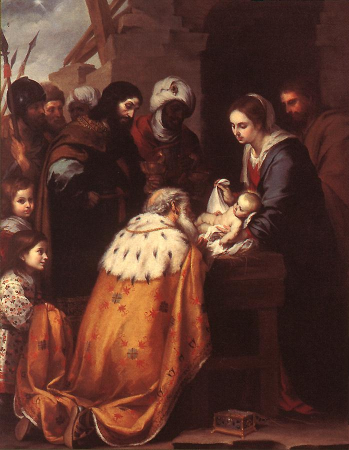
The Epiphany


Adoration of the Magi by Bartolomé Esteban Murillo (Wikipedia)


We three kings of Orient are
Bearing gifts we traverse afar
Field and fountains, moor and mountains
Following yonder star

O Star of wonder, star of night
Star with royal beauty bright
Westward leading, still proceeding
Guide us to thy Perfect Light
(Reverend John Henry Hopkins, Jr., 1857)

When Jesus was born in Bethlehem of Judea, in the days of King Herod, behold, magi from the east arrived in Jerusalem, saying, "Where is the newborn king of the Jews? We saw his star at its rising and have come to do him homage." When King Herod heard this, he was greatly troubled, and all Jerusalem with him. Assembling all the chief priests and the scribes of the people, he inquired of them where the Messiah was to be born. They said to him, "In Bethlehem of Judea, for thus it has been written through the prophet: 'And you, Bethlehem, land of Judah, are by no means least among the rulers of Judah; since from you shall come a ruler, who is to shepherd my people Israel.'" Then Herod called the magi secretly and ascertained from them the time of the star's appearance. He sent them to Bethlehem and said, "Go and search diligently for the child. When you have found him, bring me word, that I too may go and do him homage."

After their audience with the king they set out. And behold, the star that they had seen at its rising preceded them, until it came and stopped over the place where the child was. They were overjoyed at seeing the star, and on entering the house they saw the child with Mary his mother. They prostrated themselves and did him homage. Then they opened their treasures and offered him gifts of gold, frankincense, and myrrh. And having been warned in a dream not to return to Herod, they departed for their country by another way. (Matthew 2:1-12, NAB)

Friday, January 05, 2007

The birthday


St. Telesphorus

The old calendar
Vigil of the Epiphany, St. Telesphorus

From Catholic Encyclopedia:

St. Telesphorus was the seventh Roman bishop in succession from the Apostles, and, according to the testimony of St. Irenæus [...], suffered a glorious martyrdom. Eusebius [...] places the beginning of his pontificate in the twelfth of Hadrian's reign (128-129), his death in the first year of the reign of Antoninus Pius (138-139). These statements, however, should be compared with Lightfoot, [...] Harnack, [...] 70 sq. In the fragment of the letter of Irenæus of Lyons to Pope Victor concerning the celebration of Easter [...] Telesphorus is mentioned as one of the Roman bishops who always celebrated Easter on Sunday, without, however, abandoning church fellowship with those communities that did not follow this custom. None of the statements in the "Liber pontificalis" and other authorities of a later date as to liturgical and other decisions of this pope are genuine. In the Roman Martyrology his feast is given under 5 January; the Greek Church celebrates it on 22 February.

The new calendar
General: Feria
USA: St. John Neumann

From the Catholic Encyclopedia article on the see of Philadelphia:


St. John Neumann

The fourth Bishop of Philadelphia, John Nepomucene Neumann, was consecrated 28 March, 1852. (See NEUMANN, JOHN NEPOMUCENE, VENERABLE.) Ten churches sprang up during the first year of his episcopate. The constant topic of his exhortations was the necessity of parish schools. Failing to bring the contumacious trustees of Holy Trinity to their senses, he undermined their influence by putting up the church of St. Alphonsus. On 19 Oct., 1854, he left for Rome to assist at the proclamation of the dogma of the Immaculate Conception, and he returned in March, 1855. On 26 April, 1857, the Rt. Rev. James Frederick Wood was consecrated in the cathedral of Cincinnati as coadjutor to the Bishop of Philadelphia. Bishop Wood was acknowledged by the financial world as thoroughly acquainted with every phase of the banking business, which had been the occupation of his earlier years. At a meeting of the clergy, Bishop Neumann announced that the work of completing the cathedral had been committed to his coadjutor. In October, 1857, he held his last synod: there were 114 priests present, and 32 had been excused from attendance.

The press goes Wilde!

The Vatican goes Wilde - Belfast Telegraph

What is going on? After all, this is the Church that brands as an "intrinsic moral evil" the homosexual acts for which Wilde's catamite, Lord Alfred Douglas, coined the phrase "the love that dare not speak its name". Wilde was, after all, a byword for the decadence upon which the Victorian values of the age showered ignominy.

Yet it is only the latest such rapprochement. Six years ago, on the centenary of Wilde's death, the Vatican-backed Jesuit quarterly La Civilta Cattolica praised the homosexualist author of such cynical aphorisms such as "there is no sin except stupidity", and "a thing is not necessarily true because a man dies for it".

Wilde's writings, said Fr Antonio Spadaro, in the years that followed his two-year sentence of hard labour in Reading jail for "acts of gross indecency with other male persons", demonstrated spiritual values and an "understanding of God's love" that revealed he had seen into the depths of his own soul after a lifetime of "degradation, vanity and frivolity".

Vatican comes out of the closet and embraces Oscar - Times Online

Vatican embraces gay icon - pinknews.co.uk

Oscar Wilde, long claimed by the gay community as the ultimate bitchy queen, has been embraced by one of Pope Benedict’s closest advisers.
[...]

The book is designed to "stimulate a reawakening in certain Catholic circles," Fr Sapienza told Italian paper La Repubblica.

"Our role [as Christians] is to be a thorn in the flesh, to move people’s consciences and to tackle what today is the number one enemy of religion — indifference."

While no-one would argue that the present Pontiff has indeed been a thorn in the flesh of liberal-minded Christians across the world, the inclusion of Wilde in a Catholic-endorsed book has puzzled many Vatican watchers. [Why? Just because he was gay? Tsk.]

Included in the inspirational book are some of Wilde’s best known sayings.

Although his remarks were designed to appear spontaneous, Wilde in fact spend many hours honing his bon mots, in much the same way that today’s homosexuals spend time at the gym perfecting a 'natural' physique.

While Wilde has been claimed as a gay icon, the famous playwright would never have recognised himself as such, being married with children.

He did, however, coin the phrase, "the love that dare not speak its name" in his meditation on desire and punishment, The Ballad of Reading Gaol.

Father Sapienza claims that Wilde will be remembered not for his fall from grace, convicted and imprisoned for gross indecency in 1895 and sentenced to two years hard labour, but rather for his powerful body of work.

Wilde himself flirted with Catholicism during his lifetime, but once said, "To go over to Rome would be to sacrifice and give up my two great Gods: money and ambition."

In the end Wilde opted for that most convenient way to hedge one’s bets - a deathbed conversion.

As I said yesterday, there is no reason why this book should be a shock. Unless the good Father's book is full of indecent and lewd comments (which I'm assuming it's not), then I don't get it. Clever, thoughtful sayings are to be engaged and thought about, not ignored. By engaging them on their own level and considering them and what they mean, Christians can better engage the world at large that has embraced such words that lend so much credence to our instant gratification society.

Thursday, January 04, 2007

He spoiled our party: or how to get yourself a libel suit

VATICAN CITY (ANSA) - Swiss Guards Commander Elmar Theodore Maeder has denied reports that his attempts to stifle the corps' New Year celebrations caused unrest. The colonel said the reports of friction in the ranks published by British daily The Independent were "all false".

The Independent quoted an anonymous Guard, who complained Maeder imposed a midnight curfew on festivities and confiscated 20 bottles of wine.

The source even suggested the commander then used the wine at his own private end-of-year bash.

"No orders were given for New Year's Eve, apart from the one extending the time of return to the barracks," Maeder said in a statement.

The commander threatened to take legal action against "those who have spread this false news that damages the good name of the Swiss Guards".
[...]

Bolding is mine of course. This kind of story is just so easy to confirm unless they're all living under a code of silence. It's funny how the press comes up with stuff like this. The anonymous guard should either come out or shut up (if he even exists). He's volunteered for the position he is in and that includes taking orders.

Sorting out the agendas and a radical theory

ROME (ANSA) - The mysterious biblical figure of Mary Magdalene has become an icon not only for some feminists but also for many theorists interested in playing up the importance of women, according to a new book.

Written by the scholar Mario Arturo Iannaccone, the book says that in recent times Magdalene has come to be seen as the embodiment of "the sacred feminine and the spirituality of the goddess".
[...]

Iannaccone's attempt to demolish more recent views of her appealed to Italian bishops' daily Avvenire so much that it devoted a whole page this week to a discussion of the ideas in his book. The headline was Hands off Mary Magdalene.

Although Iannaccone makes no reference to Dan Brown, the new Magdalen he refers to is clearly present in the recent bestseller The Da Vinci Code in which it is suggested that Magdalene was Jesus's wife.
[...]

According to some theologians, one reason Mary Magdalene has attracted so much attention is that very little is said about her in the Bible. With nothing concrete to go on, the imagination can run wild.

But one of the latest theories to emerge about Magdalene has nothing political to it and is being taken very seriously by experts. According to Australian biblical expert Elizabeth Fletcher, Magdalene was in fact a Jewish businesswoman able to offer financial support to a roving rabbi called Jesus of Nazareth.

Fletcher maintains that the woman often depicted naked in art was involved in trading dried fish and wool dyes, two products which were important in the economy of the town of Magdala.

The book is interesting. But this last theory is even more interesting. I am wondering how a biblical scholar could get that kind of a theory out of what's in the Bible. One never really thinks of Jesus as having patrons per se and having Mary Magdalene as the primary patron of Jesus' ministry is rather novel.

That's nice

Octave of the Holy Innocents
General: Feria
USA: Saint Elizabeth Ann Seton


AKI cites a story today in La Repubblica on a new book coming out by Father Leonardo Sapienza, the head of protocol at the Prefecture of the Pontifical House. The book, Pro-vocations - Aphorisms for an anticonformist Christianity, "lists about a thousand of the author's most famous aphorisms - such as 'I can resist everything except temptation' - along with those of a less famous and equally provocative writer, Nicolas Gomez Davila, a Colombian Christian who died in 1994."

The article is short and there's probably more in La Repubblica on how exactly this book is a rehabilitation. After all, a priest could publish a book of some of the wittier aphorisms of Nietzsche, but that wouldn't necessarily be a rehabilitation of Mr. 'God is dead'.

Wednesday, January 03, 2007

Ugh

I usually wake up around seven. I come out to my computer and I sort through the various news stories that I find. I blog on what I find interesting. Today, I came out to my computer and found once again that the cable internet was not working. I messed around on other things and finally it connected again at about 9:00. Unfortunately by then, I am not so in the mood to blog. ;)

We'll see about tomorrow.

Tuesday, January 02, 2007

And now the news

Octave of St. Stephen the Protomartyr
Memorial of Ss. Basil the Great and Gregory Nazianzen


The Holy See announced today the erection of a new eparcy of the 'MAVELIKARA DEI SIRO-MALANKARESI' and includes information on the man chosen to be the first bishop of the eparchy.

The Ethiopians in Somalia intend to leave in two weeks, but the Somali government wants them to stick around for awhile (BBC). Ethiopia needs to pull out as soon as possible. A protracted struggle between the UIC and Ethiopia is bad for both Ethiopia and Somalia in general.

Monday, January 01, 2007

Merry Christmas and a happy New Year!

Octave of Christmas
Circumcision of the Lord
Mary, Mother of God


Per my usual tradition, I went to bed at 10:30-11:00. I could justify such a tradition by saying that the year started with Advent or that Christmas is the true beginning for all Christians with the incarnation of the Lord, but actually... I simply have nothing better to do. Going out costs money and a lot of my friends have moved away. January 1st is just another day (aside from its liturgical significance). The sun is already rising earlier. Christmas Day has already arrived. My birthday is only a few days away. New Year's is nothing to get the heart pumping when it comes to festivities. :) Unless the ladies out there like to swoon over Dick Clark while guzzling their champagne?

If you all are recovering, I wish you well in your efforts. Enjoy the day off. I know I will. There is a nice blue sky outside. It should be almost 40 here today. News and commentary will resume tomorrow.

Finally, one reader commented and recommended the Baronius version of the 1962 Missal. Unless anyone wishes to object and comment in favor of another version, I will probably go with that. Thanks to the reader for chiming in and also to Louis for the very informative link.

Saturday, December 30, 2006

Friday, December 29, 2006

St. Thomas Becket

On his feast day in the cold northern winter, let us look to spring and a merry literary jaunt to visit the hooly blisful martir.

Here bygynneth the Book of the tales of Caunterbury.

1 Whan that Aprille, with hise shoures soote,
2 The droghte of March hath perced to the roote
3 And bathed every veyne in swich licour,
4 Of which vertu engendred is the flour;
5 Whan Zephirus eek with his swete breeth
6 Inspired hath in every holt and heeth
7 The tendre croppes, and the yonge sonne
8 Hath in the Ram his halfe cours yronne,
9 And smale foweles maken melodye,
10 That slepen al the nyght with open eye-
11 So priketh hem Nature in hir corages-
12 Thanne longen folk to goon on pilgrimages
13 And palmeres for to seken straunge strondes
14 To ferne halwes, kowthe in sondry londes;
15 And specially, from every shires ende
16 Of Engelond, to Caunturbury they wende,
17 The hooly blisful martir for the seke
18 That hem hath holpen, whan that they were seeke.

Recommendations still needed

*points down to his Recommendations needed post*

Thank you to long-time reader Louis for sending a helpful link. If you have any thoughts, please email or leave a comment. Thank you.

This is funny

From Daily Southtown (bolding mine):

At the center of it is the figure of Our Lady of Guadalupe, once perhaps a pagan goddess, but now unquestionably the patron of the Mexican peon with whom she identifies. I tell students that if they want to understand what Catholicism was like before the Reformation and the Counter-Reformation, they should look at Mexican popular Catholicism and read the plays of Shakespeare. The "religion of the border" (as my colleague James "Big Jim" Griffith calls it) does not need, for example, the approval of the Congregation for the Making of Saints to proclaim their saints -- just as Catholics did for a thousand years.

Sometimes these saints disturb us Celts. I have in my possession (but never wear) a medallion of San Juan Malverde, the patron of the narcotrafficantes. In Perez-Reverte's great novel "The Queen of the South," the protagonist prays fervently to both Malverde and Guadalupe without any sense that there might be an inconsistency in such devotions.

Go figure.

The article written by Andrew Greeley and describes his thoughts on the Council of Trent and its effect in the Americas.

Let's talk about Somalia

This will be one of my off-topic posts, so if you're here exclusively for the selected Vatican news items I usually post, I'm sorry.

Somalia is one of those places that has gained such an image in the wider world that it is hard to really figure out what the best course of action is to help the country and its people. Out of anarchy has been born the Union of Islamic Courts and the Provisional Transitional Government backed by Ethiopia. These two factions spar in a land that is poor, starving and all around the very definition of 'Third World'.

My own view of Somalia over the last few years has been increasingly altered by reading about the northern region of Somalia. More specifically, I've been reading about the Republic of Somaliland.

From Wiki:

In 1991, after the collapse of the central government in Somalia, the territory asserted its independence as the Republic of Somaliland. It regarded itself as the successor state to the briefly-independent State of Somaliland but did not receive any international diplomatic recognition.

The news weekly Somaliland Times is a handy way of keeping up to date on the unrecognized state's efforts at gaining international recognition.

As one academic whose writing is featured at the Somaliland Times website pointed out, Somaliland is a victim of its own success. As a democratic state that enjoys basic levels of the rule of law and a stable, if terribly underdeveloped economy, Somaliland is not very interesting for the West. The academic noted that Somaliland would be far more likely to be recognized as a functioning sovereign state only after it allows itself to descend into anarchy and becoming a training ground of al-Qaeda. There are a number of issues facing Somaliland in its bid for recognition internationally that are outlined and refuted by the same academic. The final conclusion is that the US in particular is waiting for the African Union, but the AU seems to be invested in the transitional government in the south fighting the Union of Islamic Courts while ignoring the democratic and stable northlands.

This is pretty much a public service announcement on Somaliland and why it ought to be recognized. It's democratic, it's stable, it has a strong community both at home and abroad through its diaspora. Its legality is clear under international law. The world is fixated on the Somali theater of the War on Terror and Mogadishu that it completely overlooks a democratic Muslim state in the north. It's time for this tunnel vision to stop.

Thanks for reading.

Thursday, December 28, 2006

Recommendations needed

Dear readers,

As the motu proprio draws closer and closer, I have been considering investing in a 1962 Missal for my personal edification and use should I ever make it an indult/post-motu proprio Mass. Having looked around, I have been comparing different missals on the market from Angelus and Baronius as well as used missals and the like.

I ask my readers who have personal knowledge of the different missals out there to offer counsel on which they think would be most edifying and easy to use. I do not intend to spend more than US$60, so please, do not leave any links to antique missals being sold on Ebay or at ABE or Loomis. I would prefer to get something brand new, but if there is used copy to be had that is exceptional, I would consider it as well as long as it's within my price range.

I look forward to your help and advice.

The calendar biz

The Holy Innocents

New Twist To Annual Calendar Frenzy | ANSA.it

ROME (ANSA) - The New Year is on its way and Italy's news stands and book stores are bristling with the usual steamy array of calendars of naked and semi-naked women models.

The pin-ups, however, are facing increasingly stiff competition here from a range of more politically correct alternatives.

Bolding is mine. I find it interesting that the papal calendar is deemed PC. It does sort of make sense, but in a counter-intuitive way. One would think that 'politically correct' would be reserved for the usual European secular scruples...

Reciprocity

We'll let you pray in the Cordoba Cathedral when you convince your coreligionists in Turkey to grant certain privileges to our brethren in Turkey.

Wednesday, December 27, 2006

And I return

St. John the Evangelist

In the grand tradition of this blog, I am leaving all that I missed to the past, as there is too much to really sort through and by which to be overwhelmed. So onward and forward.

Homily at Midnight Mass

Urbi et Orbi message on Christmas Day

Wednesday, December 20, 2006

It's that time again

Travel for Christmas begins later today. Have a blessed Christmas season.

Ruini's address

Good morning, everyone. Thank you all for your prayers. I am okay for now.

Magister has Ruini's address from December 14th where the Cardinal-Vicar General of Rome spoke to the priests "on the “heart” of Ratzinger’s teaching."

No need for excerpts, Magister has his own breakdown and commentary as well as the full text of the cardinal's essay. Read it all.

Tuesday, December 19, 2006

Absence today

I have an appointment today for an MRI and then to see my oto doctor to discuss my tumor and how soon it needs to be removed. Thus, I will not be posting today.

Let's hope it doesn't need to come out immediately or else I may have to solicit some donations. :)

For now, I only ask that you all pray for me. Thank you.

Monday, December 18, 2006

A few blogs worth checking out

Nothing in the news is jumping out at me this morning. So here are a few blogs that I've added to the blogroll down the left this last week.

Embajador en el Infierno
It's in Spanish, but the blogger linked to me in a post. I will return the favor.

The Lair of the Catholic Cavemen
I keep thinking 'Captain Caveman'...


Vir Ecclesiasticus
Stay-at-home dad who blogs on a variety of things.

John Three Sixteen
Incisive commentary on Scripture.

Disclaimer: If you go to those blogs and read something you don't like... Tough luck for you. :)

Sunday, December 17, 2006

Show your support

Read this.

If you agree, send an email here: lettere@ilfoglio.it

Subject: Appello di Antonio Socci

Text:
“Esprimiamo il nostro plauso per la decisione di Benedetto XVI di cancellare la proibizione dell’antica messa in latino secondo il messale di san Pio V, grande patrimonio della nostra cultura da salvare e riscoprire”. [English: "We express our praise for the decision of Benedict XVI to cancel the prohibition of the ancient Mass in Latin according to the Missal of Saint Pius V, a great legacy of our culture, which must be saved and rediscovered."]

Sign: Name, Profession (optional), City (optional) and Country of Residence

Friday, December 15, 2006

Fourth-hand?

Rorate Caeli, from Father Z, from ACI Prensa, from unnamed interal sources:

Going with the whole "sources close to the Vatican" bit, ACI Prensa is reporting that the Motu Proprio "may be published after Christmas; while the post-Synodal [Apostolic] Exhortation on the Eucharist will see the light [of day] by mid-January"
---
Fr. Zuhlsdorf found the news first, and we are only sharing the wealth. Thanks, Father.

Rorate Caeli also has an interview posted. The interviewee has an interesting summary of Benedict's pontificate thus far. Bolding is mine.

[...] So the real question is, "who is Benedict XVI ?"

And this is a very difficult question! Who can give a documented answer? We can notice a very limited number of decisions and tons of rumors: I'm struck by the frenzy of the rumor-mills after the election of Pope Benedict. The contrast is sharp between this mass of conjectures and the rarity of the facts. The question of TLM freedom is typical: the rumor has been going on since ... the Summer of 2005 and we are in December 2006 without anything for real.

Mixed messages seem to be the pontificate orientation so far: audience to Bishop Fellay followed by another with Hans Küng in 2005; decisive speech of December 22, 2005 and a first encyclical everybody has already forgotten; appointments of cardinal Bertone and Archbishop Ranjith Patabendige Don on one hand, sudden and surprising promotion of cardinal Hummes in the middle of the French teacup-storm on the other hand; neutrality during the Synod of bishops (Fall 2005) when the topic was so close to J. Ratzinger's main concerns (the Eucharist); Regensburg speech and the visit in Turkey, etc.

With the noticeable exception of the December 22, 2005 speech, we don't have for the moment any significant decision or major intervention of the pope on the fundamental questions at stake for the Church. We can at least say he wants to depart from the style of the Wojtylian papacy: less travels, fewer Marinian shows.
[...]

Ask and ye shall receive

Yesterday I said I should do some research into the background behind Rome-Athens relations since I had forgotten or was not recalling anything I'd read in the past. Zenit provides with an interview with a Monsignor Salachas of the Greek Catholic Exarchy in Athens who explains.

Q: Some years ago, and not that many, a visit by the Orthodox archbishop of Athens to the Pope was quite improbable. What is changing?

Monsignor Salachas: Insofar as I know, Archbishop Christodoulos' intention to visit the Pope already ripened during the last years of John Paul II's pontificate, whose funeral he attended personally.

The starting point of a new era in relations between the Church of Rome and the Orthodox Church of Greece was precisely John Paul II's Jubilee pilgrimage to Greece in May 2001 "in the footsteps of St. Paul," and the signing of a Joint Declaration in Athens' Areopagus by Pope John Paul II and Archbishop Christodoulos, committing themselves to fraternal collaboration and a common testimony to safeguard the Christian identity of the European continent.

It was followed in March 2002 by the visit to the Holy See of a delegation of the Holy Synod of the Church of Greece, and in February 2003 by the visit of a delegation of the Holy See, headed by Cardinal Walter Kasper, president of the Pontifical Council for Promoting Christian Unity, to the Church of Greece, and the participation of representatives of the Holy See in several initiatives convoked by the Church of Greece at the international and ecumenical level.

Pope Benedict XVI's visit to Constantinople consolidated the decision already made months earlier by the archbishop to visit the Church of Rome and meet with her Bishop to reaffirm the commitment assumed with the declaration in Athens' Areopagus in 2001.

The monsignor's comments on the Eastern Catholic Churches are worth reading:

It is known that the Orthodox Churches' reservation is based on the fact that they don't see a theological foundation that justifies the existence of the Eastern Catholic Churches, while for the Catholic Church the fact of their full communion with the Apostolic See of Rome with the bonds of the profession of the faith, of the sacraments and of the ecclesiastical government, justifies their ecclesiasticism and canonicity.

On several occasions, Orthodox exponents, theologians and ecclesiastics have expressed their point of view for the solution of this problem, considering that Eastern Catholics should opt to return to the Orthodox Church, from which they stem, or incorporate themselves to the Latin Church, inasmuch as they are united to Rome.

Obviously, such a solution cannot find agreement on the part of the Catholic Church, for essentially doctrinal, ecclesiological and pastoral reasons.

I think that "Uniatism" implies fundamentally the more delicate and theologically more difficult question, that is, the primacy of the Roman Pontiff.

In a comment I read someplace yesterday, an Eastern Catholic was lamenting the current status of the Eastern Churches as sort of bastard children that were over time being viewed as unwanted and as obstacles to be overcome in the road to ecumenism. The jurisdictional issues that lie ahead should all the other prerequisites of full communion be fulfilled are quite huge in and of themselves.

Thursday, December 14, 2006

N. 214 - THURSDAY, DECEMBER 14, 2006

I should use that as the official title every time I post info from VIS.

  • This morning, the Holy Father received His Beatitude Christodoulos, archbishop of Athens and of all Greece, who is making an official visit to the Vatican. Prior to his audience with the Pope, the archbishop visited St. Peter's Basilica where he prayed at the tomb of John Paul II.
    [...]

    "At the same time," he added, "we must increase collaboration among Christians in all European countries in order to face the new risks that challenge the Christian faith: growing secularization, relativism and nihilism, which open the way to forms of behavior and laws that damage the inalienable dignity of man and threaten such fundamental institutions as marriage. It is vital to undertake joint pastoral activity, as a joint testimony to our contemporaries and an expression of our hope."

  • This morning in the Vatican, following their private meeting and after each had pronounced a public address, the Pope and His Beatitude Christodoulos, archbishop of Athens and of all Greece, signed a Joint Declaration in the presence of members of the archbishop's Greek delegation and of Catholic representatives.

    "We, Benedict XVI, Pope and Bishop of Rome, and Christodoulos, Archbishop of Athens and of all Greece, in this sacred place of Rome, ... wish to live ever more intensely our mission to bear apostolic witness, to transmit the faith, ... and to announce the Good News of the birth of the Lord. ... It is also our joint responsibility to overcome, in love and truth, the multiple difficulties and painful experiences of the past."

    "Our meeting in charity makes us more aware of our joint task: together to follow the arduous path of dialogue in truth in order to re-establish full communion of faith. ... Thus we obey a divine mandate ... and continue our commitment, ... following the example of the Apostles and demonstrating mutual love and a spirit of reconciliation."
    [...]

I need to find some more material in the Greek Church and its own relationship with Rome. Benedict and Christodoulos got on quite well it looks like. But Greece has its own archconservatives who view Rome with distrust, though they report to Constantinople, not Athens.

  • The Office of Liturgical Celebration of the Supreme Pontiff published today the calendar of celebrations at which the Holy Father will preside during the Christmas season:

    DECEMBER

    - Sunday, 24: Solemnity of the Nativity of the Lord. The Pope will celebrate Midnight Mass in the Vatican Basilica.

    - Monday, 25: Solemnity of the Nativity of the Lord. At noon from the central balcony of the Vatican Basilica, the Pope will deliver his Christmas message to the world and will impart the "Urbi et Orbi" blessing.

    - Sunday, 31: At 6 p.m. in the Vatican Basilica, the Holy Father will preside at first Vespers on the Solemnity of Mary Mother of God, during which the traditional "Te Deum" hymn of thanksgiving will be sung for the conclusion of the civil year.

    JANUARY 2007

    - Monday, 1: Solemnity of Mary Mother of God and 40th World Day of Peace which has as its theme: "The Human Person, the Heart of Peace." In the Vatican Basilica at 10 a.m., the Holy Father will preside at the celebration of Mass.

    - Saturday, 6: Solemnity of the Epiphany of the Lord. Holy Father to preside at Mass in the Vatican Basilica at 10 a.m.

    - Sunday, 7: Baptism of Our Lord. Benedict XVI will preside at Mass in the Sistine Chapel at 10 a.m., during which he will impart the Sacrament of Baptism to a number of children.

Turkey and Regensburg are not to be divorced

Samir Khalil Samir of the Jesuits in Asia News writes on the continuation of what Benedict XVI said at Regensburg through his trip to Turkey. (My bolding.)

[...] But now, most comments are that “finally” Regensburg has been forgotten, wiped out, killed and the Pope changed his “policy” in Turkey [my link], having become even an astute politician who is more careful about opportunity than about truth.

Actually, though, the Pope’s message in Turkey is a continuation of that of Regensburg. The essential message at Regensburg was two-fold. Firstly, with a view toward the West, it was to say that secularization is not a positive thing and does not allow for universal dialogue. Instead, Reason allows for universal dialogue on the condition that it is not detached from religiosity and from moral principles. This was a critique of the West. There was also a critique of the Islamic world, too tempted by violence.

The final aim of this two-fold critique was a positive affirmation: if we want universal peace and global dialogue, these aspirations are threatened in the West and the East by these two main issues. The Pope is thus striving to build a philosophical-theological framework centred on rationality, but a rationality which is open to the transcendental dimension.

In his trip to Turkey, Benedict XVI gave substance to this vision, applying it to a concrete situation, but his thinking remains that of Regensburg. Speaking to the Muslims, he discretely [sic?] recalled the question of violence, but avoided the misunderstanding which occurred with his words at Regensburg. [...]

Father Samir's points are a valid look at the Pope's message from a man who has been intimately involved with Cardinal Ratzinger and then Benedict XVI for some time. He pointed out back on November 1st that "If he refers directly to it, I don’t think it will help because Muslims are not ready to understand it." Father Samir's comments are further comfirmation that Benedict is a pretty bright guy who shouldn't be underestimated when it comes to getting his message across to those who aren't really interested in hearing it.