Thursday, January 11, 2007

Awards day

From the Kuwait News Agency, we have this story:

VATICAN CITY, Jan 10 (KUNA) -- Pope Benedict XVI awarded Kuwait Ambassador to the state of Vatican Ahmed Abdul-Karim al-Ibrahim a grand badge of honor Wednesday in recognition of his effort to enhance Kuwait-Vatican ties.

The Vatican City assigned three days for the farewell ceremonies of al-Ibrahim who ended his tenure as Kuwait top diplomat to the Vatican.

Vatican Foreign Minister Pope Monsieur Mapriti handed Al-Ibrahim the "Grand Cross of Saint Georgiou, the Great" on behalf of Pope Benedict XVI during a ceremony held here for the occasion.
[...]

He hailed the warm relation between Kuwait and Vatican and praised the effort made by al-Ibrahim to enhance the ties between the two sides and boost dialogue between Islam and Christianity.

For his part, al-Ibrahim conveyed best regards of His Highness Kuwaiti Prime Minister Sheikh Nasser Al-Muhammad al-Ahmed al-Sabah to Vatican Prime Minister Cardinal Tartchisiu Birtoni.

Kuwait is keen on pushing forward the dialogue and understanding among all religions in the interest of world peace and stability, said al-Ibrahim who represented Kuwait to Vatican since 2000.

Just about everyone gets along with Kuwait. Kuwait is also one of the few Middle-Eastern countries that has granted political freedom for women (voting, standing as candidates, etc.). There is a generation of boys in Kuwait today named 'George Bush' after the country's famed liberator Bush 41 (I recall reading that somewhere, don't quote me on it).

Fall out III

Within the Octave of the Epiphany, St. Hyginus
Feria


Though Archbishop Wielgus is gone from the scene, the commentary on what exactly happened continues along with a growing look at collaboration in general and how to reconcile the past with the future.

Magister outlines various forces in Poland and who is being accused of what. Also included are excerpts from Benedict XVI's speech while he was in Poland on the very subject of forgiveness and the like. Farther down, he describes the candidates vying for the archbishopric of Warsaw and then how Archbishop Wielgus came in:

Too many contenders, none a winner. The stalemate favored the emergence of a compromise candidate after the summer – this was Wielgus, who until 1999 was professor and rector at the Catholic University of Lublin, then bishop of the little diocese of Plock. He is a learned specialist in medieval philosophy, but is equally at home at the populist Radio Maryja.

* * *


In 1978, Wielgus spent several months at the University of Munich, the German city where Ratzinger was archbishop at the time. The two met there.

If he had obeyed the secret police, who had given him his passport for Germany, on returning to Poland the young professor would have had to have given the police a report on the future pope.

But in the profile the nuncio sent to Rome there was nothing about Wielgus’ past as a collaborator with the “Sluba Bezpieczenstwa.” Yet in Poland, news was already circulating of documents that could have nailed him to the wall.

The Vatican took a few weeks for consideration. But it neither requested nor received any further information.

On December 6 came the official announcement of the appointment. A month later, the prefect of the congregation for bishops, Cardinal Re, would confess: “When archbishop Wielgus was appointed, we knew nothing about his collaboration with the secret services.”

He might have said: “We didn’t want to know anything.” Because it was only on January 2 that the Vatican nunciature asked the Institute of National Memory for the documents on Wielgus.

Over at First Things, Robert Miller examines implications:

I mention all this because I am reminded of the clerical sex scandals in the United States back in 2002. Back then some of bishops were—I put it mildly—not entirely candid in speaking to the faithful. Here, we have Wielgus saying that he made full disclosure to the Holy Father and Re expressly contradicting him. There might be some misunderstanding that explains this, but, frankly, I doubt it. Someone isn’t quite telling us the truth.
[...]

Now, either the Vatican knew about Wielgus’ past when it appointed him, as Wielgus says and as the Vatican’s statement in December strongly suggests, or else it did not, as Re now maintains. If the former, then the Vatican’s investigation of Wielgus prior to the appointment was grossly negligent, failing to discover information that was readily available in Poland. If the latter, as seems much more likely, then the Holy See exercised very poor judgment in making the appointment in the first place and even worse judgment in attempting to ram it through even after the truth about Wielgus became public. It stood by Wielgus while it knew he was lying to the faithful by denying the allegations. Many faithful Catholics looking at this situation will think that our bishops, rather than their critics, are the ones doing the real harm to the Church here.

Finally, there is an AP story in the North County Times that examines collaboration as a widespread phenomenon not only in Poland, but throughout eastern Europe in the countries formerly behind the Iron Curtain.

Records released in recent years allege involvement by dozens of priests -- including two bishops in the Czech Republic and even the retired primate of Hungary, who voted in the conclave that elected Pope Benedict XVI.

Nor was the Roman Catholic Church alone. Orthodox and Protestant clergy have also been suspected of collaborating.

So where does the truth lie? The funny thing is that in this instance, it doesn't matter. If the Vatican simply didn't know, then that's just shoddy background work. If it did know everything and it went forward anyway, its follow-through left much to be desired as far as public relations.

That truth and reconciliation commission idea is looking pretty good, not only for Poland.

Wednesday, January 10, 2007

Status and privileges in Italy

AKI:

ITALY: TOP CATHOLIC CLERIC AGAINST LAW ON RIGHTS FOR RELIGIONS

Rome, 10 Jan. (AKI) - A top Catholic cleric has spoken out against legislation being discussed in the Italian parliament to grant equal rights to all religious faiths in mainly Catholic Italy. "In the current constitutional context, the equal freedom of each confession does not imply full equality. The state should be careful not to sign too many agreements," Giuseppe Betori, the secretary of the Italian Bishops' Conference (CEI), was quoted as telling parliament's commission on constitutional affairs by the Italian media on Wednesday.

The aim of the draft law is to regulate Italy's relations with minority religions to avoid their discrimination - allowing, for example, other confessions besides Catholicism to be taught in public schools.

Betori's statements have angered the leaders of minority religious communities in Italy.

"The state should be impartial towards other religions," said Paolo Ricca, a leading member of the Protestant Valdensian community, which numbers today some 45,000 members.

Riccardo Pacifici, the leader of Rome's Jewish community, said Betori's words "bring the clock back" in time. The Jewish Italian community totals some 45,000 members.

Roman Catholicism, which was proclaimed the state religion under the Lateran Treaty signed during the Fascist regime in 1929, lost that distinction under an agreement with the Vatican ratified in 1985, but the Church maintained a privileged status within Italy, where over 90 percent of the population is Catholic.

Italy has signed a number of agreements with representatives of other religions such as Judaism and the Protestant Valdese Church but not with Islam, which represents the second largest religious grouping in Italy, estimated to number some one million.

On the one hand, Italy and the Catholic Church have been intertwined for millennia. On the other hand, a modern state really shouldn't favor one group of citizens over another.

Retaining the Catholic Church's privileged status is I think important to maintaining Italy's heritage. The secretary of CEI could be a bit more politic in his choice of words. This isn't an issue that should be divisive. Instead of talking about 'equality' and 'freedom' and 'the state shouldn't be making too many agreements', the Church would be better served by mentioning 'Italy's storied history' and 'the Church's role in supporting and maintaining the Italian identity'. Something like that would be good.

Fall out II

Within the Octave of the Epiphany
Feria


This morning there are several stories out there on the 'national crisis' and 'greater accusations' in Poland.

Indianapolis Star:
Polish leader: Catholic Church spy scandal is 'national crisis'


The Ledger:
In Poland, New Wave of Charges Against Clerics


I don't have a whole lot to say now. The Poles will have to sort it out themselves. Amy Welborn quoted a piece by George Weigel in Newsweek:

The Catholic Church thus has everything to gain by turning the Wielgus affair into an opportunity to deal with the IPN archives in a serious way, making a clean breast of its modern history while helping shape a sophisticated public understanding of the nature of life under totalitarianism—which is already being forgotten among too many Poles (not to mention Westerners). By the same token, Polish Catholicism has a lot to lose, if it does not take the responsibility to tell the full truth about its recent history—and the potential damage reaches far beyond the court of public opinion. For, if every piece of paper in the IPN’s archive is duplicated in Moscow, then the Catholic Church in Poland will be open to blackmail for the foreseeable future, if it does not take the lead in clarifying the truth about its past, with both its glories and failures.

Tuesday, January 09, 2007

The fall out

From ANSA:

But when Sunday came, there had been a turnaround and the Vatican announced Wielgus had stepped down. The official Vatican daily, Osservatore Romano, reduced the story to a few lines which it tucked into the bottom right hand corner of its front page. Meanwhile, off the record, sources in the Vatican murmured that it would be some time before the Polish capital was given a new archbishop and it would also be the last time that the Vatican blindly trusted the Polish Church.

That at last has something of the ring of truth to it. At the time of the archbishop's appointment, it seems clear enough that the Vatican really had no idea. Fool me once, shame on you... The idea that it did have some idea and went ahead anyway just seems too implausible.

The really sad part though is the conduct of everyone in Poland and Rome after Archbishop Wielgus' affairs came to light.

And another

Within the Octave of the Epiphany
Feria


Houston Chronicle:

A day after Warsaw's new archbishop stunned the faithful by resigning minutes before his formal installation ceremony, the Rev. Janusz Bielanski resigned as rector of Krakow's prestigious Wawel Cathedral, burial place to Polish kings and queens, Krakow church spokesman Robert Necek said.

Bielanski's resignation was "in connection with repeated allegations about his cooperation with the secret services" of the communist era, Necek said. He added that Krakow's archbishop, Cardinal Stanislaw Dziwisz, accepted the resignation.

The allegations against Bielanski first surfaced last February, but the timing of his resignation deepens the sense of crisis around the church over the issue of priests who were compromised by the secret police.
[...]

According to sociologist Lena Kolarska-Bobinska, the Wielgus affair exploded because church leaders have simply refused to "face the reality" about uncomfortable chapters in its history and address them openly.

"Now they suddenly have to face a democratic environment _ with the press and the like," said Kolarska-Bobinska, director of the Institute for Public Affairs, a Warsaw-based think tank. "The church in the United States has responded to the democratic challenges, but here the church was trying to close its eyes, hoping that would never happen."
[...]

The New York Times:

The archbishop’s resignation has divided the church between those, like Cardinal Jozef Glemp, who were angered that public pressure had scuttled the appointment and the 60 percent who wanted him to step down, according to a recent survey.

The cardinal, who held the archbishop’s post before the appointment of Bishop Wielgus and was reappointed to the job temporarily after the resignation, publicly defended Bishop Wielgus on Sunday.

Poland’s conservative Dziennik daily newspaper called Cardinal Glemp’s defense a “huge mistake,” writing that “he didn’t even mention that the archbishop lied to the last minute. That he lied to the pope, bishops and faithful.”

The turmoil in Poland reverberated back to the Vatican, amid deepening questions of why officials gave such strong support to Bishop Wielgus’s contentious appointment in a place of such importance to the Catholic Church.

Funny how the NYT piece doesn't even name Father Bielanski.

Monday, January 08, 2007

What did we know and when did we know it?

From Monsters and Critics:

Vatican accuses disgraced Polish prelate of misleading the pope

Vatican City - The Vatican on Monday accused one of Poland's leading prelates, Stanislaw Wielgus, of misleading Pope Benedict XVI by failing to reveal the true nature of his ties with communist-era secret agents.
[...]

According to Cardinal Giovanni Battista Re, head of the church's Congregation for Bishops, the Vatican had no knowledge of the allegations at the time of his December 6 appointment.

'When Monsignor Wielgus was nominated (archbishop of Warsaw) we knew nothing of his collaboration with the secret service,' Battista Re told Italian daily Corriere della Sera.
[...]

Are we really supposed to believe this?

How Catholic are the Poles?

Speigel Online has a story about Poland and the Church: The Battle for Souls. In the usual fashion of the magazine, the article starts off with a variety of facts and figures.

The church and state have been close allies in Poland since 966. And in the postcommunist era, as political analyst Dominik Hierlemann has argued, "The church has skillfully adapted to the new system, and remained one of the most powerful social and political organizations."

Nonetheless, the Polish episcopacy cannot simply assume that its followers will go where it leads. For centuries - through the country's multiple partitions, the Nazi occupation and the communist rule - the church fought to save the Polish nation, paying a heavy price in the process. Today it is fighting to prevent its flock from being shepherded to the verdant pastures of capitalism. A battle has begun, with minds and souls at stake: the new Poland, intoxicated by its freshly acquired wealth, is battling the millennium-old Roman Catholic Church.

Ninety-five percent of all Poles are Roman Catholics, and well over half say they attend mass at least once a week. The Poles, along with the Irish, are among the most pious members of the European Union. But the fact remains that "the majority of the Polish faithful have grown impervious to the moral teachings of the church," according to Warsaw sociologist Pawel Spiewak.

Almost three out of four young Polish Catholics approve of premarital sex. Tens of thousands skillfully circumvent the extremely harsh abortion laws. Experts estimate the number of illegal abortions per year at 80,000 to 200,000. And while Polish Pope John Paul II vigorously opposed the death penalty, some 70 percent of his compatriots want it reinstated, with the most vocal support coming from the nationalistic Catholic League of Polish Families. Sixty percent of Poles believe that priests should keep out of politics, that a strict line should be drawn between the pulpit and the state: a bitter pill for a church so deeply rooted in national tradition.
[...]

Bolding is mine. After this, the article goes on to recount the fortunes of the Polish nation and those of the Church during the trials and tribulations of Poland. It goes on to look at the erosion of Church influence as Poland emerged as a post-communist democracy with 'modern' ideas of the separation of Church and State.

DEWEY DEFEATS TRUMAN

From CNS:

Warsaw archbishop takes over despite findings he helped communists

The webpage the link goes to:

Editor's Note: Due to this weekend's developments, the story posted here Friday on Archbishop Stanislaw Wielgus will be updated Monday by Catholic News Service.

Bertone on Turkey

Sandro Magister has extracts from an interview given by Cardinal Bertone to a French Catholic magazine.

Bertone prefaces his remarks by saying that the Catholic Church does not have any “particular power to favor Turkey’s entry into Europe or to veto it.” But he immediately adds that “without Turkey, Europe would no longer benefit from that bridge between East and West that Turkey has always been throughout history.”

How he belittles the Church's influence. A cunning ploy. As for the 'bridge' remark, I made that same point awhile ago. I must have a fan.

Having been archbishop of Genoa until last summer, the Vatican secretary of state recalls that “Turkey has long been one of Europe’s partners. For example, the Republic of Genoa maintained good relations with the Turks, and it was in order to trade with them that England obtained the flag of Saint George from the Genoese, with the aim of passing within the Ottoman gates.”

Is this before or after Lepanto and Vienna? Did the archbishop just admit his city was trading with the enemy while Christendom was engaged in a life and death struggle against territorial ambitions of the Turkish Empire? (A joke...)

As for today’s Turkey, the cardinal emphasizes that the country “has a distinctly secular system and a regime that tends toward greater democracy. It is in Europe’s interest to help the country to become a true democracy, to consolidate a system of values more and more. Leaving Turkey outside of Europe risks, furthermore, favoring Islamist fundamentalism within the country.”

'Distinctly' and 'tends toward greater'... Such qualifies and fine distinctions... The comment about Islamic fundamentalism is valid to a point. However, I would submit that as a country becomes more and more Westernized, that is when the Islamists truly come to the fore. Look at Iran and the Shah, the Saudis and their oil wealth, etc. Be careful what you wish for, Your Eminence.

About the concrete forms of Turkey’s membership, Bertone hypothesizes that “integration within Europe could be realized in concentric circles, with an inner circle of the historically European countries currently united within the euro zone, and a second level for those that are more distant from this.”

Perhaps. The last thing Europe needs is letting in countries that may or may not be even technically in Europe geographically. The continent is having a hard enough time keeping its own economy going.

In the same interview, cardinal Bertone also touches upon relations between Christianity and Islam after Benedict XVI’s lecture at the University of Regensburg:

“The clarifications made by the pope brought an understanding of his clear intention to develop, beginning with his address in Regensburg, a debate on faith and reason. This had nothing at all to do with a polemic with Muslims, whom he did not stigmatize. Besides, a short time later there were Muslin intellectuals and leaders who understood this well. The Church’s role in interreligious dialogue is well known beyond the confines of the Church itself. [...] For some observers, after the pope’s trip to Turkey 'polemics about Regensburg are now ancient history.'”

Which is good.

Regarding the Turkish EU bid, this is what I said before:

However! Just because a modern nation-state can claim to be a part of the European historical tapestry, it should not be entitled to automatic inclusion into what is not a cultural organization. The European Union is (aside from behing a huge bureaucratic mess) a political and economic supra-national organization with various delegated powers. Its purpose is not cultural exchange or preserving European culture. If Turkey is going to be admitted into the European Union, it should be admitted according to present-day criteria (rule of law, personal liberty, etc.).

Sunday, January 07, 2007

The Vatican response

From Zenit:

In a statement issued today, Jesuit Father Federico Lombardi, director of the Vatican press office, said: "Archbishop Wielgus' conduct in the past years of the Communist regime in Poland has seriously compromised his authority, including before the faithful.

"Therefore, despite his humble and moving request for forgiveness, the resignation to the See of Warsaw and its speedy acceptance on the part of the Holy Father has seemed to be an appropriate solution to address the situation of disorientation that has been created in that nation."

Not exactly a clear-cut recitation of the facts on the ground as far as humble forgiveness preceded by minimizing and spinning, but hey, it's the Press Office.

The Vatican spokesman added: "It is a time of great suffering for a Church to which we all owe very much and which we love, which has given us pastors of the greatness of Cardinal Stefan Wyszybnski and, above all, Pope John Paul II.

"The universal Church must feel spiritually sympathetic to the Church in Poland and support her with prayer and encouragement, so that she will soon regain her serenity."

Hear hear! Amen.

Father Lombardi continued: "At the same time, it is appropriate to observe that the case of Archbishop Wielgus is not the first and will probably not be the last case of attack on personalities of the Church in virtue of the documentation of the services of the past regime.

So it's an attack? But wait, there's more.

"There is enormous material and, in attempting to assess its value and draw reliable conclusions, it must not be forgotten that it was produced by officials of an oppressive and blackmailing regime."

The press office director added: "After so many years of the Communist regime, when the great and untouchable figure of Pope John Paul II is no longer here, the present wave of attacks against the Catholic Church in Poland does not seem to be a sincere search for transparency and truth, but rather a strange alliance between persecutors of the past and other adversaries, a vengeance on the part of those who, in the past, had persecuted her and were defeated by the faith and the thirst for freedom of the Polish people."

Father Lombardi explained that members of the Church must be faithful to the truth: "'The truth will make you free,' says Christ. The Church is not afraid of the truth and, to be faithful to her Lord, her members must be able to acknowledge their own faults.

"We hope that the Church in Poland will be able to live and surmount with courage and lucidity this difficult period, so that she will be able to continue offering her precious and extraordinary contribution of faith and evangelical drive to the European and universal Church."

*rubs his forehead* Bolding is mine as usual.

After a brief recapitulation of the facts, Father Lombardi called for prayers for the Polish Church and he ended his remarks in the same fashion. Everything in between...

Can we say damage control for the bishop-selection process in Rome?

It's not about the archbishop being a former collaborator and his conduct since the details of his collaboration came out. It's not about reconciling Poland's communist era past with the present and bringing about reconciliation. Instead, it's about the Church's enemies levying attacks on Church personalities as a "a vengeance on the part of those who, in the past, had persecuted her and were defeated by the faith and the thirst for freedom of the Polish people."

The above is in US politics-speak called 'CYA'.

It doesn't even matter if the communists who persecuted the Church back in the day unearthed the documents and floated them in the press. That's really immaterial. Archbishop Wielgus' conduct isn't even the issue now. The dissatisfaction with the bishop selection process that allowed Wielgus to get into this situation in the first place has been growing lately and this little statement from the Press Office is not going to help matters at all. If Father Lombardi and his brethren had been smart, they would have announced the resignation, said a prayer for Poland and left it at that. The rest with attacks and blackmail and getting back at the Church just comes off as such an obvious attempt at deflecting blame in the aftermath.

Benedict had better sign the motu proprio and release it and it had better be good. He is going to need the good press. It's Monday in Rome already. We'll see what the week brings.

Resignation

COMUNICATO DELLA NUNZIATURA APOSTOLICA IN POLONIA

La Nunziatura Apostolica in Polonia comunica che Sua Eccellenza Mons. Stanisław Wielgus, Arcivescovo Metropolita di Varsavia, nel giorno in cui era previsto l’ingresso nella basilica cattedrale, per dare inizio al suo ministero pastorale nella Chiesa di Varsavia, ha rassegnato a Sua Santità Benedetto XVI le dimissioni dall’ufficio canonico a norma del can. 401 § 2 del Codice di Diritto Canonico.

Il Santo Padre ha accettato le dimissioni dell’Arcivescovo Stanisław Wielgus ed ha nominato Sua Eminenza il Card. Józef Glemp, Primate di Polonia, Amministratore Apostolico dell'Archidiocesi di Varsavia fino a nuovo provvedimento.

Varsavia, 7 gennaio 2007

+ Józef Kowalczyk
Nunzio Apostolico in Polonia


Rorate Caeli's English translation:

The Apostolic Nunciature in Poland informs that His Excellency Abp. Stanisław Wielgus, Metropolitan Archbishop of Warsaw, on the day in which his installation, beginning his pastoral ministry in the Church of Warsaw, was expected at the Basilica-Cathedral, tendered to His Holiness Benedict XVI his resignation from the canonical office, as established in Can. 401 § 2 of the Code of Canon Law.

The Holy Father has accepted the resignation of Archbishop Stanisław Wielgus and has named His Emminence Cardinal Józef Glemp, Primate of Poland, Diocesan Administrator of Warsaw until further provision.

Warsaw, January 7, 2007

+ Józef Kowalczyk
Apostolic Nuncio in Poland

Saturday, January 06, 2007

Choices

CALLS for the dismissal of Monsignor Stanislaw Wielgus, the new Archbishop of Warsaw, mounted yesterday after he was challenged to say whether he had supplied intelligence to the secret police about the late Pope John Paul II.

Wielgus, 67, has confessed to spying for the Polish security service, Sluzba Bezpieczenstwa, during the cold war until the communist regime collapsed in 1989. He met police agents more than 50 times in one five-year period during the 1970s.
[...]

Most of the church hierarchy plan to attend but there are notable exceptions. Tadeusz Goclowski, the progressive Archbishop of Gdansk, is not coming. He pleaded “other obligations”. Yesterday he told the press that Wielgus ought to ask the Vatican to relieve him from office.
[...]

On a visit to Poland in May, Benedict tackled the issue of “priest-spies” in remarks which appear to explain his attitude towards Wielgus. “The errors of the past,” he said then, must be recognised but without “falling prey to easy accusations . . . or ignoring the different preconceptions of the time”.
[...]

Privately, leading Vatican officials expressed dismay at the embarrassment which Wielgus’s mea culpa had created for the pontiff, while playing down the scandal. “In that period everyone had contacts and were collaborators with the authorities,” one Vatican official claimed.

Cardinal Edmund Casimir Szoka, whose parents were Polish, said he was sure the Vatican had made the right choice: “The Holy See made its choice after carrying out adequate investigations.”
[...]

On the most basic level, I agree with the Holy Father that the past is the past. But if the Poles don't have confidence in Wielgus given their own situation in reconciling the past with the present, then there's not much point in forcing the issue. There are valid points in either direction.

Are things over for Bush?

Spengler of Asia Times Online has an interesting take on the situation. No need to quote, it's all worth reading.

The snowball effect

Spain: Cordoba Cathedral row continues (AKI)

Cordoba, 5 Jan. (AKI) - Spain's Federation of Islamic Religious Entitities (FEERI) is seeking to negotiate with the Catholic Church "to recuperate Muslim property on Spanish soil," FEERI spokesman Javier Isla announced. "In exchange, FEERI is prepared to return Catholic assets currently held by Muslim bodies in Spain," Isla said, quoted on Friday by Spanish daily ABC.

The move - described ironically by ABC as "a curious attempt at reciprocity," comes amid a simmering row sparked by the Bishop of Cordoba's refusal to allow Muslims to pray alongside Catholics in Cordoba Cathedral in southern Spain - which is a former mosque. "With these kinds of initatives, Islam has decided to put more pressure on the Church," ABC added.

An immediate rejection of FEERI's overture came from Spain's Espiscopal Conference. Despite interreligious dialogue, "Cordoba Cathedral remains Cordoba Cathedral, and no other group has legitimate historical claims upon it," said spokesman Juan Antonio Martinez Camino.

Juan Jose Asenjo, the Bishop of Cordoba, last week turned down the request by Muslims to be allowed to pray in the mosque. However, FEERI is holding out for a Muslim prayer room in Cordoba Cathedral, claiming this would not create the "confusion" between faiths cited by Asenjo as one of his reasons for not allowing Muslims to pray in the mosque. Asenjo also claimed joint prayers would lead to "religious indifference".

Spain's Islamic Board - which represents a community of some 800,000 in a traditional Catholic country of 44 million - also wants Muslims to be able to pray in Cordoba Cathedral - a request which has been made repeatedly in recent years. The Islamic Board, argued in a letter last week to Pope Benedict XVI that such a move in Cordoba could serve to "awaken the conscience" of followers of both faiths and help bury past confrontations.

The Islamic Board's spokesman, Mansur Escudero, has confirmed it does not intend to make any property claims, citing a 1992 accord with the state that defined Muslim property in Spain.

The Cordoba mosque was turned into a Catholic cathedral in the 13th century after the city was conquered by King Ferdinand III in the war to drive the North African Moors from the Iberian peninsula. Cordoba was the capital of 'al-Andalus' or the area of southern Spain under Arab rule from the eighth to the 15th century AD.

(Mco/Ajd/Aki)

Bolding is of course mine.

It was a church first. I think that is the most important fact.

There should be a map. On this map is drawn the furthest bounds of Christendom at the time of the death of Muhammad or some other appropriate date (maybe the triumphant return of Muhammad to Mecca, but we'll be charitable and just give them all that Muhammad presided over at his death). In the name of 'fair is fair' and 'what was originally ours and what was originally yours we'll exchange', the Muslims of northern Africa, the Levant, various places throughout the Middle-east and on through central and southern Asia will all get up and go to Arabia. No muss, no fuss.

Can't beat the real thing

Coca Cola to Sponsor the Pope

Old fears about the influence of American corporations in global affairs resurfaced Tuesday with the sensational announcement that Pope Benedict XVI is to be sponsored by Coca Cola.

The controversial five-year, multi-million dollar deal - signed at St. Peter�s late Monday - marks the first time in history that a major religious figure has been sponsored by a beverage company.

In a press conference this morning, Coca Cola CEO Neville Isdell said, �This is an historic moment for the corporation � a great drink and a great man - we are thrilled and delighted to have the Coca Cola brand associated with the Pope.�

It is not yet known how the sponsorship will operate day to day. However, television, print and even a poster campaign featuring the Pope �smiling and enjoying a refreshing can� are said to be �in the cards.� Suggestions that the Pope will now give his Sunday morning St Peter�s Square mass in a Coca Cola cap are said to be �on the table, but unlikely.�

Coca Cola refused to comment on whether the deal will give them naming rights. However, a leaked report from Vatican City suggests that Ratzinger�s official title could well become �Pope Coke I� before the end of the year.

The Vatican was quick to defend the deal, describing it as an �unprecedented yet positive development for Christendom.� They also urged Catholics worldwide to keep the news within perspective, �The blending of the Catholic and Coca Cola brands will be beneficial for both parties. The deal will bring a little fizz into the image of our new and beloved Pontiff, whilst opening up the commercial potential of the global Catholic brand.�

Rumors that the Catholic Church will demand the use of coke instead of communion wine in its churches were said to be �unfounded and absurd� - although it might be used as an �alternative� for recovering alcoholics and children. It was also �not beyond the realm of possibility� that Coca Cola would become the official drink of Catholic Sunday schools � �the kids do love it."

The deal is a major coup for Coca Cola, rising the corporation�s share price sharply. They certainly had to fight off considerable competition to secure the deal. Privately, Pepsi was said to be �devastated� that they were beaten to the Pope�s signature. However, publicly they responded to the announcement in typically bullish fashion:

�Why any soft drink empire would want to associate their product with an aging, boring, �filler� Pope is staggering. Pope Benedict XVI will soon be succeeded by a younger, more radical, far cooler Pope. We have already begun our campaign to ensure that he is known as Pope �C� Cola and marketed as �the choice of a new generation.��

Many of the World�s political leaders were horrified by the news. UK Prime Minister Tony Blair, whose wife Cherie is a practising Catholic, described the deal as �a serious threat to the sanctity of established religion� and called for an emergency summit of the G8. President Bush on the other hand was �encouraged� by the deal. Speaking from his Texas ranch he said: �It�s good for Coca Cola, it�s good for America and it�s good for me.�

With the world in shock and opinion seemingly divided, all eyes are certain to be fixed on Rome.

No. :)

Did he or didn't he?

New Warsaw archbishop ruffles Vatican feathers (Monsters and Critics)

Rome - Italian press reports said Saturday that there was embarrassment and irritation at the Vatican over the controversial new archbishop of Warsaw, Stanislaw Wielgus, who has been accused of working for the Polish secret service.

Some members of the Roman Curia, the administrative body that runs the Vatican, expressed the concern that Pope Benedict XVI's reputation could be damaged by the affair, La Repubblica reported.

Especially now that Wielgus has admitted working for the secret service, Benedict risked 'cutting a poor figure,' the newspaper said.

Nobody wanted to express it openly in the Vatican, 'but the irritation is great,' the report said.

Polish members of the Curia have demanded that Wielgus step down. 'Archbishop of Warsaw and such a start to his term in office is terrible,' said Adam Boniecki, director of the Polish edition of the Vatican newspaper L'Osservatore Romano.

Officially the Vatican announced a few days ago that 'they had investigated all the circumstances of his life, including those which related to his past' in their decision to appoint Wielgus archbishop.

The Vatican added more explicitly, 'That means that the Holy Father has the utmost trust in Stansilaw Wielgus.'

The official ceremony installing Wielgus as archbishop is scheduled to take place on Sunday.

On Friday, Wielgus publicly expressed his regret for his error: he had cooperated with the secret service in order to be able to continue travelling abroad, but he never reported anyone to the service, nor had his contacts with the service caused anyone any harm, Wielgus said.

© 2007 dpa - Deutsche Presse-Agentur

I've been thinking about this off and on over the last few days. I have not read all that there is to read on this, so don't hold me to it it.

1. The archbishop-elect has stated that he only did it so he could travel abroad and that he never informed on anyone. If this is in fact the case, then I have a problem with his election and installation.

2. If all these reports out there of three or four code-aliases and deeper ties with the SB than the archbishop-elect is letting on are true, then whether or not he actually told the SB anything sensitive is important. After all, if he reported back to his superiors that that crazy Archbishop of Krakow was saying certain things, well, nothing sensitive there. On the other hand, if he was actually conscientiously informing...

Having never lived in a totalitarian country, I can't say how I would feel. Forgiveness is a great thing, but there is nothing worse than being a quisling.

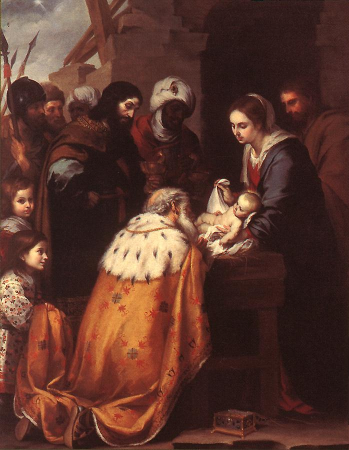
The Epiphany


Adoration of the Magi by Bartolomé Esteban Murillo (Wikipedia)


We three kings of Orient are
Bearing gifts we traverse afar
Field and fountains, moor and mountains
Following yonder star

O Star of wonder, star of night
Star with royal beauty bright
Westward leading, still proceeding
Guide us to thy Perfect Light
(Reverend John Henry Hopkins, Jr., 1857)

When Jesus was born in Bethlehem of Judea, in the days of King Herod, behold, magi from the east arrived in Jerusalem, saying, "Where is the newborn king of the Jews? We saw his star at its rising and have come to do him homage." When King Herod heard this, he was greatly troubled, and all Jerusalem with him. Assembling all the chief priests and the scribes of the people, he inquired of them where the Messiah was to be born. They said to him, "In Bethlehem of Judea, for thus it has been written through the prophet: 'And you, Bethlehem, land of Judah, are by no means least among the rulers of Judah; since from you shall come a ruler, who is to shepherd my people Israel.'" Then Herod called the magi secretly and ascertained from them the time of the star's appearance. He sent them to Bethlehem and said, "Go and search diligently for the child. When you have found him, bring me word, that I too may go and do him homage."

After their audience with the king they set out. And behold, the star that they had seen at its rising preceded them, until it came and stopped over the place where the child was. They were overjoyed at seeing the star, and on entering the house they saw the child with Mary his mother. They prostrated themselves and did him homage. Then they opened their treasures and offered him gifts of gold, frankincense, and myrrh. And having been warned in a dream not to return to Herod, they departed for their country by another way. (Matthew 2:1-12, NAB)

Friday, January 05, 2007

The birthday


St. Telesphorus

The old calendar
Vigil of the Epiphany, St. Telesphorus

From Catholic Encyclopedia:

St. Telesphorus was the seventh Roman bishop in succession from the Apostles, and, according to the testimony of St. Irenæus [...], suffered a glorious martyrdom. Eusebius [...] places the beginning of his pontificate in the twelfth of Hadrian's reign (128-129), his death in the first year of the reign of Antoninus Pius (138-139). These statements, however, should be compared with Lightfoot, [...] Harnack, [...] 70 sq. In the fragment of the letter of Irenæus of Lyons to Pope Victor concerning the celebration of Easter [...] Telesphorus is mentioned as one of the Roman bishops who always celebrated Easter on Sunday, without, however, abandoning church fellowship with those communities that did not follow this custom. None of the statements in the "Liber pontificalis" and other authorities of a later date as to liturgical and other decisions of this pope are genuine. In the Roman Martyrology his feast is given under 5 January; the Greek Church celebrates it on 22 February.

The new calendar
General: Feria
USA: St. John Neumann

From the Catholic Encyclopedia article on the see of Philadelphia:


St. John Neumann

The fourth Bishop of Philadelphia, John Nepomucene Neumann, was consecrated 28 March, 1852. (See NEUMANN, JOHN NEPOMUCENE, VENERABLE.) Ten churches sprang up during the first year of his episcopate. The constant topic of his exhortations was the necessity of parish schools. Failing to bring the contumacious trustees of Holy Trinity to their senses, he undermined their influence by putting up the church of St. Alphonsus. On 19 Oct., 1854, he left for Rome to assist at the proclamation of the dogma of the Immaculate Conception, and he returned in March, 1855. On 26 April, 1857, the Rt. Rev. James Frederick Wood was consecrated in the cathedral of Cincinnati as coadjutor to the Bishop of Philadelphia. Bishop Wood was acknowledged by the financial world as thoroughly acquainted with every phase of the banking business, which had been the occupation of his earlier years. At a meeting of the clergy, Bishop Neumann announced that the work of completing the cathedral had been committed to his coadjutor. In October, 1857, he held his last synod: there were 114 priests present, and 32 had been excused from attendance.

The press goes Wilde!

The Vatican goes Wilde - Belfast Telegraph

What is going on? After all, this is the Church that brands as an "intrinsic moral evil" the homosexual acts for which Wilde's catamite, Lord Alfred Douglas, coined the phrase "the love that dare not speak its name". Wilde was, after all, a byword for the decadence upon which the Victorian values of the age showered ignominy.

Yet it is only the latest such rapprochement. Six years ago, on the centenary of Wilde's death, the Vatican-backed Jesuit quarterly La Civilta Cattolica praised the homosexualist author of such cynical aphorisms such as "there is no sin except stupidity", and "a thing is not necessarily true because a man dies for it".

Wilde's writings, said Fr Antonio Spadaro, in the years that followed his two-year sentence of hard labour in Reading jail for "acts of gross indecency with other male persons", demonstrated spiritual values and an "understanding of God's love" that revealed he had seen into the depths of his own soul after a lifetime of "degradation, vanity and frivolity".

Vatican comes out of the closet and embraces Oscar - Times Online

Vatican embraces gay icon - pinknews.co.uk

Oscar Wilde, long claimed by the gay community as the ultimate bitchy queen, has been embraced by one of Pope Benedict’s closest advisers.
[...]

The book is designed to "stimulate a reawakening in certain Catholic circles," Fr Sapienza told Italian paper La Repubblica.

"Our role [as Christians] is to be a thorn in the flesh, to move people’s consciences and to tackle what today is the number one enemy of religion — indifference."

While no-one would argue that the present Pontiff has indeed been a thorn in the flesh of liberal-minded Christians across the world, the inclusion of Wilde in a Catholic-endorsed book has puzzled many Vatican watchers. [Why? Just because he was gay? Tsk.]

Included in the inspirational book are some of Wilde’s best known sayings.

Although his remarks were designed to appear spontaneous, Wilde in fact spend many hours honing his bon mots, in much the same way that today’s homosexuals spend time at the gym perfecting a 'natural' physique.

While Wilde has been claimed as a gay icon, the famous playwright would never have recognised himself as such, being married with children.

He did, however, coin the phrase, "the love that dare not speak its name" in his meditation on desire and punishment, The Ballad of Reading Gaol.

Father Sapienza claims that Wilde will be remembered not for his fall from grace, convicted and imprisoned for gross indecency in 1895 and sentenced to two years hard labour, but rather for his powerful body of work.

Wilde himself flirted with Catholicism during his lifetime, but once said, "To go over to Rome would be to sacrifice and give up my two great Gods: money and ambition."

In the end Wilde opted for that most convenient way to hedge one’s bets - a deathbed conversion.

As I said yesterday, there is no reason why this book should be a shock. Unless the good Father's book is full of indecent and lewd comments (which I'm assuming it's not), then I don't get it. Clever, thoughtful sayings are to be engaged and thought about, not ignored. By engaging them on their own level and considering them and what they mean, Christians can better engage the world at large that has embraced such words that lend so much credence to our instant gratification society.