Thursday, December 14, 2006

The Russians unite

Interfax has an article on the impending final unification between the Russian Orthodox Church and the Russian Church outside Russia that was formed during the Russian Civil War back in the early 20th century.

New York, December 11, Interfax – The Bishops’ Synod of the Russian Church Outside of Russia has approved the proposals for ‘the time, place and rite of the ceremony of signing the Act of Canonical Communion’ in May 2007.

These proposals have been worked out by the commissions of the ROCOR and Moscow Patriarchate at their recent, the 8th, joint meeting on October 24-26 in Cologne.

The exact date of signing the Act by the primates of the two parts of the Russian Church will be publicized ‘in the nearest future’, the ROCOR official website has reported. After the signing, the unity between the Church Abroad and the Church in Russia will be fully restored.

[Let us skip past internal matters that don't necessarily interest me.]

According to the Act, the Moscow Patriarchate, among other things, recognizes the Church Outside Russia as ‘an indissoluble part of the Local Russian Orthodox Church’, which is ‘independent in pastoral, educational, administrative, management, property, and civil matters’, existing at the same time ‘in canonical unity with the Fullness of the Russian Orthodox Church’.

The ROCOR will continue to be administered by its own Bishops’ Council as its ‘supreme ecclesiastical, legislative, administrative, judicial and controlling authority’ and the body electing its first hierarch on the basis of its own regulations. This election is then ‘confirmed, in accordance with the norms of Canon Law, by the Patriarch of Moscow and All Russia and the Holy Synod of the Russian Orthodox Church’.

Agreement with the Moscow patriarch and synod will be sought in making major decision on such matters as education or liquidation of the ROCOR dioceses, while the election of new bishops by the ROCOR Council will be ‘confirmed in accordance with canonical norms’ by the Patriarch and the Holy Synod of the Russian Orthodox Church, since all the newly elected bishops become full-fledged members of the Local and Bishops’ Councils of the Russian Orthodox Church and have the right to participate in the work of the Moscow Synod in the prescribed order.

The supreme instances of ecclesiastical authority for the ROCOR are the Local Council and the Council of Bishops of the Russian Orthodox Church whose decisions, as well as those of the Holy Synod, extend to the ROCOR with consideration of the particularities described by the Act, by the ROCOR Regulations and by the legislation of the nations in which she performs her ministry.
[...]

The Church Outside Russia was formed during the Civil War by emigre Russian Orthodox clergy on the instruction of Patriarch Tikhon, the then primate of the Russian Church. At present the Church Outside Russia unites about half a million faithful living outside Russia in over 30 countries.

On the one hand, the Russians uniting with their diaspora brethren is nice to see. On the other hand, it's interesting to watch as the Russian Church works to protect and extend its influence beyond the borders of Russia with moves such as this and the continued struggles in Ukraine for dominance.

Wednesday, December 13, 2006

Israeli law is weird

From Asia News (bolding is all mine):
Holy See-Israel accords are elements of international law

Jerusalem (AsiaNews) – The Catholic perspective is understanding more and more that Israel’s difficulties to realize and to fulfil – through enactment of laws –the 1993 Fundamental Agreement hinge on the Israeli government’s conception of this agreement and its ensuing unwillingness to recognize it as an international treaty.

A source of the Israeli Catholic Church and expert in international law, told AsiaNews: “Any student of international law, even first-year students, will immediately see that the Fundamental Agreement is an international treaty and thus a juridical and totally binding agreement. After all, it was negotiated, signed and ratified in this form before the whole world. Whether it should be transferred to Israeli law in all its details is up to the State, but the Israeli government cannot describe the treaty as ‘non-binding’ before courts and the Supreme Court just because it has not been translated into law.”

As for defending the Status Quo for the Catholic Church, several ecclesial personalities in Israel have clarified that the Church is not asking for privileges but simply for the recognition of rights granted by the UN itself when the state of Israel was born (1948) with Resolution 181 and which Israel has promised other nations and churches several times over that it would observe. “The State of Israel should adapt its laws to the stipulations of international law. Besides, over the years, Catholic representatives have often consulted the most prominent Israeli law experts and all of them confirmed that there is no reason to think that an Accord as desired by the Church risks being de-legitimized by Israel’s domestic judicial powers.”
[...]

Pretty straightforward assessments and statements there. The Israeli ambassador to the Holy See in an interview had a different view of things, making lots of references to the 'nature of Israeli law' without really spelling out what that nature is that makes it so difficult to bring the treaty into Israel law.

Holy See-Israel: painstaking resumption of negotiations

[Said the Israeli ambassador to the Holy See:]
Yes, certainly, they were thus before the birth of the state of Israel and before the establishment of diplomatic ties. Now we are trying to find a way to formalize matters, a way that recognizes these ancient rights while coexisting with Israeli law without problems. However, what the Church is asking for today is contrary to Israeli law. Ultimately, it is in the interests of the Vatican itself not to do something that tomorrow could be rejected or cancelled by parliament. It would be an invitation to failure.
[...]

A) In this Accord, signed in 1993, there is the basis, the framework, the parameters for future accords between Israel and the Holy See. There are clauses that tackle the necessity of tending to religious freedom, the fight against anti-Semitism and anti-Christianity, all matters regarding freedom, as well as an appeal to collaborate in the academic and cultural world. This is a non-binding part because it is worded in generic language and is a sort of infrastructure on which to base relations.

B) Another part stipulated that within one or two years, a financial and economic agreement would be reached to establish rights and duties of Catholic communities in Israel. This should have become law and we are working for this to come about.

From our viewpoint, the transfer of the Fundamental Agreement into law was not foreseen. It was just an agreement that should not have been enshrined into law. On the other hand, more practical things, like the judicial system, taxes and so on, these should have become law.
[...]

There is truly understanding and awareness of feasibility. It is not as it was in the past; we are not faced with a wall or an abyss to fill. On the other hand, we cannot accept what the Vatican wants due to the structure of Israeli law. This is another reason why several months have passed to find a path, an opening. We want to arrive at something lasting.

The ambassador makes a decent point about generic clauses in the original framework that are more guideline than actual specific directives for the relationship. If he had just stuck with that and elaborated, I think that is an understandable point. The framework provides guidelines and successive, more specific agreements on certain policy areas would get down to details. But the comments in the first excerpts and then by the ambassador about Israeli law and its structure... Does this mean that in its history, Israel has never signed a treaty with anyone that has had the force of law? The ambassador makes no effort to explain how treaties and Israeli law relate beyond his murky comments.

Cordial ‘atmosphere’ at the Bilateral Holy See-Israel Commission

Jerusalem (AsiaNews) – The Bilateral Permanent working Commission between the Holy See and the State of Israel met this morning at the seat of the Foreign Ministry of Israel. At the end of the meeting, the delegations approved a joint communiqué, in which they spoke, in an “atmosphere of great cordiality”, of “progress” in the talks, expressed a “share commitment to speed up the negotiations”, and noted that the next meeting will take place on the 29th of January.

Negotiations aim at finalising the economic component of the 1993 Fundamental Agreement to protect the Church’s tax status in Israel and protect Catholic holy sites and properties.

The Pope met with Prime Minister Olmert and they talked for a bit before Olmert went off to see Cardinal Bertone and the Relations with States crowd.

The Fundamental Agreement itself.

Tuesday, December 12, 2006

The pieces are coming together

In the past I've described this blog as the 'nose-bleed seats' of Vatican watching. I don't speak the languages (Latin and Italian) of the primary sources, so I am stuck with merely reacting. Just a moment ago, I thought of a better analogy: the guy standing at the back of a crowd asking the people in front of him what's going on. Anyway, on to business.

Rorate Caeli has lots of good stuff on the motu proprio and the long awaited exhortation.

Cardinal Medina Estevez said, "The publication of the Motu Proprio from the Pope which will liberalize the celebration of the Latin Mass according to the Missal of Saint Pius V is close."

On the exhortation (as translated at Rorate Caeli):

The recourse to the ordination of married priests of proven virtue ("viri probati") to face the lack of vocations is excluded; the admission of remarried divorced persons to Communion is forbidden, but it is recommended that the Christian community welcome and value their presence; the study of the liturgy in Latin and of Gregorian Chant in seminaries is recommended.

Monday, December 11, 2006

The fate of a title

As told by Father Z.

December 12th: Four Major Basilicas of Rome no longer called “Patriarchal”

March 22nd: Patriarchal News

March 1st: Is the Pope no longer Patriarch of the West?

Motu Proprio Watch

Rorate Caeli: Ecclesia Dei meeting tomorrow to discuss liberalization:

From La Repubblica:

Benedict XVI shortens the timing for a reconciliation with the followers of Archbishop Marcel Lefebvre.

The "Ecclesia Dei" Commission, established for this purpose by John Paul II, will meet tomorrow in a first plenary session to discuss the question of the liberalization of the Mass in Latin.

The meeting of December 12 is reported by the French news agency I.Media and will include the presence of Cardinal Ricard, a member of the Commission and president of the French Episcopal Conference.

We shall see what we shall see.

I just thought maybe...

Married Men Installed As Priests in N.J.

I read this headline and I thought just maybe Forbes was doing an article on Father Kimel (congratulations to him on his ordination), but I knew it would be about Archbishop Milingo and his company. It's the standard AP wire story. Pretty basic.

In front of a congregation that included nearly two dozen members of the media at the Trinity Reformed Church, Raymond A. Grosswirth of Rochester, N.Y., and Dominic Riccio, of Newark, were installed by Zambian Archbishop Emmanuel Milingo.

Then I saw this at Catholic News Agency this morning. I thought it was rather funny.

Parsippany, NJ, Dec. 08, 2006 (CNA) - Two groups made up of former Catholic priests, who are pushing for a married priesthood in the Roman Catholic Church, have issued warnings to married former priests about a third, similar organization, Married Priests Now, which is headed by the excommunicated Archbishop Emmanuel Milingo.

The recently formed Married Priests Now is holding a convention, from Dec. 7 to 10, at the local Sheraton Hotel. As of Wednesday only 200 people were registered to attend, far less than the 1000 organizers had expected.
[...]

CORPUS and CITI [two married priests associations] cited Milingo’s excommunication after his illicit attempt to ordain three married men as bishops. CORPUS also expressed concern about the new group’s connection with the Unification Church's Rev. Sung Myung Moon, who has called himself the Messiah.

At the big meeting, Archbishop Milingo publicly praised the Reverend Moon for his support, thus proving wrong the archbishop's early assertions that his group is completely independent.

While Archbishop Milingo moving around out there and ordaining people is certainly not good, the only people he's going to get are the extremists. Groups that hold out hope of effecting change in the Church are not going to embrace Milingo's Moonie Marriage Movement.

Sunday, December 10, 2006

What to do with the silence

In reply to Michael Dubruiel's post soliciting questions on one's spiritual life for Father Benedict Groeschel where the good Father will answer selected questions, I submitted my own question. In a follow-up email, I elaborated further.

Allow me to explain a bit more. As someone who has lost his hearing only in the last few years as a young adult, I don't know what to do with that silence. The Holy Father talks of silence as an integral part of the Mass, but with the Great Silence (to borrow from the monastics) that is everlasting, it is easy to wander as fragments of music and bits and pieces of the Eucharistic Prayers flit through. I am trying to find structure, something that holds it all together beyond just reading the readings and the rites and the Prayers.

I throw this out to all of you. I am looking for some kind of interior counterpart, a complement to the Mass. Something that ties in with the whole thing, but is not dependent on trying to read along and figure out where the priest is at. Is there some kind of structured 'interior' Mass that isn't just a personal spiritual program of prayer made up by individuals to suit their personal tastes?

Friday, December 08, 2006

The Immaculate Conception


The Vatican is closed for the day, so I will be too. Mass is at 12:10 and 7:00 here. Be sure to visit your own parish.

Thursday, December 07, 2006

Thoughts this eve of the Immaculate Conception

The Motu Proprio
According to Father Z and his travel schedule, the motu proprio (still trying to figure how how that is capitalized, both the M and the P or just the M or neither?) may very well be made public tomorrow. Father Z is guessing based on the fact that he'll be out of town and out of the loop. o{]:¬( But really, his post has quite a bit of informed speculation on both timing and content.

The Blue Mosque episode
I've been reading quite a bit of backlash lately in both directions.

1. The Pope prayed in a mosque! He caved in!
2. The Pope prayed in a mosque! So what?

I've seen good arguments on both sides. Here's a hypothetical question: If Hagia Sophia was still a mosque today and not a museum, would Benedict XVI be criticized for praying there?

Cardinal Hummes
I missed this last week. There's not really a lot that can be said. The issue was discussed, a statement was released. Case closed, right? Maybe Cardinal Hummes wanted to express himself and kind of feel the bounds of his authority as the incoming prefect. Unfortunately, he shot his credibility to hell with everyone who might have given him the benefit of the doubt due to Benedict's judgment.

The silver lining.
As one blogger pointed out, he'll be retired in less than three years and Sao Paolo is now freed up for a Benedict-elected bishop with new ideas on how to stem the outflow of Catholics to the protestant churches down there.

The image I was looking for

Thanks to Katherine for leaving a comment.

Wednesday, December 06, 2006

Henry isn't hired after all

A follow up on this:

Vatican: Population Control Architect Kissinger Not Advising Pope

VATICAN CITY, December 5, 2006 (LifeSiteNews.com) – The Vatican has dispelled any rumor that former U.S. Secretary of State, Henry Kissinger is acting as a foreign advisor to Pope Benedict XVI reports the Catholic News Agency. The veracity of the report was held in question, since Kissinger was the architect of US foreign policy supporting population control.

Vatican Spokesman Father Lombardi clarified yesterday that the report from the Italian Newspaper La Stampa saying Benedict XVI had enlisted Kissinger as an advisor is “without any foundation.” Father Lombardi told CNS that Pope Benedict XVI has neither a foreign affairs advisory board, and he has not asked former U.S. Secretary of State Henry Kissinger to become one of his advisers.

The truth is that Kissinger met privately with the pope on Sept. 28 and that Mary Ann Glendon, a U.S. law professor and president of the Pontifical Academy of Social Sciences, has extended an invitation to Kissinger to speak to the academy in late April.
[...]

The veracity of the report was first held in question, however, because in 1974 Kissinger as Secretary of State issued National Security Study Memorandum 200 entitled "Implications of Worldwide Population Growth for U.S. Security and Overseas Interests." The extensive document warned that increasing populations in developing countries endangered U.S. strategic, economic, and military interests.

One thing to remember though is that such a report was written back in the days when guys like Paul Ehrlich were (and still are) running around screaming about a population double or triple or quadruple what we have now along with scare food supplies, no drinkable water and on and on. Mr. Realpolitik probably was quite concerned by such predictions and such events' effects on the US.

I don't even want to read the rest of this

John Allen, whose reporting I've been unimpressed with lately, has the lead story for National Catholic Reporter. After starting off with the usual 'this Pope makes us wait' fluff, Allen sinks his teeth into what he sees as the big moment of Benedict's trip to Turkey (bolding mine):

In Turkey, however, the biggest splash came on Day 1, roughly a half-hour after the pope landed at the Ankara airport. In a closed-door meeting with Turkish Prime Minister Recep Tayyip Erdogan, who had been among the most outspoken critics of Benedict XVI after the Regensburg speech, the pope indicated that he now smiles upon Turkey’s candidacy to join the European Union.

In reality, Erdogan probably engaged in a bit of spin with regard to the pope’s comments. It was Erdogan who told the press that the pope had endorsed Turkey’s EU bid, while the Vatican later clarified that the pope had not taken a political position for or against admission, but instead merely affirmed the country’s efforts at “dialogue and drawing close” to Europe.

Nevertheless, the bottom line is that Benedict XVI effectively disavowed his earlier position, expressed while still a cardinal, that Turkey is “in permanent contrast to Europe,” and that admitting it to the EU would further muddy the Christian roots of the continent.

Anyone familiar with even a smidgen of papal history knows that popes don’t often reverse field in quite so clear a fashion, [this is where I stopped reading] and the fact that Benedict did so right out of the gate crystallized the basic spirit of this Nov. 28-Dec. 1 trip, Benedict’s fifth as pope and his first to a majority Muslim state: No effort was spared to convince the Muslim world that “the pope of Regensburg,” depicted variously by Muslim critics as a neo-crusader and as the chaplain to the U.S.-led war in Iraq, is actually a friend.

I don't know if John Allen goes on to make some kind of point in his article and at this moment, I just don't really care.

I read an article someplace either yesterday or the day before about the Pope's language when he referenced the Armenian Genocide while visiting the Armenian Patriarch of Constantinople. Benedict didn't directly name the Genocide, but instead went with something like 'tragedy' (I forget now what words he used exactly). Some might call that being wishy-washy and wanting to be the friend of the Turks, but as the article pointed it, it was due to the fact that the Armenian Patriarchate contacted Rome before the visit to ask that Benedict not mention it. Since all those Armenians would have to deal with the Turkish backlash after the Pope went home if he had mentioned it directly.

Commentators out there can go on and on regarding Benedict XVI's actions during the trip and how he betrayed this or that position or he totally reversed himself, et cetera, et cetera. But moderation in what one says while being a stranger in a strange land =/= outright reversal of positions. Let's give Benedict some credit for showing some charity and humility while visiting a foreign land.

Tuesday, December 05, 2006

Readers: I need your help

Dear readers,

I have been busy lately, please excuse my absence. I will return shortly. But in the meantime, I need some help. This last week during the Pope's visit to Constantinople, I saw a picture of Hagia Sofia at a few different places online that I cannot remember now. The picture was a close up of the front of the church and the dome. The minarets were not visible on either side. The redness of the building was apparent. If you have any idea where I might have seen this picture, please let me know. I'd appreciate it.

Friday, December 01, 2006

In conclusion

The Holy Father has flown home after presiding over Mass at the Cathedral of the Holy Spirit in Istanbul. Tomorrow evening is Vespers and the start of Advent, so Benedict won't get much of a break right away.

Vatican watchers, church commentators and everyone else though will have time to sit down and ponder what it all means as far as the trip to Turkey and its effect on Christian-Muslim and Catholic-Orthodox relations.

1. Christians and Muslims
When discussing the brief 'recollection' in the Blue Mosque and the cordial relations between the Pope and the Mufti, it's easy to forget that the Mufti was one of the sigers of the open leader to Benedict addressing the (in)famous lecture. The Mufti is one of the men who took the time to assess what the Pope was driving at and engage him on his own tersm. When looking at their meeting in the Blue Mosque, that kind of respect is something to keep in mind.

It's what they who don't especially like Benedict are going to do next that is important. Will Turkey get the message and allow more freedom of religion? Only time will tell. As Benedict in his writings has noted over and over again, dialogue is only worthwhile if there are concrete results. Otherwise it's just a lot of empty gestures.

2. Catholics and Orthodox
There are a lot more opportunities here for actual progress, but the stakes are also higher. If Christians and Muslims misstep, well... Sad, but not unexpected. On the other hand, the efforts of the Catholic and Orthodox Churches mean so much to the internal unity of the Body of Christ on Earth. Missteps here last for centuries and remain engraved in the collective memory of both churches.

Reading the outline at Patriarchate.org, it's clear that the meetings and discussions have reached the critical point: the primacy of the Pope. Bolding is mine.

1990 -- Work began by the Joint Coordinating Committee on the next common document in Moscow, Russia, “Ecclesiological and Canonical Consequences of the Sacramental Nature of the Church”, but at the request of the Orthodox Church the discussions were stopped in order to address the question of “Uniatism”.

1993 – The Joint Commission issued the common document on “Uniatism: Method of Union of the Past, and Present. Search for Full Communion” (Balamand, Lebanon)

2000 – The Joint Commission met in Baltimore, U.S.A., and discussed a text on “ The Ecclesiological and Canonical Implications of Uniatism”.

2005 - The Orthodox Church and the Roman Catholic Church agree to resume the theological dialogue.

2006 – The Joint Commission met in Belgrade, Serbia and discussed a text entitled: ”The Ecclesiological and Canonical Consequences of the Sacramental Nature of the Church: Conciliarity and Authority in the Church”, at three levels of the Church’s life: local, regional and universal.

Only time will tell what the next entry to such an outline will look like. Let us pray it is a positive one.

Uhhh, right

John Allen posted this:

To date, the line on Benedict XVI has been that this is a pope of words, often set in contrast with John Paul II’s mastery of gestures and symbols. Joseph Ratzinger is possessed of an extraordinarily refined intellect, and his natural medium is indeed the written word. This is a pope, after all, who had penned some 60 books by the time of his election, to say nothing of countless essays, lectures, journal articles and scholarly monographs.

Does anyone else remember the talk of imagery when Benedict XVI met the representatives of the Muslim community during World Youth Day last year? I wrote:

At WYD 05 in Cologne, the Holy Father met the Muslim representatives in the unique setting of him sitting with a large cross behind him on the wall. The fact that he is now putting in place the personnel to ensure that his gestures become more than just gestures is heartening to see in a world where cartoons can spark so much destruction.

If you're not familiar with it, when Benedict XVI met with the Muslim representatives in Cologne during World Youth Day in 2005, he did so sitting in front of the group. Behind him on the wall was a really big cross. At the time, commentators noted the imagery of the Supreme Pontiff sitting under the Cross of Jesus and telling the locals 'this is how it is'.

John Allen does great on-the-scene reporting, but even he sometimes likes to perpetuate certain stereotypes just to have something to write about when 'the Wordsmith Pope' figures out how to use images.

Thursday, November 30, 2006

Where is the Monolith?

The Dawn of Man
(according to Clarke and Kubrick)


Interfax has a commentary on the Pope's trip and its relationship to the rest of the Orthodox world. Though dated today (the 30th), it seems to have been written before the Pope left for Turkey.

The final paragraph (my bolding):

Meanwhile, the ecumenical vector of Benedict XVI’s policy seems to have grown ever more consistent after the first statement he made immediately after his election to the See of Rome, pledging to commit himself to the visible unity of Christian Churches. The Eastern Christian component of ecumenism appears to be a priority for the pope, who admitted a month ago a desire to bring nearer the moment of communion with the Orthodox Greeks. However, the historically establish multi-polar nature of the Orthodox world will demand that the Holy See elaborate as multi-component and multifaceted policy of relations with National Orthodox Churches. The meeting of the Orthodox-Catholic Theological Commission in September in Belgrade has reaffirmed that it is inadmissible to use uniform methods in the dialogue between the Roman Catholic West and the polycentric Orthodox East and that it is necessary to use individual reciprocal ways in every particular case. The Istanbul meeting between Benedict XVI and one of the Orthodox patriarchs, even if more ready than others to make a compromise on the issue of the papal primacy, will still remain a meeting between the leader of the Catholic world and the head of the Patriarchate of Constantinople. And the opinion of the religious leader of a comparatively small Greek flock to be expressed in a future joint declaration made together with the Pope of Rome will never become, however strong the wish, a testimony to an ‘ecumenical breakthrough’ in the awareness of the millions-strong Orthodox world.

Elena ZHOSUL,
Interfax-Religion observer

The Divine Liturgy

I will spare you all from massive excerpts. Amy Welborn has them all and links to the associated texts that came out of the Divine Liturgy celebrated today.

Wednesday, November 29, 2006

Discourses at the Church of St. George

Pope's Discourse at the Patriarchial Church of Saint George
Istanbul, November 29, 2006


“Behold, how good and pleasant it is when brothers dwell in unity” (Ps 133:1)
[...]

I conclude by expressing once more my joy to be with you. May this meeting strengthen our mutual affection and renew our common commitment to persevere on the journey leading to reconciliation and the peace of the Churches.
I greet you in the love of Christ. May the Lord be always with you.

Welcome by His All Holiness Ecumenical Patriarch Bartholomew

We are deeply grateful to God that Your Holiness has taken similar steps today in the same spirit. We offer thanks to God in doxology and express thanks also to Your Holiness in fraternal love.

Beloved Brother, welcome. "Blessed is he that comes in the name of the Lord."

"Blessed is the Name of the Lord now and forevermore."

Homily at Ephesus

Mass before the Shrine of Meryem Ana Evi
Homily of the Holy Father, Ephesus, Wed. 29 Nov. 2006


Here are some passages that stood out with salient points bolded by me.

A privileged witness to that event was the author of the Fourth Gospel, John, the only one of the Apostles to remain at Golgotha with the Mother of Jesus and the other women. Mary’s motherhood, which began with her fiat in Nazareth, is fulfilled at the foot of the Cross. Although it is true – as Saint Anselm says – that “from the moment of her fiat Mary began to carry all of us in her womb”, the maternal vocation and mission of the Virgin towards those who believe in Christ actually began when Jesus said to her: “Woman, behold your son!” (Jn 19:26). Looking down from the Cross at his Mother and the beloved disciple by her side, the dying Christ recognized the firstfruits of the family which he had come to form in the world, the beginning of the Church and the new humanity. For this reason, he addressed Mary as “Woman”, not as “Mother”, the term which he was to use in entrusting her to his disciple: “Behold your Mother!” (Jn 19:27). The Son of God thus fulfilled his mission: born of the Virgin in order to share our human condition in everything but sin, at his return to the Father he left behind in the world the sacrament of the unity of the human race (cf. Lumen Gentium, 1): the family “brought into unity from the unity of the Father and the Son and the Holy Spirit” (Saint Cyprian, De Orat. Dom., 23: PL 4, 536), at whose heart is this new bond between the Mother and the disciple. Mary’s divine motherhood and her ecclesial motherhood are thus inseparably united.
[...]

[...] The text also contains the expression that I have chosen as the motto for my Apostolic Journey: “He, Christ, is our peace” (Eph 2:14). Inspired by the Holy Spirit, Paul tells us that Jesus Christ has not only brought us peace, but that he is our peace. And he justifies this statement by referring to the mystery of the Cross: by shedding “his blood”, by offering in sacrifice “his flesh”, Jesus destroyed hostility “in himself” and created “in himself one new man in place of the two” (Eph 2:14-16). The Apostle explains how, in a truly unforeseen way, messianic peace has now come about in Christ’s own person and his saving mystery. He explains it by writing, during his imprisonment, to the Christian community which lived here, in Ephesus: “to the saints who are in Ephesus and are faithful in Christ Jesus” (Eph 1:1), as he says in the salutation of the Letter. The Apostle wishes them “grace and peace from God our Father and the Lord Jesus Christ” (Eph 1:2). Grace is the power that transforms man and the world; peace is the mature fruit of this transformation. Christ is grace; Christ is peace. Paul knows that he has been sent to proclaim a “mystery”, a divine plan that only in the fullness of time has been carried out and revealed in Christ: namely, that “the Gentiles have become fellow heirs, members of the same body, and sharers in the promise in Christ Jesus through the Gospel” (Eph 3:6). This mystery is accomplished, in salvation history, in the Church, the new People in which, now that the old dividing wall has been broken down, Jews and pagans find themselves united. [...]

[...] Strengthened by God’s word, from here in Ephesus, a city blessed by the presence of Mary Most Holy – who we know is loved and venerated also by Muslims – let us lift up to the Lord a special prayer for peace between peoples. From this edge of the Anatolian peninsula, a natural bridge between continents, let us implore peace and reconciliation, above all for those dwelling in the Land called “Holy” and considered as such by Christians, Jews and Muslims alike: it is the land of Abraham, Isaac and Jacob, destined to be the home of a people that would become a blessing for all the nations (cf. Gen 12:1-3). [...]

With firm trust let us sing, together with Mary, a magnificat of praise and thanksgiving to God who has looked with favour upon the lowliness of his servant (cf. Lk 1:48). Let us sing joyfully, even when we are tested by difficulties and dangers, as we have learned from the fine witness given by the Roman priest Don Andrea Santoro, whom I am pleased to recall in this celebration. Mary teaches us that the source of our joy and our one sure support is Christ, and she repeats his words: “Do not be afraid” (Mk 6:50), “I am with you” (Mt 28:20). Mary, Mother of the Church, accompany us always on our way! Holy Mary, Mother of God, pray for us! Aziz Meryem Mesih’in Annesi bizim için Dua et. Amen.

Turkish EU bid

There has been quite a bit floating around out there after it was announced by the Turkish prime minister that the Vatican would support Turkey's bid to enter the European Union. As Amy has pointed out here and as I mentioned the other day, the actual statement by the Pope is not quite as black and white.

The Holy See wants to to see reciprocity. European countries accept the right of Muslims to practice their religion, so Muslim countries should return the favor. The clarification of the Turkish PM's comments shows clearly that this is the message: accept the EU's conditions regarding religious freedom, the rule of law, etc. and the Vatican will not oppose Turkish aspirations.

But many are saying, "Turkey doesn't belong!"

Leaving aside present-day considerations, the historical Ottoman Empire was not exactly a purely Middle-Eastern entity. Bosnia, just across the Adriatic from Italy, has quite a few Muslims precisely because the Ottomans ruled there for quite awhile before 19th century nationalism began to weaken their rule on Southeast Europe. As the principal successor state to the Ottoman Empire, Turkey's heritage is a European one, whether Europe likes it or not.

However! Just because a modern nation-state can claim to be a part of the European historical tapestry, it should not be entitled to automatic inclusion into what is not a cultural organization. The European Union is (aside from behing a huge bureaucratic mess) a political and economic supra-national organization with various delegated powers. Its purpose is not cultural exchange or preserving European culture. If Turkey is going to be admitted into the European Union, it should be admitted according to present-day criteria (rule of law, personal liberty, etc.).

Vatican Watcher's formal position is that the European Union should be disbanded in favor of several multi-lateral treaties on trade, immigration, joint defense, the environment and law enforcement. Yes, this position makes Turkey's admission a moot point.

Live blogging: Church of St. George

Benedict XVI and his host Bartholomew I are at the Church of St. George there in Constantinople. I have no clue what they're saying, but I'm watching.

The church there is pretty impressive. If the Patriarchate ever runs short of cash, they have plenty of gold to sell on the world market. My experience of Catholic churches is rather limited, but having seen different churches on TV, the West seems to have chosen marble over gold?

It looks like they'll be proceeding out and off to their private meeting in a moment. The camera shot pulled back showing the line of Orthodox clergy on one side and the Romans on the other is cool.

There they go. It's cool that Benedict has revived certain portions of the papal wardrobe. If he were simply wearing the usual white garb, he'd look rather bland and out-of-place I think.

An important reminder

Rorate-Caeli has a post on the various Turkish efforts at removing non-Turks from their homeland.

They really want him to come

From Zenit:

ROME, NOV. 28, 2006 (Zenit.org).- A delegation of the Israeli government visited the Holy See to renew its invitation to Benedict XVI to visit Israel and to establish an agenda of negotiations.

In this connection, Aaron Abramovich, director general of foreign affairs, and Oded Ben-Hur, Israel's ambassador to the Holy See, were received by Cardinal Tarcisio Bertone, Vatican secretary of state, and Archbishop Dominique Mamberti, Vatican secretary for relations with states.

At a press conference, organized by the Israeli Embassy to the Holy See on Monday in Rome, Abramovich explained that the meeting took place in a very cordial atmosphere.

The Israeli representative added that during the meeting, an agenda entailing two meetings was established to overcome the present divergences in the implementation of the Fundamental Treaty between the Holy See and the state of Israel.

The first meeting will take place in December, and will be attended by experts from the Vatican and Israel. The second will be held in January, at the level of interlocutors with the rank of ministers.

Tuesday's addresses in Turkey

Magister has a summary of Benedict XVI's addresses.

Meeting with the President of the Religious Affairs Directorate
Address by the Holy Father, Ankara, Tues. 28 Nov. 2006


Above all, we can offer a credible response to the question which emerges clearly from today’s society, even if it is often brushed aside, the question about the meaning and purpose of life, for each individual and for humanity as a whole. We are called to work together, so as to help society to open itself to the transcendent, giving Almighty God his rightful place. The best way forward is via authentic dialogue between Christians and Muslims, based on truth and inspired by a sincere wish to know one another better, respecting differences and recognizing what we have in common. This will lead to an authentic respect for the responsible choices that each person makes, especially those pertaining to fundamental values and to personal religious convictions.

As an illustration of the fraternal respect with which Christians and Muslims can work together, I would like to quote some words addressed by Pope Gregory VII in 1076 to a Muslim prince in North Africa who had acted with great benevolence towards the Christians under his jurisdiction. Pope Gregory spoke of the particular charity that Christians and Muslims owe to one another “because we believe in one God, albeit in a different manner, and because we praise him and worship him every day as the Creator and Ruler of the world.”

Freedom of religion, institutionally guaranteed and effectively respected in practice, both for individuals and communities, constitutes for all believers the necessary condition for their loyal contribution to the building up of society, in an attitude of authentic service, especially towards the most vulnerable and the very poor.

Meeting with the Diplomatic Corps to the Republic of Turkey
Address of the Holy Father, Ankara, Tues. 28 Nov. 2006


Turkey has always served as a bridge between East and West, between Asia and Europe, and as a crossroads of cultures and religions. During the last century, she acquired the means to become a great modern State, notably by the choice of a secular regime, with a clear distinction between civil society and religion, each of which was to be autonomous in its proper domain while respecting the sphere of the other. The fact that the majority of the population of this country is Muslim is a significant element in the life of society, which the State cannot fail to take into account, yet the Turkish Constitution recognizes every citizen’s right to freedom of worship and freedom of conscience. The civil authorities of every democratic country are duty bound to guarantee the effective freedom of all believers and to permit them to organize freely the life of their religious communities. Naturally it is my hope that believers, whichever religious community they belong to, will continue to benefit from these rights, since I am certain that religious liberty is a fundamental expression of human liberty and that the active presence of religions in society is a source of progress and enrichment for all. This assumes, of course, that religions do not seek to exercise direct political power, as that is not their province, and it also assumes that they utterly refuse to sanction recourse to violence as a legitimate expression of religion. In this regard, I appreciate the work of the Catholic community in Turkey, small in number but deeply committed to contributing all it can to the country’s development, notably by educating the young, and by building peace and harmony among all citizens.

Tuesday, November 28, 2006

South of Turkey

Asia News has an update on the Israeli situation:

Tel Aviv (AsiaNews) – In Israel, confirmation is available of the surprise statement of Israeli diplomats, at a press conference they convened in Rome yesterday (Monday, 27 November), that Israel and the Holy See have agreed to hold negotiating sessions of their "Bilateral Permanent Working Commission" in December and in January - after the Olmert Government had, in effect, declined to do so ever since taking office last spring. The officials of Israel's Foreign Ministry, led by the Director General, had just concluded a previously unannounced visit to the Holy See's Secretariat of State, at the Vatican Palace. The news is being received with relief, and with cautious optimism, in Church circles. Ever since the incoming Israeli Government cancelled the negotiating sessions that had been planned for May this year, there were apprehensions that the protracted negotiations ( begun on 11 March 1999) required by the 1993 Fundamental Agreement between the Holy See and the State of Israel, might be suspended indefinitely - with incalculable consequences, both for the Catholic institutions in Israel and for the bilateral relationship, which is entirely founded on the Fundamental Agreement and its implementation.

The article goes on to describe the discreet diplomatic efforts of the Vatican along with pressure from the US Church, the US Government and an organization (Church and Israel Public Education Initiative) headed by one of the negotiators of the original 1993 agreement, Father Jaeger.

"The announced resumption of the negotiations is very important, and gives reason for renewed hope," says its President, Franciscan Father David-Maria A. Jaeger, who admits happily that he is "delighted" with Israel's own announcement of the imminent re-starting of the talks. "Whatever the difficulties," says Father Jaeger - himself an experienced negotiator, who is much respected in Israel, and elsewhere, for his role in helping to shape the historic accord of 1993 - "everything can always be resolved by negotiating, while nothing can be resolved by not negotiating...".

This is a positive sign, though there have been plenty of false starts before. I get the feeling sometimes that Israel wants to hold the Catholic Church hostage much the same way it does the Orthodox Church in Jerusalem. The Pope has no battalions, but he has the political action of a billion Catholics on his side.

December 1st

I have learned third hand that there may be an announcement on the first of the month on large withdrawals and a change in strategy. This would include a redeployment of military chaplains.

As far as what exactly what the alleged announcement is related to is anyone's guess, but that's the rumor.

Shuttle diplomacy was so last pontificate

I haven't seen anyone mention this article from National Catholic Register: Kissinger to Serve As Papal Advisor?

According to the Italian newspaper La Stampa, Pope Benedict XVI has invited the 83-year-old former adviser to Richard Nixon to be a political consultant, and Kissinger has accepted.

Quoting an “authoritative” diplomatic source at the Holy See, the paper reported Nov. 4 that the Nobel laureate was asked at a recent private audience with the Holy Father to form part of a papal “advisory board” on foreign and political affairs.
[...]

If true, there is speculation on which issues Kissinger would advise the Holy Father. Relations with Islam, Palestine and Israel, and Iraq — Kissinger has been critical of the conduct of the war but opposes a quick withdrawal — are likely to be high up on the agenda.

It has also been speculated that, in view of the Muslim hostility to Benedict’s recent Regensburg speech, Kissinger might provide advice on dealing with an increasingly fractious Islamic world.

Furthermore, like the Pope, Kissinger has analyzed the challenges of globalization and might provide advice in this area as well.

“The idea [of his appointment] sounds like a good one,” said veteran Vatican journalist Sandro Magister. “But so would it also be to consult other experts on geopolitics with different orientations.”

Aside from the fact that the Pope has in the past and will continue to call in outside experts for their opinions (or their witty repartee over dinner), this mention of a papal advisory board perhaps says something as well about how Benedict XVI feels about the experts of the Secretariat of State.

This morning

I got up too late to see anything live as far as the arrival. Other stuff going on this morning will take place while I am out at my regular morning activity. :(

As it's been widely reported, the Prime Minister of Turkey found time in his busy schedule to welcome the Pope. According to the BBC, they met for about 20 minutes.

Monday, November 27, 2006

On to Constantinople

I once read that in Greece, road signs leading to Turkey name the city Constantinople 500 years after its fall to the Turks.

I was going to come up with a huge summary post, but all the material out there floating around was rather daunting. Various other sites out there have done a great job. Down the left under the 'Daily Readings' heading are blogs that have and will have lots of info. Amy's post is invaluable for details on what the Pope will be doing in Turkey over the next few days.

So yeah, note to self: don't take the week off right before the Pope takes off to Turkey. :)

Random thoughts
It's a certainty the mainstream media will be fixated on the Christian/Muslim aspect of the trip. CNN and Anderson Cooper have already aired a 'When Cultures Collide' thing that I didn't bother watching.

Despite the statement from the other day from the Vatican regarding Turkey's membership in the EU, the way I read it, there is plenty of wiggle room there as far as what the intent was. 'We hope you do everything you need to to get in'... Like accept religious freedom for Christians, etc. etc. 'But if you don't'...

Back to the real reason for the trip, the visit from the Pope can only strengthen the Patriarch. It's funny though. Back 150 years go, Europe went to war in the Crimea over the Holy Land with the Ottoman Empire as the fulcrum. Here we are a century and a half later with Turkey pursuing admission into the EU. The Orthodox of that country continue to be squeezed while Russia looks elsewhere. It is the Church of Rome that's stepping up in fraternal friendship with its brother Church.

Home again

I am home again. But I'll save any posting for either tonight or tomorrow as I sort through everything that I just glanced at these last few days.

Wednesday, November 22, 2006

The rest of this week

I have a doctor's appointment here in a while and then I am travelling for Thanksgiving. Posting will be light, though I'll keep up on any official pronouncements from the visit.

Tuesday, November 21, 2006


Catholics welcome Bishop Amos to Iowa (QCTimes.com)

Bishop Martin Amos knocked on the doors of a Quad-City church, and the people of the Catholic Diocese of Davenport stood to welcome him into their arms during his formal installation ceremony Monday.

Archbishop Jerome Hanus of the Archdiocese of Dubuque officially welcomed Amos through the open doors of St. John Vianney Church, Bettendorf, and bade him be a “loving father, gentle shepherd and wise teacher” to the faithful of the diocese that stretches over 22 counties in southeastern Iowa.

Later, during his homily, the new bishop discussed life’s journey. He spoke of an experience when he became lost during a walk and finally, after some difficulty, found his way back to a monastery.

“Life is like this,” he said, noting that the journey is not made alone but in concert with others and with Christ.

Amos said he will reach out to those who were sexually abused by priests and try to promote healing. He also will work to restore financial health to the diocese, which last month became the fourth one in America to declare bankruptcy.

“I will continue the journey and listen to God’s word on the gentle breeze, move with Jesus and trust the shepherd,” he said.

Amos, who becomes the eighth bishop to be installed in the 125-year history of the Diocese of Davenport, will begin his new job by doing a lot of listening, he said, repeating his intentions to go out and meet the people of the 84-parish diocese.
[...]

In his homily, Amos talked about the call he received to move to the Davenport Diocese.

“The nuncio told me what the pope wanted to do to me,” he said, adding that Bishop Franklin assured him he would find that many good people live in this area of the country.

“I was then calm, but that didn’t last,” he said with a laugh.

Image: Kevin E. Schmidt/QUAD-CITY TIMES

Monday, November 20, 2006

Magister has something on the remarks of the Holy Father to the Irish bishops and the growing efforts of the Holy See in cracking down on priest who abused minors.

Ratzinger as well, when he was prefect of the congregation for the doctrine of the faith, was less insistent than he is today. Offenses against the sixth commandment were the exclusive domain of his congregation, but in a number of cases, even very circumstantiated denunciations were never pursued. Still in November of 2002, when the scandal in the United States was at its acme, Ratzinger minimized the number of guilty priests: “less than 1 percent,” and he attributed the explosion of the scandal above all to “the desire to discredit the Church.”

But then he changed course. It was the autumn of 2004, and Ratzinger ordered the promoter of justice at the congregation for the doctrine of the faith, Charles J. Scicluna of Malta, to retrieve from the files all the cases concerning the sixth commandment.

The order was: “Every case must take its normal course.” In other words: no one could be held as untouchable anymore, not even those protected by the then extremely powerful cardinal Sodano, and not even the favorites of the reigning pope, John Paul II.

Rowan Cantaur meets Benedict PP. XVI

David Virtue wrote last year about the first meeting between the two men after the inauguration:

At Benedict XVI's inaugural mass Dr. Rowan Williams was invited but Frank Griswold was not. Archbishop Drexel Gomez (West Indies) was invited, but the Canadian archbishop was not. The US church was represented by Bishop Pierre Whalon of Europe, and Bishop Christopher Epting, the Griswold's deputy for Ecumenical and Interfaith Relations.

Symbolism is everything. When the new pope met with the patriarchs from the Orthodox churches there were public embraces and kisses, but when Benedict XVI met Williams there was only a handshake. Dr. Williams edged forward perhaps hoping for a papal embrace but it was not forthcoming.

By the way, read through all of David's letter. It is a well-written personal encounter with the Southeast Asian Anglican community that illustrates 'orthodox' Christianity growing by leaps and bounds within the communion while ignoring the northern craziness.

The Independent has a profile of Dr. Williams:

Instead, [the Anglican Communion] needs at its head someone who will take a clear line over divisive issues such as the ordination of women and gay priests, so that the whole communion doesn't just tear itself apart. Yet the confused signals that Dr Williams repeatedly sends out on these and other subjects have caused a dramatic reversal of fortunes for the 56-year-old, Welsh-born archbishop.
[...]

Expectations were high. But some of Dr Williams's friends believe he was always too clever for the job. It is better suited to a dully plodder, like the previous incumbent, George Carey, or a high-profile man of certainties, like the cleric hotly tipped to be the next, Archbishop John Sentamu of York. Dr Sentamu's interventions on Islam and secularism have been in marked contrast to Dr Williams's invisibility on such subjects, though you could argue that it is easier to take risks in speaking out when you're second-in-line rather than the primate.

That could very well be true about Sr. Sentamu. Of course, if Dr. Williams didn't think he was up to the task of dealing with everything wrong with the Anglican Communion, he could have declined. After all, he was chosen through a political process (is there any Anglican theology out there declaring the Prime Minister and the Queen as acting as divine instruments?).

At her blog this Thursday last, Ruth Gledhill linked to an interview of the archbishop in which he declared, "And the thing that always held me back from becoming a Roman Catholic at the points when I thought about it is that I can’t quite swallow papal infallibility. I have visions of saying to Pope Benedict: “I don’t believe you’re infallible” — I hope it doesn’t come to that. [Laughs]" Perhaps he ought to ask for some helpful hints on how to be a leader since he'll be meeting with someone who in the last year and a half has proven himself to be quite able.

Times (of London) Online has a story about the Pope's recruitment efforts:

Pope Benedict XVI is keen to reach out to conservative Anglicans who have been antagonised by their church’s stance on women priests and homosexuality. Senior Vatican figures are understood to have drawn up a dossier on the most effective means of attracting disenchanted Anglicans.

The recruitment drive is a potential embarrassment for Rowan Williams, the Archbishop of Canterbury, who is travelling to Italy for his meeting with the Pope.

It is understood that Fr Joseph Augustine di Noia, undersecretary of the Congregation of the Doctrine of the Faith, the most powerful of the Vatican’s departments, has led a team analysing the current schism in the Anglican world.

John Myers, the Archbishop of Newark, New Jersey, who has been involved in supporting former Anglicans who have converted to Catholicism, has been helping di Noia with his recruitment dossier. He travelled to Rome last month to suggest ways of appealing to Anglicans.

The Pope’s enthusiasm for bringing traditional Anglicans into the fold was expressed powerfully three years ago when as Cardinal Ratzinger he sent greetings to a group of conservative churchmen meeting in Texas [and bypassing the national church] in protest at the election of Robinson.
[...]

While the Pope is keen to welcome any conservative Anglicans, he is also keen to forge good relations with Williams. “The Vatican will do nothing to undermine Williams at such a precarious moment in Anglican history,” one source said.

Despite the friendly overtures, the Pope believes the Anglican Church faces a difficult future. Graham Leonard, the former Bishop of London and now a Roman Catholic monsignor, said: “The Pope’s view is that theologically Anglicanism has no guts in it.”

The Times story makes no specific mention of the pastoral provision in the United States, the ongoing efforts to broaden it or the talks between the Traditional Anglican Communion and the Catholic Church. I discussed the rumors regarding a proposal to facilitate the entry of Anglicans a few days ago.

Catholic News Service and The Tablet both have stories suggesting that the rifts in the Anglican Communion will be the primary points of discussion rather than the issues that separate the Catholic Church and the communion. In its story, The Tablet calls for a 'wait and see' approach on the part of the Holy See to see into what the communion evolves.

The question I have for the writers at The Tablet is for what are we waiting? It's been posited at different places at different times that whatever the Anglican Communion ends up as, the Anglo-Catholic faction will be a dead letter. There will be those who are pro-sexual liberation and there will be the evangelicals dominated by the Global South and the Anglo-Catholics will be gone to Rome.

Complete credit goes to titusonenine for pulling together these stories. That will be the blog to check out for all things Anglican this coming week.

My assessment (what you've all been waiting for)
One thing the Russian Patriarch can be admired for is the fact that he is serious when it comes to meeting the Pope. He isn't going to meet with Benedict XVI until real progress is made and the meeting can be more than just a photo op. The Archbishop of Canterbury will go to Rome. Gifts will be exchanged. He and the Holy Father will meet for one of Benedict's usual 25-30 minute private audiences (probably longer though). Then he'll make the rounds to the various dicasteries that concern him. All the while, the basic message will be, "It's great having you here. We're sorry about your troubles at home. We'll talk again soon. Good luck and ciao."

In the spirit of all these documents I've been reading, I'll sign off this this...

Given in IC on the 33rd Sunday in Ordinary Time of the year 2006, the second of our blogificate.

Documents

Sunday, November 19, 2006

An account

[Unedited except for some line breaks. Veracity is unknown.]

The Revd Thomas Mozely, the Times Special Correspondent in Rome in 1870 records the Definition of the Dogma of Papal Infallability took place during a violent thunderstorm. One hesitates to predict the weather for the forthcoming visit of the Archbishop but if he denies Papal infallibility to the Pope’s face, I forecast a chill wind.

Here is his account.
The reading of the Dogma was followed by the roll-call of the Fathers, and Placet after Placet (vote of agreement) followed, though not in very quick succession. (in fact, 533 votes for, two against, one of the two going to the throne immediately afterwards with the words, "Modo Credo, sancta Pater – now I believe Holy Father." Many French bishops had already left - my added comment). They were uttered in louder and bolder tones than on former occasions, either that the echo was greater from the comparative emptiness of the church or that the Fathers were pleased at being shorn, and amid their utterances there was a loud peal of thunder.

The storm, which had been threatening all the morning, burst now with the utmost violence, and to many a superstitious mind might have conveyed the idea that it was the expression of Divine wrath, as ' no doubt it will be interpreted by numbers,' said one officer of the Palatine Guard. And so the Placets of the Fathers struggled through the storm, while the thunder pealed above and the lightning flashed in at every window and down through the dome and every smaller cupola, dividing if not absorbing the attention of the crowd. Placet, shouted his Eminence or his Grace, and a loud clap of thunder followed in response, and then the lightning darted about the baldacchino and every part of the church and Conciliar Hall, as if announcing the response. So it continued for nearly one hour and a half, during which time the roll was being called, and a more effective scene I never witnessed. Had all the decorators and all the getters-up of ceremonies in Rome been employed, nothing approaching to the solemn splendour of that storm could have been prepared, and never will those who saw it and felt it forget the promulgation of the first Dogma of the Church.

The facade of the Hall had not been removed as on former occasions, only the great door was opened, so that it could be scarcely called an open Session, and people could get a glimpse of what was going on only by struggling fiercely and peering over one another's shoulders, or by standing at a distance and looking through a glass. I chose this last and better part. The .storm was at its height when the result of the voting was taken up to the Pope, and the darkness was so thick that a huge taper was necessarily brought and placed by his side as he read the words which invested him with Divine powers, ' Nosque, sacro approbante Concilio, ilia ita decernimus, statuimus atque sancimus ut lecta sunt, definimus et apostolica auctoritate confirmamus' And again the lightning flickered around the Hall, and the thunder pealed.

I was standing at this moment in the south transept trying to penetrate the darkness which surrounded the Pope, when the sound as of a mighty rushing something, I could not tell what, caused me to start violently, and look about me and above me. It might be a storm of hail. Such for an instant was my impression ; and it grew and swelled, and then the whole mystery was revealed by a cloud of white handkerchiefs waving before me. The signal had been given by the Fathers themselves with clapping of hands. This was my imaginary hailstorm ; and it was taken up by the crowd outside the Hall and so the storm grew in violence until at length it came to where I stood. Viva il Papa Infallibile! Viva il trionfo dei Cattolici!

Saturday, November 18, 2006

For all

CWN: Pro multis means "for many," Vatican rules [updated] --Subscription required for full text.

Vatican, Nov. 18 (CWNews.com) - The Vatican has ruled that the phrase pro multis should be rendered as "for many" in all new translations of the Eucharistic Prayer, CWN has learned.

Although "for many" is the literal translation of the Latin phrase, the translations currently in use render the phrase as "for all." [...]

Here we have the Roman Canon with the Latin and the English side by side [at the link; here it is one over the other]:

Accipite et bibite ex eo omnes:
--Take this all of you and drink from it:

hic est enim calix Sanguinis mei novi et aeterni testamenti, qui pro vobis et pro multis effundetur in remissionem peccatorum.
--this is the cup of my blood, the blood of the new and everlasting covenant. It will be shed for you and for all and for many so that sins may be forgiven.

The emptiness


The dark alley of the Turkish Soul

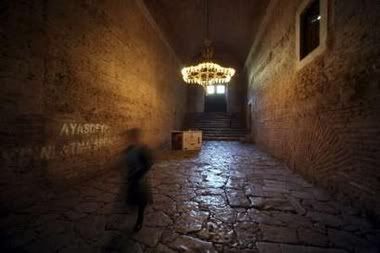
A visitor walks through an alley at the sixth century Byzantinian monument of St Sophia in the old city of Istanbul November 16, 2006. The place was once a church in the Byzantinian era that turned into a mosque during the Ottoman empire and now is now a museum. REUTERS/Fatih Saribas (TURKEY)

The enigmatic Spengler of Asia Times Online revisits the novel Snow by Orhan Pamuk. The title of Spengler's essay is 'The fallen bridge over the Bosporus' and it is an apt one. He writes:

Not since Boris Pasternak refused the Nobel Prize for literature in 1958 has a Nobel laureate regarded the award with such mixed feelings as Turkish novelist Orhan Pamuk. He set out to be a political dilettante, as befits a postmodern European novelist, and to his profound consternation has had to become a man of principle. That in no way diminishes the poignancy of Pamuk's position, but it makes him more interesting than the average martyr, in a postmodern sort of way.
[...]

During a June 2004 visit to Turkey, US President George W Bush offered:

The Turkish writer Orhan Pamuk has said that the finest view of Istanbul is not from the shores of Europe, or from the shores of Asia, but from a bridge that unites them, and lets you see both. His work has been a bridge between cultures, and so is the Republic of Turkey. The people of this land understand, as that great writer has observed, that "what is important is not [a] clash of parties, civilizations, cultures, East and West". What is important, he says, is to realize "that other people in other continents and civilizations" are "exactly like you".

The bridge has fallen, leaving Pamuk gasping for breath on the Western shore. Turkey's Western loyalties were founded upon a secular nationalism that sought to bury Islam under modernizing reforms. Pamuk's theme in Snow is the horrible emptiness of secular Turkey, with its poverty, inertia, bureaucratic sclerosis and official brutality. Thoroughly secular in upbringing and outlook, Pamuk nonetheless evinces profound sympathy for the Islamic loyalties of the Turkish poor, as well as the terrible attraction that political Islam holds for Turkey's disappointed elite.


From where will the light come?

Friday, November 17, 2006

A link

I don't read Andrew Sullivan. I don't like to take this blog too much into the realm of 'secular politics'. However, this interview is interesting and I thought I'd post it. A commenter at titusonenine linked to an interview of Andrew Sullivan by Hugh Hewitt the radio show host and blogger. It's interesting.

Spin your headline

The Age: Vatican softens line on married priests

THE Catholic Church may be preparing to readmit priests who left to marry — as long as they are now celibate.

A Vatican meeting chaired by Pope Benedict on Thursday discussed readmitting priests and issued a more neutral statement than many expected, while upholding celibacy.

Calgary Sun/AP: Vatican sticks with celibacy stance

VATICAN CITY -- The Vatican yesterday reaffirmed the value of celibacy for priests after a summit led by Pope Benedict that was spurred by a married African archbishop who has been excommunicated from the Roman Catholic Church.

The three-hour meeting's conclusions "were not a change in how the present rules (on celibacy) are applied," Rev. Federico Lombardi, a Vatican spokesman, said by telephone.

The actual communique:

"In the Apostolic Palace this morning, November 16, the Holy Father presided at one of the regular meetings of the heads of dicasteries of the Roman Curia, for a moment of shared reflection.

"The participants in the meeting had at their disposal detailed information concerning requests for dispensation from the obligation of celibacy presented during recent years, and concerning the possibility of readmission to the exercise of the ministry of priests who currently meet the conditions established by the Church.

"The value of the choice of priestly celibacy in accordance with Catholic tradition was reaffirmed, and the need for solid human and Christian formation was underlined, both for seminaries and for ordained priests."

Thursday, November 16, 2006

And there you have it

From the BBC:
"The value of the choice of priestly celibacy... has been reaffirmed,"

Housekeeping

The labels/categories have been expanded and more posts have been labeled/categorized. Remember though, not all posts have been labeled, so if a complete search is needed, the search box at the top is still the best bet.

What is this about?

Interfax: Ukrainian Greek Catholics’ attempt to seize an Orthodox church in Transcarpathia

Moscow, November 16, Interfax - The Ukrainian Greek Catholics attempted to seize an Orthodox church in the village of Zarechevo, Perechin district, Transcarpathia region.

The Orthodox village inhabitants could not enter their church for two weeks because the Uniates blocked it up.

The Orthodox church in Zarechevo has always been open, even under the Soviet power. The Greek Catholic comprise 2% of the local worshippers, yet the Transcarpathia administration resolved to build a church for them at the state’s expense. The Orthodox worshippers living in the village favored the decision, the Ukrainian Orthodox Church press service told Interfax.

The Uniates declined the offer and made an attempt to seize the Orthodox church by force.

Bishop Agapit of Uzhgorod and Mukachevo arrived in Zarechevo to encourage his flock. The police managed to stop Uniates’ provocations, and the Orthodox believers could enter the church and celebrate the divine service.

In checking out the Ukrainian Greek Catholic Church's website, The Resolutions of The Patriarchal Synod of Bishops of the Ukrainian Greek Catholic Church make interesting reading.

The first resolution:

1) A sui juris Church;

2) Completely united with the successor of St. Peter- the Bishop of Rome;

3) Bearers of the Eastern Christian Byzantine tradition from the time of Volodymyr's Baptizing;

4) Taking into consideration our history, our geographic location, and our religious and ecclesiastical experience, we are called to assist in the full and mutual understanding of two Christian traditions- Byzantine and Latin.

The list of resolutions concludes with this [bolding is mine]:

These resolutions are effective as of October 14, 2006, on the Feast of theProtection of Our Most Holy Queen, the God-Bearer and Ever-Virgin Mary

+ Lubomyr

Major Archbishop of the Ukrainian Greek Catholic Church

The interdicasterial meeting

From VIS:

VATICAN CITY, NOV 16, 2006 (VIS) - As announced earlier, this morning in the Vatican, the Holy Father met with heads of dicasteries of the Roman Curia in order to examine the situation that has arisen following the disobedience of Archbishop Emmanuel Milingo. The order of the day also included an examination of requests for dispensation from the obligation of celibacy, and requests for readmission to the priestly ministry presented by married priests over the course of recent years.

Now we wait.

Wednesday, November 15, 2006

The Anglicans

I was going to wait and post on this closer to the Archbishop of Canterbury's visit to Rome, but with the recent remarks of Professor Tighe making the rounds, I think I'll take a moment to contemplate the situation.

For background, Professor Tighe left a comment to the post on the Archbishop's trip to Rome at titusonenine. In the midst of talking about the plight of the Archbishop of Canterbury's own making as far as the Church of England's support of women's ordination and actively gay clergy, Tighe noted the following (bolding is mine):

However, one would really like to be privy to their conversations, especially as I have heard that a proposal is due to land on the pope’s desk on November 16, a proposal that has something to do with facilitating the entry into the Catholic Church of disgruntled Catholic-minded Anglicans. I know nothing of the details, but I would guess that it might involve some sort of expansion and “globalization” of the present “Pastoral Provision” set up some 20+ years ago here in the USA for Episcopalians distressed over WO. My guess is that it may involve a “Personal Prelature” for these people (as for Opus Dei) or else an “Apostolic Administration” like that that was erected a couple of years ago for a whole schismatic “Tridentine Mass” group and their bishop in Brazil. (And it may be that certain ECUSA bishops received a “sneak preview” of what’s in the works on September 6th, but verbum satis sapientibus est, ans we won’t know about it till after January 31st at the earliest.)

Following up yesterday on Professor Tighe's comment was The Times' (of London) religion correspondent Ruth Gledhill at her online column. In part (be sure to read Ruth's actual post, she had all kinds of relevant links throughout her post):

The comment on Titus was posted by the well-informed US church history professor William Tighe. So it cannot be discounted. But the truth actually might be a little more complex. One possible option, for example, is that the document Tighe refers to and the [Tridentine Mass] indult are one and the same. That the indult will contain a more general permission for the Anglican Use rather than it being confined to the US. This was not adopted as the solution to the Anglican women priest's crisis in the first place because it was opposed by the late Cardinal Hume, as William Oddie reported in his book The Roman Option.

This speculation is not, according to a well-informed Anglican source, a step too far. Fr Aidan Nicholls wrote a wonderful essay on the Anglican Use recently. And Paddy Power has him as 5-1 to be the next Archbishop of Westminster. He was also the theologian offered by the Archbishop of Westminster to Forward in Faith, when they asked him for a Catholic to contribute to the discussions for their recent paper, Consecrated Women.

Kudos to Amy for pulling all this together.

So...

1. I think the major indicator in this not being likely in the near term is the fact we have not seen any kind of response from the hierarchy. On the one hand, this document could be really secret and people are being discreet in their comments. However, as we've seen from the French response to the alleged motu proprio on the Mass of Pius V, the hierarchy isn't afraid of publicly making its thoughts (both for and against) known.

2. Benedict XVI has if nothing else proven himself to be a step-by-step kind of man. The tsunami of curial reform never materialized. In place of it, the Pope has steadily appointed people over the months. It just doesn't seem likely that any progress on an Anglican Use document would be pursued while the Tridentine Mass document is still out there. The latter could realistically take months to be processed. When Professor Tighe suggested nothing would be seen of the Anglican Use document until after January 31st of next year, I would agree with that assessment.

3. The Milingo factor. As it was mentioned at some point out there, a canonical framework for the Anglican Use as suggested by Professor Tighe would grant the ability to form seminaries for Anglican Use clergy. Let's consider a hypothetical. The Pope creates an Anglican Use prelature. Masses of Anglo-Catholics make the transition around the world. We now have the Latin Rite with its celibate clergy and the Anglican Use with its married clergy coexisting in may locales. Without trying to generalize the dynamics, it stands to reason that Benedict XVI would be considering such possibilities and any messages that might be sent while Archbishop Milingo's actions remain in recent memory.

Finally,
4. The time factor. It's November 15th. Ash Wednesday falls on February 21st, 2007. That is just over three months away. Assuming that Benedict follows the precedent he set this year during Lent, it's quite possible we'll see another consistory in early to mid-March. I would suggest that unless things breaks sooner rather than later, a lot of what everyone is waiting for could be held in limbo until March at the earliest.

Nothing to fear

AKI: TURKEY: POPE HAS NOTHING TO FEAR DURING VISIT, SAYS TOP ISLAMIC OFFICIAL
Bolding in red is mine.

Turin, 15 Nov. (AKI) - Turkey's top Muslim official who recently demanded an apology from Pope Benedict XVI for remarks the head of the Catholic Church made on Islam, believes the pontiff's safety won't be at risk during the papal visit to Turkey which begins on 28 November. "We are a democratic state and there's freedom: that's why some people don't approve of this visit and they say so. But this won't detract from our traditional hospitality," said Ali Bardakoglu head of the state department for religious affairs, the Diyanet (Mercy).

"This trip [the pope's to Turkey] won't resolve all the problems but it is a good step on the path to dialogue. Peace can be destroyed in an istant [sic] but it takes a long process to rebuild it," Bardakoglu was quoted as saying in an interview published Wednesday in the Turin-based daily La Stampa.

The Turkish cleric was among Benedict's most vocal critics after the pope on 12 September in a speech at a university in Regensburg, Germany appeared to suggest that the Islamic belief in jihad or holy war ran against the will of God and that Islam is at odds with the concept of rationality.
[...]

Asked if he would again ask for Benedict's apology [since B16 never gave one], Bardakoglu replied: "I don't waste time speaking about the past. It's not important whether the person who says something unacceptable on Islam is a layman, a religious figure or an important person - it is one's duty to correct him."

In the interview, Bardakoglu - who will be meeting Benedict XVI in Ankara - denied that Islam is irrational and described the meaning of jihad as "mainly an individual internal struggle agains the evil tendencies of human nature."

On Tuesday the Vatican's ambassador to Turkey, Apostolic Nuncio, Antonio Lucibello, said "we trust the sincerity of Turkish authorities," after meeting Istanbul Mayor Kadir Topbas.
[...]

On 2 November, a Turkish man fired a gun against the Italian consulate in Istanbul chanting slogans against Benedict and threatening to shoot him during the papal visit to Turkey. Police said they believed the 26-year-old man who was later arrested acted alone.
[...]

It's just this kind of thing that leaves me leery. I don't really expect anything to happen to Benedict while he's in Turkey. There will be too much security for that and the government would never allow an assassination to jeopardize its status with the EU. But it's just this kind of language that I've pointed out that illustrates why Turkey shouldn't be included. Michael Crichton wrote of the Japanese that their thinking was 'fundamentally different'. And note, he was writing of a society that is thoroughly modern and thoroughly Westernized. While proclaiming its secularity and Westernism, Turkey is busy preventing the Orthodox from training priests, suppressing any mention of the Armenian genocide and forcibly dealing with Kurdish autonomy aspirations. The Turks are going to eventually suffer the consequences and realize that they can't keep one foot in Asia and the other in Europe and play both sides without losing.

Tuesday, November 14, 2006

News round-up

BBC: Vatican enters Muslim veils debate

Cardinal Renato Martino said immigrants must respect the traditions, culture and religion of the nations they go to.

They ought to abide by local laws banning the wearing of certain types of Muslim veils, he added.

"It seems elementary to me and it is quite right that the authorities demand it," said Cardinal Martino, who heads the Vatican department dealing with migration issues.

I agree wholeheartedly with His Eminence's words. It just struck me though. What if he were talking about for instance Mexican immigrants in the US and the Church's efforts to provide them with Spanish language services at the expense of English and assimilation? What would the response to be that? I'll leave you all to guess.

CNS: Pope calls Curia to discuss married priests, Archbishop Milingo
I really hope that there isn't any kind of a relaxation on this. It's a feel-good bandaid to the general lack of discipline in leading Christian lives. Not enough priests? Gee, I wonder why? Maybe because they don't get to have wives? Hey, one answer is as good as another!

Interfax: Alexy II is prepared for personal meeting with the Pope of Rome only after the differences between the two Churches are resolved

‘A possibility of personal meeting with the Pope has never been eliminated. We have always insisted that such a meeting should open a new page in our relations and not be just a protocol meeting before TV cameras to show that we have no problems, while in fact we have them,’ the Patriarch said in his interview to Paris Match published Thursday.

He noted that the Primate of the Russian Orthodox Church had never met with the head of the Roman Catholic Church. If this meeting takes place, ‘probably in a third country, - it would have become an exclusive historic event.’

‘Therefore, this meeting should be thoroughly prepared with the betterment of relations between our Churches as its primary object,’ Alexy II underscored.

Does anyone ever get the feeling that the Russian Patriarch has... pretensions? Maybe it's just the translation and all that, but Alexy and his subordinates always ocme off as rather imperious in tone. 'We aren't going to meet with you until you see things our way...' 'Play the game the way we want or we'll take our ball home.'

AKI: VATICAN: TOP CLERIC SLAMS SATIRE OF POPE

Rome, 14 Nov. (AKI) - Pope Benedict XVI's personal secretary Georg Gaenswein on Tuesday slammed a TV and radio satire of the pontiff and himself. "I hope it stops right away," Gaenswein told Adnkronos. "I hope these programmes will end immediately: satire is fine but these things have no intellectual level and offend men of the Church. They are not acceptable."

Gaenswein's comments follow an article in Avvenire - the newspaper of the Italian Bishops' Conference - which slammed a satire of the pope by comedian Maurizio Crozza on private television channel La7 and the imitation, by another popular Italian showman, Fiorello, of the pontiff's secretary in a radio programme on state broadcaster RAI Viva Radio 2.

Avvenire lashed out at the programmes saying they were trying to "ridicule Catholic figures."

Gaenswein stressed that he would never watch nor listen to these programmes and noted he wanted "to forget" the entire episode.

He also stressed the pontiff had never commented on the programmes: "A comment of the pope would really honour too much these people."

I wish I had a secretary... :)

Briefly...

This morning I have to get out to the local vocational rehabilitation office to participate in a weekly job search/job counseling activity. I will post again in the afternoon.

If those of you out there who read this blog on a regular basis have any job openings that you think I might be qualified for based on what you've read here, please leave a comment or email me.

Monday, November 13, 2006

Surprise, surprise!

Let me just voice my disappointment at the lack of closed captioning for the live USCCB events being televised this week. My disappointment is made somewhat less by Amy's excellent summary, but still...

French opposition

Magister has a nice summary of events surrounding the motu proprio for the liberalization of the Mass of Pius V. He ends with the following [the link is my own]:

It is thus foreseeable that Benedict XVI will take a little more time, will listen to the objections from some bishops and cardinals, but in the end – probably by winter – will issue the Motu Proprio that will facilitate the use of the Tridentine rite.

He’s sure that this will do nothing but add to the plurality of rites that have always made the Church multifaceted.

The Council of Trent itself was careful not to unify the rites by force. Next to the “Roman” rite, Pius V confirmed the legitimacy of all the other rites in the Church that had been in existence for at least two centuries. And there were quite a few of these rites at the time. The predominance of the Roman rite asserted itself gradually over the following centuries, but it was never complete. Still today, there are marked differences between the Mass in the Roman rite and the “Ambrosian” rite celebrated in the archdiocese of Milan. To this must be added the great variety of the rites of the Eastern Churches united with Rome.

This is without mentioning the incredible – and often unapproved – variety in styles of celebration that was unleashed by the liturgical reform inaugurated by Vatican Council II and by its new missal, enacted in 1970.

Father Z has more on Magister's article.

While there are many out there who are eagerly awaiting a motu proprio, I am not terribly bothered by the delays. Mass these days is an almost-silent reading experience and the wonders of the Mass of Pius V will be found for me in the beauty of my missal and any outward movements of the priest up front rather than singing, chanting and the like. I was talking to a friend last night about the efficaciousness of going it alone through the missal while everyone else around me was busy singing, responding, etc. in the Novus Ordo. He said it was indeed efficacious and made the astute comment that I was merely doing what the laity had been doing for centuries before recent reforms.

That cheered me considerably.

Sunday, November 12, 2006

Places to go, people to see in Turkey

From Zenit:

Tuesday, November 28th
The Pope will leave from Rome's Fiumicino airport at 9 a.m. on Tuesday, Nov. 28. He will arrive at the Esenboga airport at Ankara, the Turkish capital, at 1 p.m., local time.

The Holy Father will first visit the Mausoleum of Ataturk, "Father of the Turks," who proclaimed the Turkish republic in 1923.

Subsequently, the welcome ceremony will take place as well as a courtesy visit to Turkish President Ahmet Necdet Sezer.

The Pontiff will then meet with the deputy prime minister before meeting with the president of religious affairs, Ali Bardokoglu, Grand Mufti and highest Muslim authority, at his headquarters, and with the diplomatic corps in the Apostolic Nunciature. The Holy Father will deliver addresses to each.

Wednesday, November 29th
The following day, Benedict XVI will travel to Smyrna, the country's third-largest city, known as "The Pearl of the Aegean," from where he will go to Ephesus, the city where the Apostle Paul lived and was captive, and where, according to tradition, the Blessed Virgin Mary and John the Evangelist also lived.

In Ephesus, Benedict XVI will celebrate Mass at the Meryem Ana Evi (House of Mary) Shrine and deliver a homily. It was in this city that a Council in the year 431 proclaimed the Virgin Mary "Theotokos," of Mother of God.

On that Wednesday afternoon, the Holy Father will fly from Smyrna to Istanbul -- formerly Constantinople -- where he will visit and pray at the Patriarchal Church of St. George and have a private meeting with Orthodox Ecumenical Patriarch Bartholomew I of Constantinople. The Pope will greet him at the patriarchate's headquarters.

Thursday, November 30th
On Thursday morning, Nov. 30, Benedict XVI will take part in the Divine Liturgy in the Patriarchal Church of St. George in Istanbul. He will deliver an address and sign a joint declaration.

The Pontiff will thus fulfill the original objective of his trip: to respond to the invitation of Patriarch Bartholomew I to take part on the feast of St. Andrew, patron of the patriarchate, observed on Nov. 30.

After the ceremony, the Holy Father will lunch with Bartholomew I in the patriarchate. In the afternoon, he will visit the St. Sophia Museum.

Then Benedict XVI will go to the Armenian Apostolic cathedral, where he will pray and meet and greet Patriarch Mesrob I.

That same afternoon, the Pope will meet with the Syro-Orthodox metropolitan and the chief rabbi of Turkey.

Finally the Holy Father will meet and dine with the members of the country's Catholic bishops' conference.

Friday, December 1st
On Friday, Dec. 1, Benedict XVI will preside over the celebration of Mass in Istanbul's Cathedral of the Holy Ghost and deliver a homily.

It will be his last appointment, as he will then go to the city's airport and, after the farewell ceremony, depart at 1:15 p.m. for Rome's Ciampino airport.

Recently in the PRC

Zenit has a nice summary of recent events in the People's Republic of China pertaining to religious affairs.

One item of interest:

HONG KONG, NOV. 12, 2006 (Zenit.org).- As speculation continues over the future of relations between the Vatican and China, Cardinal Joseph Zen Ze-kiun recently offered to step up his activity in this area. In January the archbishop of Hong Kong reaches 75 years of age, when he must offer his resignation to the Pope. If this is accepted, then he would like to dedicate more time to the Church in mainland China, he told the South China Morning Post on Sept. 22.

Cardinal Zen said that he had spoken of this desire with Benedict XVI. According to a Sept. 28 report in the Morning Post, the Pope promised to consider the matter.