Tuesday, November 28, 2006

Shuttle diplomacy was so last pontificate

I haven't seen anyone mention this article from National Catholic Register: Kissinger to Serve As Papal Advisor?

According to the Italian newspaper La Stampa, Pope Benedict XVI has invited the 83-year-old former adviser to Richard Nixon to be a political consultant, and Kissinger has accepted.

Quoting an “authoritative” diplomatic source at the Holy See, the paper reported Nov. 4 that the Nobel laureate was asked at a recent private audience with the Holy Father to form part of a papal “advisory board” on foreign and political affairs.
[...]

If true, there is speculation on which issues Kissinger would advise the Holy Father. Relations with Islam, Palestine and Israel, and Iraq — Kissinger has been critical of the conduct of the war but opposes a quick withdrawal — are likely to be high up on the agenda.

It has also been speculated that, in view of the Muslim hostility to Benedict’s recent Regensburg speech, Kissinger might provide advice on dealing with an increasingly fractious Islamic world.

Furthermore, like the Pope, Kissinger has analyzed the challenges of globalization and might provide advice in this area as well.

“The idea [of his appointment] sounds like a good one,” said veteran Vatican journalist Sandro Magister. “But so would it also be to consult other experts on geopolitics with different orientations.”

Aside from the fact that the Pope has in the past and will continue to call in outside experts for their opinions (or their witty repartee over dinner), this mention of a papal advisory board perhaps says something as well about how Benedict XVI feels about the experts of the Secretariat of State.

This morning

I got up too late to see anything live as far as the arrival. Other stuff going on this morning will take place while I am out at my regular morning activity. :(

As it's been widely reported, the Prime Minister of Turkey found time in his busy schedule to welcome the Pope. According to the BBC, they met for about 20 minutes.

Monday, November 27, 2006

On to Constantinople

I once read that in Greece, road signs leading to Turkey name the city Constantinople 500 years after its fall to the Turks.

I was going to come up with a huge summary post, but all the material out there floating around was rather daunting. Various other sites out there have done a great job. Down the left under the 'Daily Readings' heading are blogs that have and will have lots of info. Amy's post is invaluable for details on what the Pope will be doing in Turkey over the next few days.

So yeah, note to self: don't take the week off right before the Pope takes off to Turkey. :)

Random thoughts
It's a certainty the mainstream media will be fixated on the Christian/Muslim aspect of the trip. CNN and Anderson Cooper have already aired a 'When Cultures Collide' thing that I didn't bother watching.

Despite the statement from the other day from the Vatican regarding Turkey's membership in the EU, the way I read it, there is plenty of wiggle room there as far as what the intent was. 'We hope you do everything you need to to get in'... Like accept religious freedom for Christians, etc. etc. 'But if you don't'...

Back to the real reason for the trip, the visit from the Pope can only strengthen the Patriarch. It's funny though. Back 150 years go, Europe went to war in the Crimea over the Holy Land with the Ottoman Empire as the fulcrum. Here we are a century and a half later with Turkey pursuing admission into the EU. The Orthodox of that country continue to be squeezed while Russia looks elsewhere. It is the Church of Rome that's stepping up in fraternal friendship with its brother Church.

Home again

I am home again. But I'll save any posting for either tonight or tomorrow as I sort through everything that I just glanced at these last few days.

Wednesday, November 22, 2006

The rest of this week

I have a doctor's appointment here in a while and then I am travelling for Thanksgiving. Posting will be light, though I'll keep up on any official pronouncements from the visit.

Tuesday, November 21, 2006


Catholics welcome Bishop Amos to Iowa (QCTimes.com)

Bishop Martin Amos knocked on the doors of a Quad-City church, and the people of the Catholic Diocese of Davenport stood to welcome him into their arms during his formal installation ceremony Monday.

Archbishop Jerome Hanus of the Archdiocese of Dubuque officially welcomed Amos through the open doors of St. John Vianney Church, Bettendorf, and bade him be a “loving father, gentle shepherd and wise teacher” to the faithful of the diocese that stretches over 22 counties in southeastern Iowa.

Later, during his homily, the new bishop discussed life’s journey. He spoke of an experience when he became lost during a walk and finally, after some difficulty, found his way back to a monastery.

“Life is like this,” he said, noting that the journey is not made alone but in concert with others and with Christ.

Amos said he will reach out to those who were sexually abused by priests and try to promote healing. He also will work to restore financial health to the diocese, which last month became the fourth one in America to declare bankruptcy.

“I will continue the journey and listen to God’s word on the gentle breeze, move with Jesus and trust the shepherd,” he said.

Amos, who becomes the eighth bishop to be installed in the 125-year history of the Diocese of Davenport, will begin his new job by doing a lot of listening, he said, repeating his intentions to go out and meet the people of the 84-parish diocese.
[...]

In his homily, Amos talked about the call he received to move to the Davenport Diocese.

“The nuncio told me what the pope wanted to do to me,” he said, adding that Bishop Franklin assured him he would find that many good people live in this area of the country.

“I was then calm, but that didn’t last,” he said with a laugh.

Image: Kevin E. Schmidt/QUAD-CITY TIMES

Monday, November 20, 2006

Magister has something on the remarks of the Holy Father to the Irish bishops and the growing efforts of the Holy See in cracking down on priest who abused minors.

Ratzinger as well, when he was prefect of the congregation for the doctrine of the faith, was less insistent than he is today. Offenses against the sixth commandment were the exclusive domain of his congregation, but in a number of cases, even very circumstantiated denunciations were never pursued. Still in November of 2002, when the scandal in the United States was at its acme, Ratzinger minimized the number of guilty priests: “less than 1 percent,” and he attributed the explosion of the scandal above all to “the desire to discredit the Church.”

But then he changed course. It was the autumn of 2004, and Ratzinger ordered the promoter of justice at the congregation for the doctrine of the faith, Charles J. Scicluna of Malta, to retrieve from the files all the cases concerning the sixth commandment.

The order was: “Every case must take its normal course.” In other words: no one could be held as untouchable anymore, not even those protected by the then extremely powerful cardinal Sodano, and not even the favorites of the reigning pope, John Paul II.

Rowan Cantaur meets Benedict PP. XVI

David Virtue wrote last year about the first meeting between the two men after the inauguration:

At Benedict XVI's inaugural mass Dr. Rowan Williams was invited but Frank Griswold was not. Archbishop Drexel Gomez (West Indies) was invited, but the Canadian archbishop was not. The US church was represented by Bishop Pierre Whalon of Europe, and Bishop Christopher Epting, the Griswold's deputy for Ecumenical and Interfaith Relations.

Symbolism is everything. When the new pope met with the patriarchs from the Orthodox churches there were public embraces and kisses, but when Benedict XVI met Williams there was only a handshake. Dr. Williams edged forward perhaps hoping for a papal embrace but it was not forthcoming.

By the way, read through all of David's letter. It is a well-written personal encounter with the Southeast Asian Anglican community that illustrates 'orthodox' Christianity growing by leaps and bounds within the communion while ignoring the northern craziness.

The Independent has a profile of Dr. Williams:

Instead, [the Anglican Communion] needs at its head someone who will take a clear line over divisive issues such as the ordination of women and gay priests, so that the whole communion doesn't just tear itself apart. Yet the confused signals that Dr Williams repeatedly sends out on these and other subjects have caused a dramatic reversal of fortunes for the 56-year-old, Welsh-born archbishop.
[...]

Expectations were high. But some of Dr Williams's friends believe he was always too clever for the job. It is better suited to a dully plodder, like the previous incumbent, George Carey, or a high-profile man of certainties, like the cleric hotly tipped to be the next, Archbishop John Sentamu of York. Dr Sentamu's interventions on Islam and secularism have been in marked contrast to Dr Williams's invisibility on such subjects, though you could argue that it is easier to take risks in speaking out when you're second-in-line rather than the primate.

That could very well be true about Sr. Sentamu. Of course, if Dr. Williams didn't think he was up to the task of dealing with everything wrong with the Anglican Communion, he could have declined. After all, he was chosen through a political process (is there any Anglican theology out there declaring the Prime Minister and the Queen as acting as divine instruments?).

At her blog this Thursday last, Ruth Gledhill linked to an interview of the archbishop in which he declared, "And the thing that always held me back from becoming a Roman Catholic at the points when I thought about it is that I can’t quite swallow papal infallibility. I have visions of saying to Pope Benedict: “I don’t believe you’re infallible” — I hope it doesn’t come to that. [Laughs]" Perhaps he ought to ask for some helpful hints on how to be a leader since he'll be meeting with someone who in the last year and a half has proven himself to be quite able.

Times (of London) Online has a story about the Pope's recruitment efforts:

Pope Benedict XVI is keen to reach out to conservative Anglicans who have been antagonised by their church’s stance on women priests and homosexuality. Senior Vatican figures are understood to have drawn up a dossier on the most effective means of attracting disenchanted Anglicans.

The recruitment drive is a potential embarrassment for Rowan Williams, the Archbishop of Canterbury, who is travelling to Italy for his meeting with the Pope.

It is understood that Fr Joseph Augustine di Noia, undersecretary of the Congregation of the Doctrine of the Faith, the most powerful of the Vatican’s departments, has led a team analysing the current schism in the Anglican world.

John Myers, the Archbishop of Newark, New Jersey, who has been involved in supporting former Anglicans who have converted to Catholicism, has been helping di Noia with his recruitment dossier. He travelled to Rome last month to suggest ways of appealing to Anglicans.

The Pope’s enthusiasm for bringing traditional Anglicans into the fold was expressed powerfully three years ago when as Cardinal Ratzinger he sent greetings to a group of conservative churchmen meeting in Texas [and bypassing the national church] in protest at the election of Robinson.
[...]

While the Pope is keen to welcome any conservative Anglicans, he is also keen to forge good relations with Williams. “The Vatican will do nothing to undermine Williams at such a precarious moment in Anglican history,” one source said.

Despite the friendly overtures, the Pope believes the Anglican Church faces a difficult future. Graham Leonard, the former Bishop of London and now a Roman Catholic monsignor, said: “The Pope’s view is that theologically Anglicanism has no guts in it.”

The Times story makes no specific mention of the pastoral provision in the United States, the ongoing efforts to broaden it or the talks between the Traditional Anglican Communion and the Catholic Church. I discussed the rumors regarding a proposal to facilitate the entry of Anglicans a few days ago.

Catholic News Service and The Tablet both have stories suggesting that the rifts in the Anglican Communion will be the primary points of discussion rather than the issues that separate the Catholic Church and the communion. In its story, The Tablet calls for a 'wait and see' approach on the part of the Holy See to see into what the communion evolves.

The question I have for the writers at The Tablet is for what are we waiting? It's been posited at different places at different times that whatever the Anglican Communion ends up as, the Anglo-Catholic faction will be a dead letter. There will be those who are pro-sexual liberation and there will be the evangelicals dominated by the Global South and the Anglo-Catholics will be gone to Rome.

Complete credit goes to titusonenine for pulling together these stories. That will be the blog to check out for all things Anglican this coming week.

My assessment (what you've all been waiting for)
One thing the Russian Patriarch can be admired for is the fact that he is serious when it comes to meeting the Pope. He isn't going to meet with Benedict XVI until real progress is made and the meeting can be more than just a photo op. The Archbishop of Canterbury will go to Rome. Gifts will be exchanged. He and the Holy Father will meet for one of Benedict's usual 25-30 minute private audiences (probably longer though). Then he'll make the rounds to the various dicasteries that concern him. All the while, the basic message will be, "It's great having you here. We're sorry about your troubles at home. We'll talk again soon. Good luck and ciao."

In the spirit of all these documents I've been reading, I'll sign off this this...

Given in IC on the 33rd Sunday in Ordinary Time of the year 2006, the second of our blogificate.

Documents

Sunday, November 19, 2006

An account

[Unedited except for some line breaks. Veracity is unknown.]

The Revd Thomas Mozely, the Times Special Correspondent in Rome in 1870 records the Definition of the Dogma of Papal Infallability took place during a violent thunderstorm. One hesitates to predict the weather for the forthcoming visit of the Archbishop but if he denies Papal infallibility to the Pope’s face, I forecast a chill wind.

Here is his account.
The reading of the Dogma was followed by the roll-call of the Fathers, and Placet after Placet (vote of agreement) followed, though not in very quick succession. (in fact, 533 votes for, two against, one of the two going to the throne immediately afterwards with the words, "Modo Credo, sancta Pater – now I believe Holy Father." Many French bishops had already left - my added comment). They were uttered in louder and bolder tones than on former occasions, either that the echo was greater from the comparative emptiness of the church or that the Fathers were pleased at being shorn, and amid their utterances there was a loud peal of thunder.

The storm, which had been threatening all the morning, burst now with the utmost violence, and to many a superstitious mind might have conveyed the idea that it was the expression of Divine wrath, as ' no doubt it will be interpreted by numbers,' said one officer of the Palatine Guard. And so the Placets of the Fathers struggled through the storm, while the thunder pealed above and the lightning flashed in at every window and down through the dome and every smaller cupola, dividing if not absorbing the attention of the crowd. Placet, shouted his Eminence or his Grace, and a loud clap of thunder followed in response, and then the lightning darted about the baldacchino and every part of the church and Conciliar Hall, as if announcing the response. So it continued for nearly one hour and a half, during which time the roll was being called, and a more effective scene I never witnessed. Had all the decorators and all the getters-up of ceremonies in Rome been employed, nothing approaching to the solemn splendour of that storm could have been prepared, and never will those who saw it and felt it forget the promulgation of the first Dogma of the Church.

The facade of the Hall had not been removed as on former occasions, only the great door was opened, so that it could be scarcely called an open Session, and people could get a glimpse of what was going on only by struggling fiercely and peering over one another's shoulders, or by standing at a distance and looking through a glass. I chose this last and better part. The .storm was at its height when the result of the voting was taken up to the Pope, and the darkness was so thick that a huge taper was necessarily brought and placed by his side as he read the words which invested him with Divine powers, ' Nosque, sacro approbante Concilio, ilia ita decernimus, statuimus atque sancimus ut lecta sunt, definimus et apostolica auctoritate confirmamus' And again the lightning flickered around the Hall, and the thunder pealed.

I was standing at this moment in the south transept trying to penetrate the darkness which surrounded the Pope, when the sound as of a mighty rushing something, I could not tell what, caused me to start violently, and look about me and above me. It might be a storm of hail. Such for an instant was my impression ; and it grew and swelled, and then the whole mystery was revealed by a cloud of white handkerchiefs waving before me. The signal had been given by the Fathers themselves with clapping of hands. This was my imaginary hailstorm ; and it was taken up by the crowd outside the Hall and so the storm grew in violence until at length it came to where I stood. Viva il Papa Infallibile! Viva il trionfo dei Cattolici!

Saturday, November 18, 2006

For all

CWN: Pro multis means "for many," Vatican rules [updated] --Subscription required for full text.

Vatican, Nov. 18 (CWNews.com) - The Vatican has ruled that the phrase pro multis should be rendered as "for many" in all new translations of the Eucharistic Prayer, CWN has learned.

Although "for many" is the literal translation of the Latin phrase, the translations currently in use render the phrase as "for all." [...]

Here we have the Roman Canon with the Latin and the English side by side [at the link; here it is one over the other]:

Accipite et bibite ex eo omnes:
--Take this all of you and drink from it:

hic est enim calix Sanguinis mei novi et aeterni testamenti, qui pro vobis et pro multis effundetur in remissionem peccatorum.
--this is the cup of my blood, the blood of the new and everlasting covenant. It will be shed for you and for all and for many so that sins may be forgiven.

The emptiness


The dark alley of the Turkish Soul

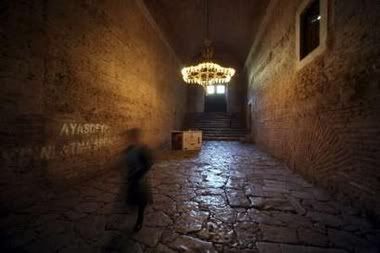
A visitor walks through an alley at the sixth century Byzantinian monument of St Sophia in the old city of Istanbul November 16, 2006. The place was once a church in the Byzantinian era that turned into a mosque during the Ottoman empire and now is now a museum. REUTERS/Fatih Saribas (TURKEY)

The enigmatic Spengler of Asia Times Online revisits the novel Snow by Orhan Pamuk. The title of Spengler's essay is 'The fallen bridge over the Bosporus' and it is an apt one. He writes:

Not since Boris Pasternak refused the Nobel Prize for literature in 1958 has a Nobel laureate regarded the award with such mixed feelings as Turkish novelist Orhan Pamuk. He set out to be a political dilettante, as befits a postmodern European novelist, and to his profound consternation has had to become a man of principle. That in no way diminishes the poignancy of Pamuk's position, but it makes him more interesting than the average martyr, in a postmodern sort of way.
[...]

During a June 2004 visit to Turkey, US President George W Bush offered:

The Turkish writer Orhan Pamuk has said that the finest view of Istanbul is not from the shores of Europe, or from the shores of Asia, but from a bridge that unites them, and lets you see both. His work has been a bridge between cultures, and so is the Republic of Turkey. The people of this land understand, as that great writer has observed, that "what is important is not [a] clash of parties, civilizations, cultures, East and West". What is important, he says, is to realize "that other people in other continents and civilizations" are "exactly like you".

The bridge has fallen, leaving Pamuk gasping for breath on the Western shore. Turkey's Western loyalties were founded upon a secular nationalism that sought to bury Islam under modernizing reforms. Pamuk's theme in Snow is the horrible emptiness of secular Turkey, with its poverty, inertia, bureaucratic sclerosis and official brutality. Thoroughly secular in upbringing and outlook, Pamuk nonetheless evinces profound sympathy for the Islamic loyalties of the Turkish poor, as well as the terrible attraction that political Islam holds for Turkey's disappointed elite.


From where will the light come?

Friday, November 17, 2006

A link

I don't read Andrew Sullivan. I don't like to take this blog too much into the realm of 'secular politics'. However, this interview is interesting and I thought I'd post it. A commenter at titusonenine linked to an interview of Andrew Sullivan by Hugh Hewitt the radio show host and blogger. It's interesting.

Spin your headline

The Age: Vatican softens line on married priests

THE Catholic Church may be preparing to readmit priests who left to marry — as long as they are now celibate.

A Vatican meeting chaired by Pope Benedict on Thursday discussed readmitting priests and issued a more neutral statement than many expected, while upholding celibacy.

Calgary Sun/AP: Vatican sticks with celibacy stance

VATICAN CITY -- The Vatican yesterday reaffirmed the value of celibacy for priests after a summit led by Pope Benedict that was spurred by a married African archbishop who has been excommunicated from the Roman Catholic Church.

The three-hour meeting's conclusions "were not a change in how the present rules (on celibacy) are applied," Rev. Federico Lombardi, a Vatican spokesman, said by telephone.

The actual communique:

"In the Apostolic Palace this morning, November 16, the Holy Father presided at one of the regular meetings of the heads of dicasteries of the Roman Curia, for a moment of shared reflection.

"The participants in the meeting had at their disposal detailed information concerning requests for dispensation from the obligation of celibacy presented during recent years, and concerning the possibility of readmission to the exercise of the ministry of priests who currently meet the conditions established by the Church.

"The value of the choice of priestly celibacy in accordance with Catholic tradition was reaffirmed, and the need for solid human and Christian formation was underlined, both for seminaries and for ordained priests."

Thursday, November 16, 2006

And there you have it

From the BBC:
"The value of the choice of priestly celibacy... has been reaffirmed,"

Housekeeping

The labels/categories have been expanded and more posts have been labeled/categorized. Remember though, not all posts have been labeled, so if a complete search is needed, the search box at the top is still the best bet.

What is this about?

Interfax: Ukrainian Greek Catholics’ attempt to seize an Orthodox church in Transcarpathia

Moscow, November 16, Interfax - The Ukrainian Greek Catholics attempted to seize an Orthodox church in the village of Zarechevo, Perechin district, Transcarpathia region.

The Orthodox village inhabitants could not enter their church for two weeks because the Uniates blocked it up.

The Orthodox church in Zarechevo has always been open, even under the Soviet power. The Greek Catholic comprise 2% of the local worshippers, yet the Transcarpathia administration resolved to build a church for them at the state’s expense. The Orthodox worshippers living in the village favored the decision, the Ukrainian Orthodox Church press service told Interfax.

The Uniates declined the offer and made an attempt to seize the Orthodox church by force.

Bishop Agapit of Uzhgorod and Mukachevo arrived in Zarechevo to encourage his flock. The police managed to stop Uniates’ provocations, and the Orthodox believers could enter the church and celebrate the divine service.

In checking out the Ukrainian Greek Catholic Church's website, The Resolutions of The Patriarchal Synod of Bishops of the Ukrainian Greek Catholic Church make interesting reading.

The first resolution:

1) A sui juris Church;

2) Completely united with the successor of St. Peter- the Bishop of Rome;

3) Bearers of the Eastern Christian Byzantine tradition from the time of Volodymyr's Baptizing;

4) Taking into consideration our history, our geographic location, and our religious and ecclesiastical experience, we are called to assist in the full and mutual understanding of two Christian traditions- Byzantine and Latin.

The list of resolutions concludes with this [bolding is mine]:

These resolutions are effective as of October 14, 2006, on the Feast of theProtection of Our Most Holy Queen, the God-Bearer and Ever-Virgin Mary

+ Lubomyr

Major Archbishop of the Ukrainian Greek Catholic Church

The interdicasterial meeting

From VIS:

VATICAN CITY, NOV 16, 2006 (VIS) - As announced earlier, this morning in the Vatican, the Holy Father met with heads of dicasteries of the Roman Curia in order to examine the situation that has arisen following the disobedience of Archbishop Emmanuel Milingo. The order of the day also included an examination of requests for dispensation from the obligation of celibacy, and requests for readmission to the priestly ministry presented by married priests over the course of recent years.

Now we wait.

Wednesday, November 15, 2006

The Anglicans

I was going to wait and post on this closer to the Archbishop of Canterbury's visit to Rome, but with the recent remarks of Professor Tighe making the rounds, I think I'll take a moment to contemplate the situation.

For background, Professor Tighe left a comment to the post on the Archbishop's trip to Rome at titusonenine. In the midst of talking about the plight of the Archbishop of Canterbury's own making as far as the Church of England's support of women's ordination and actively gay clergy, Tighe noted the following (bolding is mine):

However, one would really like to be privy to their conversations, especially as I have heard that a proposal is due to land on the pope’s desk on November 16, a proposal that has something to do with facilitating the entry into the Catholic Church of disgruntled Catholic-minded Anglicans. I know nothing of the details, but I would guess that it might involve some sort of expansion and “globalization” of the present “Pastoral Provision” set up some 20+ years ago here in the USA for Episcopalians distressed over WO. My guess is that it may involve a “Personal Prelature” for these people (as for Opus Dei) or else an “Apostolic Administration” like that that was erected a couple of years ago for a whole schismatic “Tridentine Mass” group and their bishop in Brazil. (And it may be that certain ECUSA bishops received a “sneak preview” of what’s in the works on September 6th, but verbum satis sapientibus est, ans we won’t know about it till after January 31st at the earliest.)

Following up yesterday on Professor Tighe's comment was The Times' (of London) religion correspondent Ruth Gledhill at her online column. In part (be sure to read Ruth's actual post, she had all kinds of relevant links throughout her post):

The comment on Titus was posted by the well-informed US church history professor William Tighe. So it cannot be discounted. But the truth actually might be a little more complex. One possible option, for example, is that the document Tighe refers to and the [Tridentine Mass] indult are one and the same. That the indult will contain a more general permission for the Anglican Use rather than it being confined to the US. This was not adopted as the solution to the Anglican women priest's crisis in the first place because it was opposed by the late Cardinal Hume, as William Oddie reported in his book The Roman Option.

This speculation is not, according to a well-informed Anglican source, a step too far. Fr Aidan Nicholls wrote a wonderful essay on the Anglican Use recently. And Paddy Power has him as 5-1 to be the next Archbishop of Westminster. He was also the theologian offered by the Archbishop of Westminster to Forward in Faith, when they asked him for a Catholic to contribute to the discussions for their recent paper, Consecrated Women.

Kudos to Amy for pulling all this together.

So...

1. I think the major indicator in this not being likely in the near term is the fact we have not seen any kind of response from the hierarchy. On the one hand, this document could be really secret and people are being discreet in their comments. However, as we've seen from the French response to the alleged motu proprio on the Mass of Pius V, the hierarchy isn't afraid of publicly making its thoughts (both for and against) known.

2. Benedict XVI has if nothing else proven himself to be a step-by-step kind of man. The tsunami of curial reform never materialized. In place of it, the Pope has steadily appointed people over the months. It just doesn't seem likely that any progress on an Anglican Use document would be pursued while the Tridentine Mass document is still out there. The latter could realistically take months to be processed. When Professor Tighe suggested nothing would be seen of the Anglican Use document until after January 31st of next year, I would agree with that assessment.

3. The Milingo factor. As it was mentioned at some point out there, a canonical framework for the Anglican Use as suggested by Professor Tighe would grant the ability to form seminaries for Anglican Use clergy. Let's consider a hypothetical. The Pope creates an Anglican Use prelature. Masses of Anglo-Catholics make the transition around the world. We now have the Latin Rite with its celibate clergy and the Anglican Use with its married clergy coexisting in may locales. Without trying to generalize the dynamics, it stands to reason that Benedict XVI would be considering such possibilities and any messages that might be sent while Archbishop Milingo's actions remain in recent memory.

Finally,
4. The time factor. It's November 15th. Ash Wednesday falls on February 21st, 2007. That is just over three months away. Assuming that Benedict follows the precedent he set this year during Lent, it's quite possible we'll see another consistory in early to mid-March. I would suggest that unless things breaks sooner rather than later, a lot of what everyone is waiting for could be held in limbo until March at the earliest.

Nothing to fear

AKI: TURKEY: POPE HAS NOTHING TO FEAR DURING VISIT, SAYS TOP ISLAMIC OFFICIAL
Bolding in red is mine.

Turin, 15 Nov. (AKI) - Turkey's top Muslim official who recently demanded an apology from Pope Benedict XVI for remarks the head of the Catholic Church made on Islam, believes the pontiff's safety won't be at risk during the papal visit to Turkey which begins on 28 November. "We are a democratic state and there's freedom: that's why some people don't approve of this visit and they say so. But this won't detract from our traditional hospitality," said Ali Bardakoglu head of the state department for religious affairs, the Diyanet (Mercy).

"This trip [the pope's to Turkey] won't resolve all the problems but it is a good step on the path to dialogue. Peace can be destroyed in an istant [sic] but it takes a long process to rebuild it," Bardakoglu was quoted as saying in an interview published Wednesday in the Turin-based daily La Stampa.

The Turkish cleric was among Benedict's most vocal critics after the pope on 12 September in a speech at a university in Regensburg, Germany appeared to suggest that the Islamic belief in jihad or holy war ran against the will of God and that Islam is at odds with the concept of rationality.
[...]

Asked if he would again ask for Benedict's apology [since B16 never gave one], Bardakoglu replied: "I don't waste time speaking about the past. It's not important whether the person who says something unacceptable on Islam is a layman, a religious figure or an important person - it is one's duty to correct him."

In the interview, Bardakoglu - who will be meeting Benedict XVI in Ankara - denied that Islam is irrational and described the meaning of jihad as "mainly an individual internal struggle agains the evil tendencies of human nature."

On Tuesday the Vatican's ambassador to Turkey, Apostolic Nuncio, Antonio Lucibello, said "we trust the sincerity of Turkish authorities," after meeting Istanbul Mayor Kadir Topbas.
[...]

On 2 November, a Turkish man fired a gun against the Italian consulate in Istanbul chanting slogans against Benedict and threatening to shoot him during the papal visit to Turkey. Police said they believed the 26-year-old man who was later arrested acted alone.
[...]

It's just this kind of thing that leaves me leery. I don't really expect anything to happen to Benedict while he's in Turkey. There will be too much security for that and the government would never allow an assassination to jeopardize its status with the EU. But it's just this kind of language that I've pointed out that illustrates why Turkey shouldn't be included. Michael Crichton wrote of the Japanese that their thinking was 'fundamentally different'. And note, he was writing of a society that is thoroughly modern and thoroughly Westernized. While proclaiming its secularity and Westernism, Turkey is busy preventing the Orthodox from training priests, suppressing any mention of the Armenian genocide and forcibly dealing with Kurdish autonomy aspirations. The Turks are going to eventually suffer the consequences and realize that they can't keep one foot in Asia and the other in Europe and play both sides without losing.

Tuesday, November 14, 2006

News round-up

BBC: Vatican enters Muslim veils debate

Cardinal Renato Martino said immigrants must respect the traditions, culture and religion of the nations they go to.

They ought to abide by local laws banning the wearing of certain types of Muslim veils, he added.

"It seems elementary to me and it is quite right that the authorities demand it," said Cardinal Martino, who heads the Vatican department dealing with migration issues.

I agree wholeheartedly with His Eminence's words. It just struck me though. What if he were talking about for instance Mexican immigrants in the US and the Church's efforts to provide them with Spanish language services at the expense of English and assimilation? What would the response to be that? I'll leave you all to guess.

CNS: Pope calls Curia to discuss married priests, Archbishop Milingo
I really hope that there isn't any kind of a relaxation on this. It's a feel-good bandaid to the general lack of discipline in leading Christian lives. Not enough priests? Gee, I wonder why? Maybe because they don't get to have wives? Hey, one answer is as good as another!

Interfax: Alexy II is prepared for personal meeting with the Pope of Rome only after the differences between the two Churches are resolved

‘A possibility of personal meeting with the Pope has never been eliminated. We have always insisted that such a meeting should open a new page in our relations and not be just a protocol meeting before TV cameras to show that we have no problems, while in fact we have them,’ the Patriarch said in his interview to Paris Match published Thursday.

He noted that the Primate of the Russian Orthodox Church had never met with the head of the Roman Catholic Church. If this meeting takes place, ‘probably in a third country, - it would have become an exclusive historic event.’

‘Therefore, this meeting should be thoroughly prepared with the betterment of relations between our Churches as its primary object,’ Alexy II underscored.

Does anyone ever get the feeling that the Russian Patriarch has... pretensions? Maybe it's just the translation and all that, but Alexy and his subordinates always ocme off as rather imperious in tone. 'We aren't going to meet with you until you see things our way...' 'Play the game the way we want or we'll take our ball home.'

AKI: VATICAN: TOP CLERIC SLAMS SATIRE OF POPE

Rome, 14 Nov. (AKI) - Pope Benedict XVI's personal secretary Georg Gaenswein on Tuesday slammed a TV and radio satire of the pontiff and himself. "I hope it stops right away," Gaenswein told Adnkronos. "I hope these programmes will end immediately: satire is fine but these things have no intellectual level and offend men of the Church. They are not acceptable."

Gaenswein's comments follow an article in Avvenire - the newspaper of the Italian Bishops' Conference - which slammed a satire of the pope by comedian Maurizio Crozza on private television channel La7 and the imitation, by another popular Italian showman, Fiorello, of the pontiff's secretary in a radio programme on state broadcaster RAI Viva Radio 2.

Avvenire lashed out at the programmes saying they were trying to "ridicule Catholic figures."

Gaenswein stressed that he would never watch nor listen to these programmes and noted he wanted "to forget" the entire episode.

He also stressed the pontiff had never commented on the programmes: "A comment of the pope would really honour too much these people."

I wish I had a secretary... :)